AI Coding Team Shared State: The Work-State Gap Better Models Expose
Better AI coding models expose the coordination layer your team never assigned: active task state, blockers, approvals, artifacts, and handoffs that survive Cursor, Claude Code, Codex, and closed sessions.
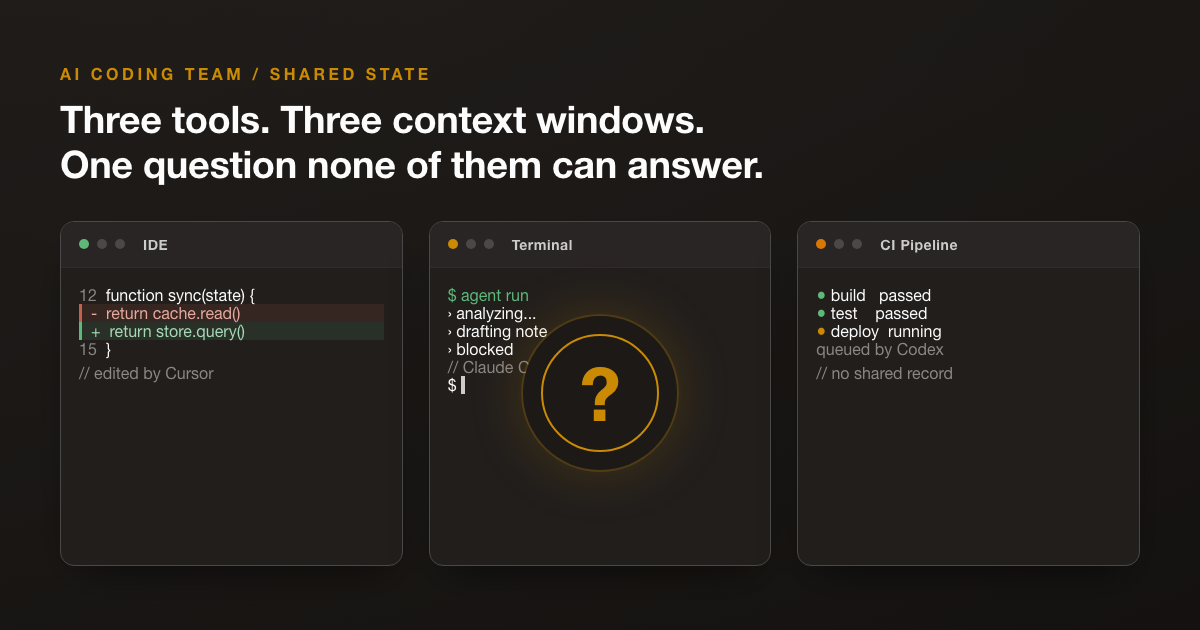
Three tools, three context windows, and one question none of them can answer alone: what is the team actually working on right now?
Short answer: AI coding team shared state is the durable record of active work: owner, status, blockers, approvals, artifacts, and handoffs. It gets worse when better models generate and change work faster than the team can track it. Files handle static rules and architecture. Live work state needs an external system of record.
Your individual developers got faster. Your delivery system did not become more stable at the same pace.
That gap is easy to misdiagnose. The visible change is model output, so teams blame model output. A better diagnosis is that the model exposed a coordination layer nobody had assigned an owner. Google Research's DORA 2025 report frames AI as an amplifier of the organization around it, based on more than 100 hours of qualitative research and nearly 5,000 survey responses [1]. If the coordination layer is clean, the model amplifies clean work. If the coordination layer is missing, the model amplifies the missing layer.
This post is about that missing layer. When a team runs Cursor, Claude Code, Codex, Copilot, and other tools side by side, it does not have one shared-state problem. It has at least three. Most teams have solved the first two. The third is where the stability went.
The Multi-Tool Setup Is Already Your Setup
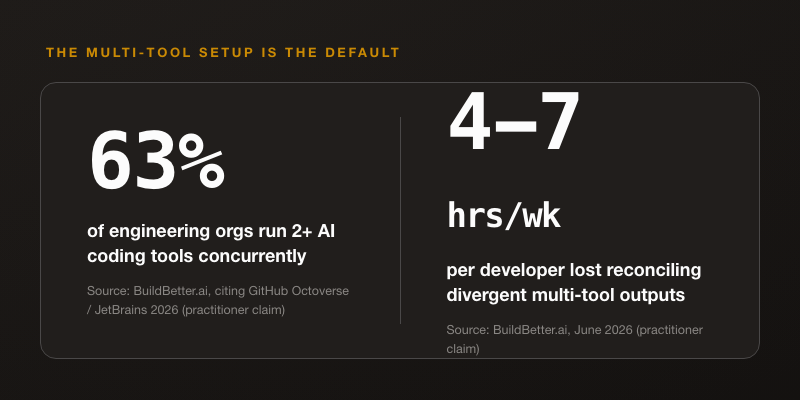
Multiple AI coding tools are no longer an edge case that only unusually experimental teams need to govern. GitLab's 2026 AI Accountability Report, based on a Harris Poll survey of 1,528 developers and technology buyers across six countries, says 91% of organizations have two or more AI coding tools in active use, and 54% have three or more [2]. Treat that as vendor-sponsored survey evidence, not neutral academic measurement. Still, it matches the shape many engineering leaders already see.
One team starts with Cursor because it lives where developers already edit code. A platform engineer adds Claude Code for longer autonomous terminal runs. A third workflow brings Codex into CI or review automation. Nobody made a shared-state decision along the way. Each tool worked well enough on its own, and the demos looked productive.
The skipped decision shows up later, usually in review. A task has a branch, a partial implementation, a generated test, a comment in Slack, a decision buried in a closed terminal session, and a teammate who is not sure whether the work is active, blocked, or waiting for approval.
If your team is still deciding which AI coding surface should own each kind of work, the control surface selection framework covers that earlier decision. This article starts one step later, after the tools are already in the building and the work record has started to split.
What Is AI Coding Team Shared State?
AI coding team shared state is the record a teammate or assistant needs to answer, "What is true about this work right now?" It is not the same as coding standards, architecture notes, or a long prompt. It is the operational state of the work.
There are three layers.
Layer 1: conventions and rules. This is where AGENTS.md, CLAUDE.md, .cursor/rules, lint commands, naming rules, and "do not touch this module without review" instructions belong. Stack Overflow argues that coding guidelines for AI agents need to be explicit, demonstrative, obvious, and version-controlled because agents do not absorb tacit codebase context the way humans do [4]. This layer is file-native.
Layer 2: durable repo knowledge. Architecture docs, ADRs, diagrams, design constraints, and local product rationale belong here. This layer changes, but not minute by minute. It is also file-native because it describes decisions that should survive across branches and releases.
Layer 3: live work state. This is the moving record: task status, current owner, blocker, approval, artifact, reviewer note, handoff summary, and workflow lock. It changes while the work is happening. It must survive a closed session, a tool switch, a time-zone handoff, and a teammate picking up the task tomorrow.
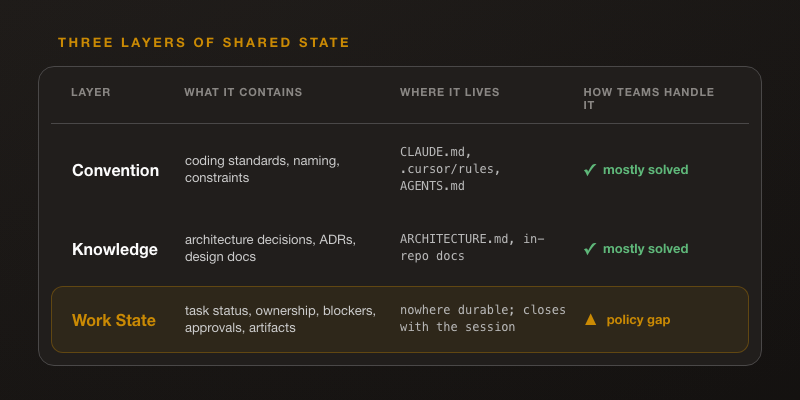
BuildBetter.ai's practitioner pattern, a canonical context directory that renders tool-specific files such as CLAUDE.md, .cursor/rules, and AGENTS.md, is useful for Layers 1 and 2 [7]. The mistake is stretching that file-sync pattern until it pretends to own Layer 3.
Layer 3 is not a better prompt. It is a state boundary.
What Belongs In AGENTS.md, Repo Docs, A Project Board, And Workflow Locks?
The fastest way to reduce confusion is to stop asking one storage shape to do every job.
| Home | Stores | Should not store |
|---|---|---|
AGENTS.md, CLAUDE.md, .cursor/rules | Repo commands, coding rules, testing expectations, tool-specific instructions | Live task status, one-off blockers, review approvals |
| Architecture docs and ADRs | Durable design decisions, system boundaries, rationale | Session handoff notes or temporary task ownership |
| Project board | Active task, owner, status, blocker, approval, artifact, handoff note | Static code style rules or long-form architecture rationale |
| Workflow locks | Exclusive work claims, approved execution scope, collision prevention | Product strategy, broad design history, or general coding guidelines |
Anthropic's context-engineering guidance is useful here because it treats context as a finite resource that must be curated, with external data, tools, MCP, message history, and memory all part of the design [3]. The prompt is not a vault. It is working memory under pressure.
For the single-session version of this problem, why AI coding agents lose context explains why long prompts drift. The team version is harsher because the state has to survive more than one context window.
Why File Sync Cannot Reach Live Work State
File sync handles stable facts. A convention file can say "run pnpm nx typecheck agiflow-app before handoff" and stay useful all week. An ADR can explain why the billing module is shaped a certain way and remain valid across many tasks.
Work state is different. It is a sequence of transitions.
At 7:14 p.m., a Claude Code session discovers that a migration is blocked on schema approval. At 7:22 p.m., it creates a partial artifact. At 7:31 p.m., a reviewer approves the API shape but asks for a test update. The next morning, another developer opens Cursor. The question is no longer "what are our coding rules?" The question is "what happened after the rules were applied?"
That answer is not in AGENTS.md. It is not in an ADR. It may be in a terminal transcript, a Slack thread, a local note, or the head of the person who ran the session. Community listening in the research found exactly that language: developers saving transcripts, re-explaining the same decisions between tools, and asking where yesterday's state lives. Treat that as qualitative signal, not survey evidence.
The underlying architecture point is stronger than the anecdotes. Anthropic recommends structured note-taking or agentic memory to persist state outside the context window for later retrieval [3]. Augment Code's operating-model guide makes the adjacent organizational claim: agentic adoption depends on workflow design, memory, governance, and decision authority, not only tool choice [8].
If a human has to carry state manually between sessions, the human is the integration layer. That works until the human is asleep, in a meeting, on another branch, or no longer sure which generated summary is the current one.
Why Better Models Shift The Bottleneck To Review And Validation
A stronger model can still make the team slower at the system level when the work-state layer is unowned.
GitLab's report gives the cleanest survey framing for the reversal. In the same Harris Poll research, 79% of respondents agreed individual developer productivity improved while overall software delivery had not accelerated at the same pace. GitLab also reported that 85% agreed the bottleneck shifted to code review and validation, and only 28% said their SDLC tools were fully integrated with shared data and workflows [2].
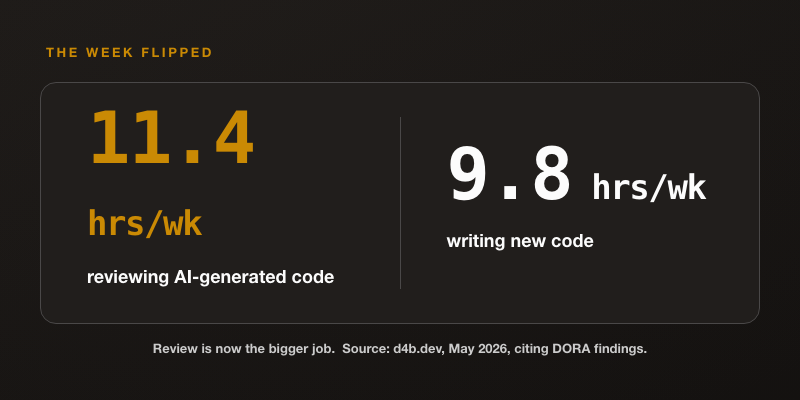
That is the work-state gap in survey form. The tools generate faster than the organization can trace, review, approve, and integrate the work record.
Stack Overflow's 2025 Developer Survey adds a second angle. It found that 84% of respondents used or planned to use AI tools in development, and 51% of professional developers used them daily. At the same time, trust and review behavior remained uneven, with more developers distrusting AI accuracy than trusting it and many avoiding AI use for committing or reviewing code [6]. Adoption is high. Review confidence is not.
That does not mean "AI code is bad." It means review has become the place where missing state gets reconstructed. The reviewer is not only checking code quality. They are also asking: why did this change happen, what is still blocked, what evidence exists, who approved the direction, and what should the next assistant do?
This is where the team-norms problem and the architecture problem meet. The AI coding team norms conflict covers the human agreement side: what reviewers owe generated code and what authors still own. This article stays on the architecture side: where the work record lives before review has to rediscover it.
How MCP Changes The Work-State Boundary
Model Context Protocol changes the boundary because it gives AI applications a standard way to connect to external systems, data sources, tools, and workflows [5]. The MCP docs list client support across tools such as Claude, ChatGPT, Visual Studio Code, and Cursor [5]. That matters for shared state because the work record no longer has to live inside one IDE, one chat, or one terminal session.
MCP does not make the board the agent. The assistant remains the agent. The board becomes the durable work-state layer the assistant can read and update through scoped tools.
That is the category Agiflow belongs to: a simple kanban project board for external AI assistants over MCP. In the product model captured in the research artifacts, Agiflow supplies scoped board tools, prompt skills, shared state, artifacts, vault entries, and workflow locks. Those are not model features. They are state-boundary features.
The practical difference is small but decisive:
| Without an external work-state layer | With an MCP-readable work-state layer |
|---|---|
| The assistant summarizes the session into text and hopes the next tool sees it | The assistant updates task status, blocker, artifact, and handoff fields directly |
| A reviewer reconstructs why the branch exists | A reviewer opens the task record and sees the evidence attached to the work |
| A second tool starts from a copied prompt | A second tool queries the same task state through the board |
| Collision prevention lives in human coordination | Workflow locks make the active claim explicit |
The boundary is the point. A board that assistants can read and write is not a prettier task list. It is a way to stop using closed context windows as the only source of truth.
See the MCP-readable board pattern for durable AI coding handoffs in Agiflow.
The Policy Decision That Comes Before The Tool
Before choosing a product, make the policy decision. Otherwise you will buy another surface and still leave Layer 3 unowned.
Ask the team three questions.
One. Which system is authoritative for active work state? Not "where could someone maybe find a clue?" The authoritative system should answer the current task, owner, status, blocker, approval, artifact, and handoff note.
Two. Can every AI coding tool query and update that system directly? If the answer depends on a person copying text between Cursor, Claude Code, Codex, Slack, and the issue tracker, the person is still the bridge. Bridges made of people fail at night and during handoffs.
Three. Where does session state live when the session ends? If the answer is "in the transcript," the state is fragile. If the answer is "in a task record with artifacts, comments, approvals, and locks," the next assistant has something to resume.
Add one more if you are already running parallel AI work: What prevents two assistants from claiming the same work? Workflow locks are not ceremony. They are the state equivalent of saying, "this task is actively owned inside this scope." For multi-task execution, work units for AI coding agents shows how scope, evidence, permissions, and locks can sit above individual tasks.
The best version of this policy is boring. Static rules live in repo files. Durable decisions live in docs. Active work lives in a board. Exclusive claims live in locks. Each assistant knows which home to read before it acts.
The Variable You Can Actually Move
The model is the most visible part of the stack, so it absorbs too much blame. It is what teams benchmark, screenshot, and argue about when delivery stalls. But the more useful variable is less glamorous: where does the AI coding team's shared state live?
If the answer is "inside each tool," every new model multiplies the same missing layer. If the answer is "inside a human's memory," every handoff taxes the same person. If the answer is "inside repo files," your conventions may improve while live work still disappears between sessions.
The durable answer is narrower. Keep static knowledge in files. Keep active work state in a system every assistant and teammate can query. Preserve status, owner, blocker, approval, artifact, handoff note, and lock scope as first-class state, not as prose hidden in a transcript.
Better AI coding models did not create the coordination problem. They made it impossible to ignore. The teams that recover stability will not be the teams with one perfect model. They will be the teams that decide which system owns Layer 3 and make every tool respect it.
For the next layer down, the Claude and Codex role-separation article covers handoff contracts and verification gates.
References
- Google Research: "DORA 2025 State of AI-assisted Software Development Report." https://research.google/pubs/dora-2025-state-of-ai-assisted-software-development-report/ . Captured 2026-07-05. Verified research publisher source: the report includes more than 100 hours of qualitative data and survey responses from nearly 5,000 technology professionals, and frames AI as amplifying existing organizational strengths and dysfunctions.
- GitLab: "GitLab Research Reveals Organizations Are Generating AI Code Faster Than They Can Control It." https://ir.gitlab.com/news/news-details/2026/GitLab-Research-Reveals-Organizations-Are-Generating-AI-Code-Faster-Than-They-Can-Control-It/default.aspx . Captured 2026-07-05. Vendor-sponsored Harris Poll survey release covering 1,528 developers and technology buyers across six countries; used for multi-tool adoption, productivity-versus-delivery, review-validation bottleneck, and SDLC integration claims.
- Anthropic Engineering: "Effective context engineering for AI agents." https://www.anthropic.com/engineering/effective-context-engineering-for-ai-agents . Captured 2026-07-05. Authoritative vendor engineering source for finite context, external data and tools, MCP, message history, and state persisted outside the context window.
- Stack Overflow Blog: "Building shared coding guidelines for AI (and people too)." https://stackoverflow.blog/2026/03/26/coding-guidelines-for-ai-agents-and-people-too/ . Captured 2026-07-05. Practitioner publisher source for explicit, demonstrative, version-controlled coding guidelines for AI agents and the review burden created by faster generated code.
- Model Context Protocol Documentation: "Introduction." https://modelcontextprotocol.io/docs/getting-started/intro . Captured 2026-07-05. Official protocol documentation for MCP as an open-source standard connecting AI applications to external systems, data sources, tools, and workflows, with broad client support.
- Stack Overflow Developer Survey 2025: "AI." https://survey.stackoverflow.co/2025/ai . Captured 2026-07-05. Survey source for AI-tool adoption, daily usage among professional developers, and uneven trust or willingness to use AI for committing and reviewing code.
- BuildBetter.ai: "How Engineering Teams Share AI Coding Context Across Claude Code, Cursor & Codex (2026)." https://blog.buildbetter.ai/how-engineering-teams-share-ai-coding-context-across-claude-code-cursor-codex-2026/ . Captured 2026-07-05. Practitioner source for the file-based context pattern that renders CLAUDE.md,
.cursor/rules, and AGENTS.md from a canonical context directory. Headline statistics from this source were not used. - Augment Code: "Agentic Engineering Operating Model." https://www.augmentcode.com/guides/agentic-engineering-operating-model . Captured 2026-07-05. Vendor practitioner source for operating-model language around workflow design, memory, governance, shared context, and decision authority.
More to read
Typed Decisions for AI Agent Workflows: Record Before Routing
A typed model answer is an inference result, not a workflow transition. Record it once, pin the policy that consumes it, and replay the same decision without silently asking again.
12 min readGPT-6 Astra Changes the Bottleneck: Five Controls Agents Still Need
GPT-6 Astra raises the operating stakes for computer-using agents. Use five controls to define authority, evidence, approval, and recovery beyond the model.
12 min readDeepSeek Harness vs Pi Coding Agent: Choose Where Runtime Complexity Lives
DeepSeek Harness puts policy inside a composable plugin runtime. Pi keeps the coding-agent core small. Compare the evidence, security boundaries, and operating burden before choosing.
12 min read