MCP Project Management: Vibe Kanban Proved the Gap
Vibe Kanban is sunsetting, and the alternatives lists that followed show a young MCP project management market still naming the job, the paid layer, and the proof buyers need.
Vibe Kanban is sunsetting, and that is a useful signal for MCP project management. The public repository says so plainly, while still describing the product as a board for planning work and running coding agents such as Claude Code, Codex, Gemini CLI, Cursor, OpenCode, and others [1].
That combination matters more than the shutdown alone. A tool can fit a real AI-agent workflow and still arrive before the paid category, search vocabulary, and buyer proof have settled.
Nimbalyst reports that Bloop announced the shutdown on April 10, 2026, that Vibe Kanban would continue as community-maintained open source under Apache 2.0, and that mostly free usage made the business model unattractive to keep pursuing [2]. Treat those details as secondary claims, not primary evidence.
Quick answer
Quick answer: If an MCP project management tool fits an emerging AI-agent workflow but is missing from alternatives lists, that does not prove the tool is wrong. It usually means the market has not finished naming the category, buyer job, or proof standard yet.
- Vibe Kanban proves there was real workflow demand around coding agents and project boards, but usage alone does not prove a paid category.
- Alternatives lists prove what search and author awareness can currently surface. They do not prove the full job-to-be-done map.
- Builders should make the job, product boundary, and proof surface legible before assuming the market will connect the dots.
The phrase that matters is MCP project management. It is still early. That is not a consolation prize. It is the operating condition.
What Vibe Kanban's sunset actually proves
The cleanest reading of Vibe Kanban is not "AI-agent boards are dead." It is narrower, and more useful.
| Evidence type | What the refreshed source set supports | How to use it |
|---|---|---|
| Verified fact | The public GitHub repository says Vibe Kanban is sunsetting and describes it as a board for planning work and running coding agents [1]. | Safe to state directly. |
| Third-party claim | Nimbalyst says Bloop announced the shutdown on April 10, 2026, that Vibe Kanban would continue as community-maintained open source under Apache 2.0, and that the business-model problem was mostly free users [2]. | Attribute to Nimbalyst unless a primary source is added. |
| Practical inference | Usage can reveal workflow demand before buyers know what they should pay for. | State as analysis, not as a measured market fact. |
Vibe Kanban appears to have hit the category-timing version of the problem. Developers were experimenting with coding agents, project state, and work planning. The vocabulary for the paid layer was still loose. Was this a kanban board, a coding-agent launcher, an IDE companion, a local workflow tool, a project management MCP server, or something else?
Young markets make that question expensive. If buyers cannot name the category, they cannot compare the options cleanly. If they cannot compare the options, alternatives lists become a proxy for the category before the category has finished forming.
Why Vibe Kanban alternatives missed MCP project management
After a shutdown, people search for replacements. That is useful behavior, and alternatives pages serve a real reader need.
The problem is that alternatives lists are discovery surfaces. They are not exhaustive functional audits.
Nimbalyst's Vibe Kanban alternatives page names Nimbalyst, Conductor, Claude Code Desktop, and Cursor [3]. The page text did not contain Agiflow when checked in the research job [3]. That is not a takedown of Nimbalyst. It is a useful example of how early discovery works.
A list can only surface what the author knows, what search already rewards, and what the market has words for. In an established category, that is often enough. In a new category, the list can be directionally helpful and still miss the actual job.
The job here is not simply "replace Vibe Kanban." The job is closer to this: give humans and external AI assistants a durable project board they can both read and update, with enough scope control and evidence that the work survives beyond one chat session.
That is why the better comparison is not just "Vibe Kanban alternatives." It is MCP project management tools, Claude Code project boards, and the growing problem of AI coding team shared state.
What MCP project management means
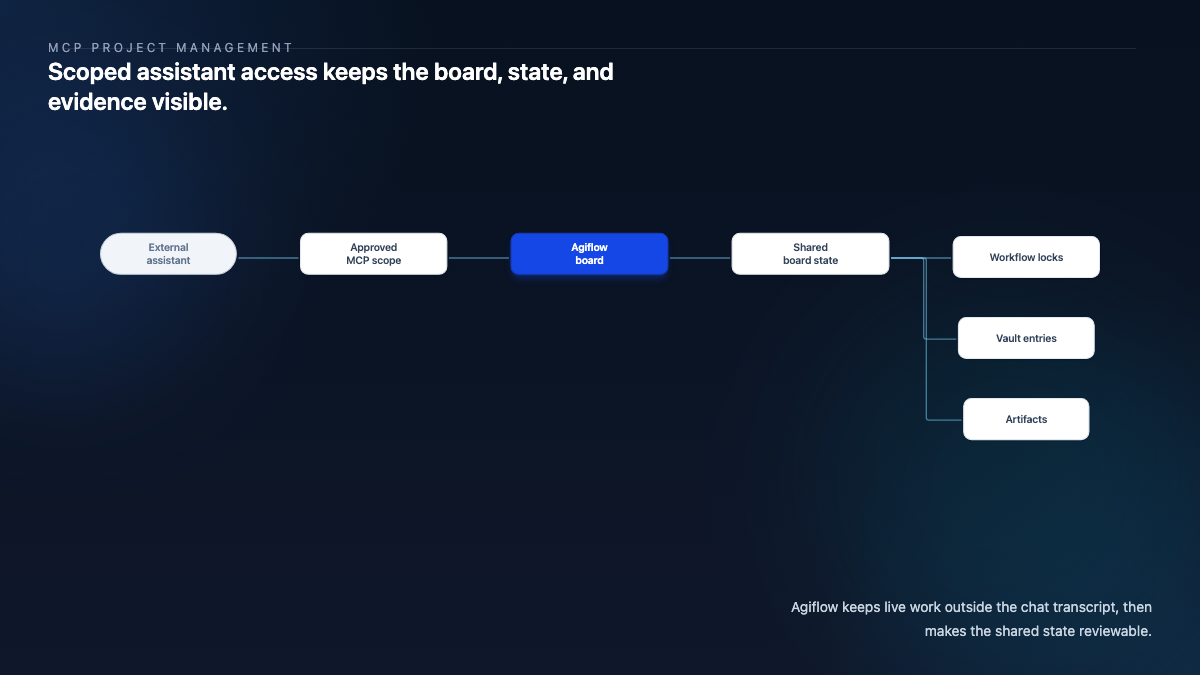
MCP project management means connecting a project board to AI assistants through the Model Context Protocol so the assistant can read and update project state through approved tools.
Anthropic introduced MCP on November 25, 2024, as an open standard for connecting AI assistants to the systems where data lives [5]. Google Cloud describes MCP as a standardized two-way connection for AI applications to access tools and data sources [6]. Those definitions are technical, but the user job is practical.
The assistant needs somewhere to put work that is not the prompt.
Plans, task status, blockers, files, comments, decisions, review notes, and handoff summaries do not belong in a single disappearing chat transcript. They also do not always belong in repo docs. Repo docs are good at stable knowledge. Live work state changes every few minutes.
A project management MCP server gives the assistant a narrow way to interact with that live state. The assistant can ask what is in scope, read the relevant tasks, create or update records, add comments, attach artifacts, and leave a trace a human can review. The protocol alone does not make that safe. The board, permissions, and product boundaries do.
That is the category Vibe Kanban pointed toward. It is also why "kanban board for AI agents" is too small as a phrase. The columns are the visible part. The durable state underneath is the product.
What an AI-agent project board needs beyond kanban columns
The community language from this refresh was more concrete than the category labels. Practitioners talked about real board state, context management, a single source of truth, audit trails, decision logs, stale cards, and agents guessing. Treat that as qualitative language, not market sizing.
It points to a practical checklist.
| Need | What it means in an AI-agent workflow | Failure mode when missing |
|---|---|---|
| Human-readable board | People can scan active work, ownership, status, blockers, and priority. | The human cannot tell whether the agent is still working or has drifted. |
| Assistant-readable state | The assistant can read the current project, work unit, task, comments, and constraints through approved tools. | The assistant guesses from stale prompt context. |
| Scoped access | Access can be limited to an organization, project, work unit, or task. | A broad token exposes more workspace state than the job needs. |
| Artifacts | Files, outputs, screenshots, reports, or links can be attached to the work record. | Status changes claim progress without evidence. |
| Decision history | Comments and handoff notes record why a choice was made. | The next session repeats the same debate. |
| Workflow locks | Active work can be claimed or guarded while an assistant runs. | Two agents or people collide on the same task. |
| Handoff reliability | A teammate or a different assistant can resume from the board without reading the entire chat. | Work depends on one closed context window. |
Sometimes you do not need a dedicated assistant-readable board. GitHub Issues, Linear, Jira, local markdown, a terminal session, or git worktrees may be enough when one person owns the work, the assistant does not need write access, and the handoff cost is low.
The dedicated board starts to matter when the workflow has multiple assistants, repeated handoffs, durable artifacts, audit needs, or a gap between planned work and what the agent actually did. That is when why AI coding agents lose context becomes more than a prompt problem. It becomes a state problem.
The builder's problem: being right before the list exists
The hardest part of this phase is psychological. Being early and being wrong produce the same outward signals for a while: few mentions, thin search demand, awkward comparisons, and alternatives lists that orbit the job without naming it.
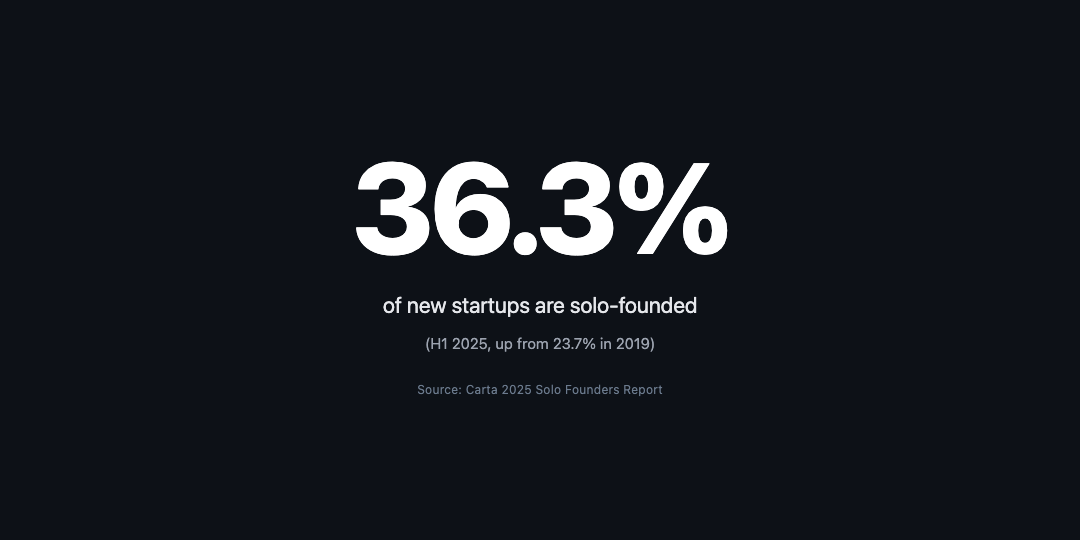
Carta's 2025 Solo Founders Report adds useful context. Carta reports that the share of new startups with a solo founder rose from 23.7% in 2019 to 36.3% in H1 2025 [4]. That does not prove anything about Vibe Kanban by itself. It does explain why many early developer-tool teams have little distribution reach while the category is still forming.
An early builder can misread the absence in both directions. "Nobody listed us, so the product must be bad" is too harsh. "Nobody listed us, so we must be visionary" is too forgiving.
The better test is stricter:
- Is there observed workflow demand, even if the category name is unstable?
- Do practitioners repeat the same pain in their own words?
- Can the product show the job clearly in one or two concrete examples?
- Can it define non-fit without sounding defensive?
- Can it make the vocabulary crawlable enough that search, AI systems, and humans can connect the category?
If the answer is yes, absence from the list is information about distribution and vocabulary. If the answer is no, absence may be information about the product.
Counterargument: maybe the product is just not good enough
This objection deserves a real answer. Sometimes a product is absent because it is not good enough. Sometimes positioning is vague. Sometimes the category is real, but the product's proof is weak. Sometimes the timing is bad and the team has no credible way to wait.
"The market is early" should never become an excuse for weak evidence.
Simon Willison's commentary on vibe coding and agentic engineering is helpful because it treats the shift as real while still drawing a line around responsible engineering practice [7]. Augment Code's AI-native engineering guide makes a similar vendor-side argument: the shift is about coordination, review, governance, and orchestration, not just faster code generation [8].
That broader shift supports the category. It does not prove any single product wins.
For a builder, the diagnosis should be concrete:
| Symptom | Possible diagnosis | Evidence to inspect |
|---|---|---|
| Users try the tool and leave quickly | Product or onboarding problem | Activation, repeated use, support tickets, setup friction |
| Users like the tool but do not pay | Pricing, packaging, buyer, or paid-layer problem | Conversion, willingness to pay, team adoption, procurement trigger |
| The tool is absent from lists and searches | Distribution or category-language problem | Search queries, internal links, docs clarity, community language |
| Users cannot explain what it replaces | Positioning problem | Homepage, docs, demos, comparison pages |
| Users want the outcome but use workarounds | Proof and trust problem | Screenshots, artifacts, audit trail, permissions, security answers |
What Agiflow can prove from inside the gap
Agiflow is a useful example because its boundary is narrow.
It does not run, host, or replace AI agents. Agiflow is a commercial project board for external assistants and humans. Its first-party documentation says it supplies scoped project-board tools, prompt skills, shared state, artifacts, vault entries, and workflow coordination [9]. The assistant remains the assistant. The board supplies durable state.
That boundary matters. If a product claims to be the agent, the IDE, the orchestration layer, the project board, and the governance system all at once, buyers have to untangle the claim before they can trust it. A narrower claim is easier to inspect:
- Can Claude, ChatGPT, Cursor, Codex, or another compatible assistant connect through approved scope?
- Can the assistant read the relevant project, work unit, task, comment, artifact, vault, or workflow-lock state?
- Can a human review the state after the assistant acts?
- Does the product say where it does not fit?
Agiflow's public documentation lists direct MCP scopes at organization, project, work-unit, and task levels, plus core tool families for projects, work units, tasks, task comments, artifacts, vault entries, and workflow locks [9]. That is first-party evidence, not an independent benchmark. It is still the kind of proof a forming category needs because it names the objects the assistant can touch.
This refresh workflow is a small example of the same idea. The task context, source audit, research notes, outline, draft, and later gate files are durable work state outside a chat transcript. The value is not that the files are glamorous. The value is that the next worker does not have to infer the scope from memory.
That is what a project board for AI agents has to do. It has to turn "the agent worked on it" into a record a human can inspect.
Short answers for builders
Did Vibe Kanban prove AI-agent boards cannot be paid products?
No. The available source set supports a more limited conclusion: Vibe Kanban is sunsetting, and Nimbalyst reports that the business model was the hard part [1] [2]. That is not enough to prove the whole category cannot be paid. It proves the category needs clearer buyer proof.
Why do alternatives lists miss tools in young categories?
Because alternatives lists depend on existing search language, visible competitors, and author awareness. When the category is still being named, lists often capture adjacent products before they capture the exact job.
When is a normal project board enough for AI-assisted work?
A normal board is enough when humans are the only writers, the assistant only needs copied context, and the cost of stale state is low. An assistant-readable board matters when the assistant needs scoped access to update live work, attach evidence, or hand off to another person or tool.
What makes Agiflow different from running agents inside a project tool?
Agiflow keeps the assistant external. It gives approved assistants scoped ways to read and update shared project-board state, while the human still chooses the assistant, reviews the work, and owns the outcome [9].
The implication
The market is using parts of MCP project management before it has stable language for the category. That is uncomfortable for builders because it makes the signal noisy. A missing roundup mention can mean bad product, weak proof, poor distribution, or early timing.
The job is to separate those signals.
Vibe Kanban did not settle the category. It exposed the shape of the work: coding agents need durable project state, humans need reviewable evidence, and buyers need a name they can trust. Alternatives lists will catch up only after enough products make that shape visible.
If you are building in that gap, absence from the list is not a verdict. It is a demand to make the proof clearer.
Read the MCP project management tools guide to compare the category without guessing.
References
[1] Vibe Kanban GitHub repository - https://github.com/BloopAI/vibe-kanban - Verified in research on 2026-07-05 as public repository evidence that the project is sunsetting and as source for the product description.
[2] Nimbalyst, "Vibe Kanban After Bloop: What's Next?" - https://nimbalyst.com/blog/vibe-kanban-after-bloop-whats-next/ - Secondary source for the reported shutdown date, open-source transition, Apache 2.0 note, and business-model explanation. Attributed as Nimbalyst's claim.
[3] Nimbalyst, "Best Vibe Kanban Alternatives in 2026" -
https://nimbalyst.com/blog/best-vibe-kanban-alternatives-2026/ - Verified in research on 2026-07-05 as naming Nimbalyst,
Conductor, Claude Code Desktop, and Cursor. Research also checked that the page text did not contain Agiflow.
[4] Carta, "2025 Solo Founders Report" - https://carta.com/data/solo-founders-report/ - Source for the solo-founder share rising from 23.7% in 2019 to 36.3% in H1 2025.
[5] Anthropic, "Introducing the Model Context Protocol" - https://www.anthropic.com/news/model-context-protocol - Source for MCP launch date and definition as an open standard for connecting assistants to external systems where data lives.
[6] Google Cloud, "What is Model Context Protocol?" - https://cloud.google.com/discover/what-is-model-context-protocol - Source for MCP as a standardized two-way connection for AI applications to access tools and data sources.
[7] Simon Willison, "Vibe coding and agentic engineering" - https://simonwillison.net/2026/May/6/vibe-coding-and-agentic-engineering/ - Independent commentary on the boundary between vibe coding and responsible agentic engineering.
[8] Augment Code, "AI-Native Engineering Guide" - https://www.augmentcode.com/guides/ai-native-engineering - Vendor guidance framing AI-native engineering as an operating-model shift around coordination, review, governance, and orchestration.
[9] Agiflow public llms.txt - apps/agiflow-app/public/llms.txt - First-party source for Agiflow
positioning, scoped project-board tools, prompt skills, shared state, artifacts, vault entries, workflow coordination,
and the boundary that Agiflow does not run or host AI agents.
More to read
Gemini 4 Argon Overnight Runs: Review Each Proposal in Three Layers
Review each overnight Gemini 4 Argon proposal against repository tests, consumer contracts and a reserved workload before deciding what to merge.
9 min readAI Agent Approvals That Hold Up: 5 Lessons From Meta's Muse
Five lessons from Meta Muse show why agent approvals need an independent authority, readable scope, and recoverable evidence. Apply the five-field receipt.
11 min readOpenAI DevDay 2026: Choose What Your Team Delegates to ChatGPT
Read the September DevDay and October ChatGPT updates through their separate execution, account and usage limits, then choose a bounded draft for review.
11 min read