How to Build an AI Code Review Workflow in Agiflow
Build a decision-ready review queue for AI-generated code with a clear task contract, inspectable evidence, visible gaps, and a named human decision.
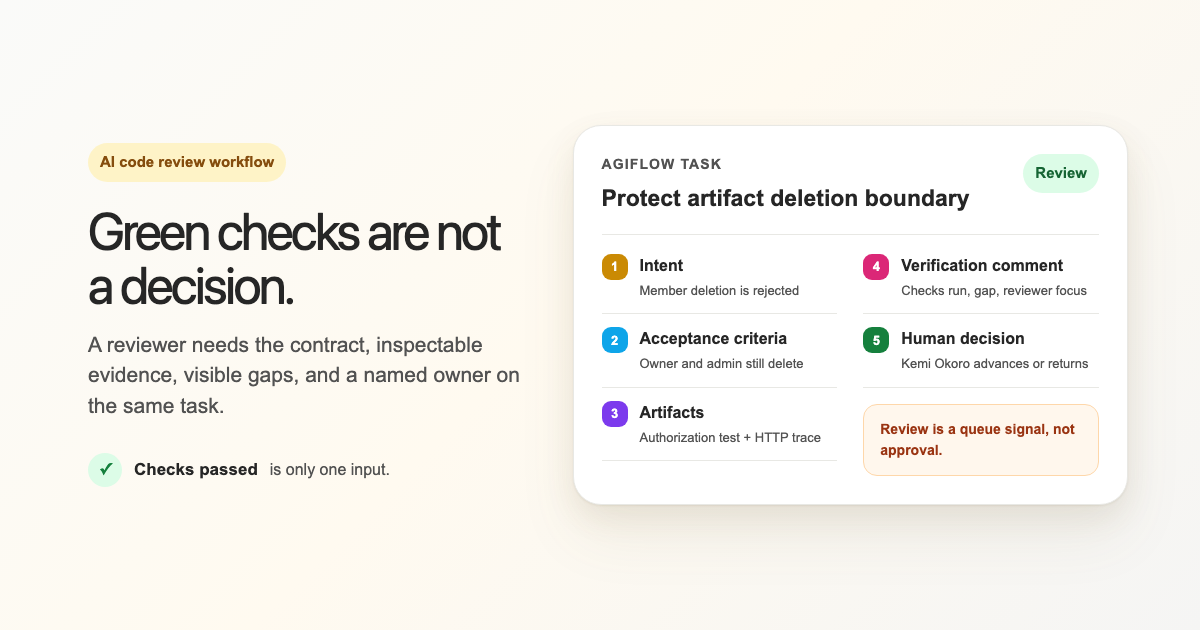
A review queue becomes useful when the change, evidence, gaps, and decision owner arrive together.
An AI code review workflow breaks down when a reviewer opens an AI-generated change with green checks and a polished summary. The change prevents a regular project member from deleting an artifact. Yet the reviewer cannot see whether owner deletion still works, whether the full integration suite ran, or who can accept the remaining risk.
This pressure is not hypothetical, although the size of it varies by team. GitLab reports that 85% of 1,528 respondents in a Harris Poll survey agreed AI had shifted the bottleneck from writing code to reviewing and validating it. Sonar separately reports that 38% of more than 1,100 surveyed professional developers found AI-code review more effortful than review of human-written code. Both are vendor-published survey claims, not causal proof. [1] [2]
TL;DR: Set up an Agiflow review queue by putting intent and acceptance criteria on the task, linking inspectable evidence as artifacts, recording checks and gaps in comments, moving the complete packet to Review, and naming the human who will advance or return it. Agiflow coordinates that record. It does not review the code.
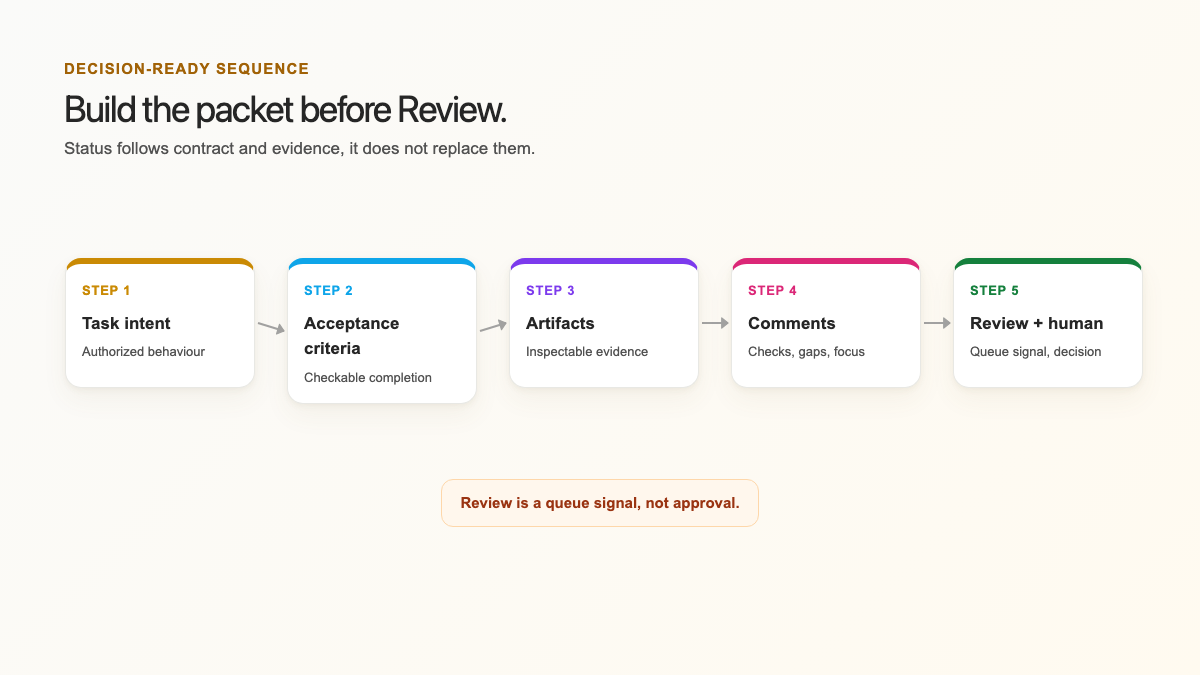
The operating rule is simple: a card enters the queue only when it is decision-ready. That rule moves the hard work to the handoff boundary, before a reviewer spends scarce attention reconstructing an assistant session.
An AI code review workflow needs an entry contract
Most AI code review guidance begins with a diff. GitHub's official guide tells reviewers to start with functional checks, confirm context and intent, examine code quality and dependencies, and use human judgment where automation cannot settle the question. That is sound review guidance. [3]
It still begins after the change exists.
A queue needs an earlier admission test. Before the card reaches Review, one screen should answer four questions:
- What behaviour was authorised?
- What observable conditions define completion?
- What evidence can the reviewer inspect?
- Who can decide whether that evidence is enough?
The distinction matters because a diff checklist cannot recover a missing product decision. If a task says “fix artifact permissions,” a reviewer can inspect the implementation and still not know whether members, owners, and admins have different deletion rights.
The review packet pattern is useful here. Practitioner Thomas De Vos proposes sending a task contract, scope, commands, skipped checks, risks, rollback information, and review focus with an AI-generated diff. That is a practical pattern, not an industry standard or proof of faster review. [4] The extra step in Agiflow is to keep those elements on a shared task and route the complete record into a visible queue.
The AI coding team norms for reviewer-ready handoffs explain the obligation behind this entry test: ownership and validation must arrive before the request for attention.
Once that entry contract exists, status is not the first field to fill. The task has to state what the change is allowed to promise.
Put intent and acceptance criteria on the task before code is generated
Use the task title and description for authorised behaviour, scope, and non-goals. Use acceptance criteria for conditions a reviewer can observe. Agiflow documents descriptions, acceptance criteria, assignees, comments, artifacts, and project-specific statuses as parts of a task record. [5] [6]
For this walkthrough, the scenario is fictional and narrow:
Prevent a regular project member from deleting a project artifact while preserving owner and admin deletion.
The task description should also say what will not change: upload, preview, download, and storage behaviour remain out of scope.
Then write acceptance criteria as behaviours, not confidence statements:
- A regular member's delete request is rejected.
- The artifact remains available after the rejected request.
- Owner and admin deletion still succeeds.
- Targeted authorisation tests and type checking complete successfully.
“Tests pass” would be weaker. It does not identify which role boundary was exercised, whether the artifact survived the rejected request, or whether privileged deletion regressed. Four criteria give the coding assistant a boundary and give the reviewer four claims to test against evidence.
Agiflow does not generate or verify these criteria. The task author remains responsible for writing the intended behaviour, and the repository remains authoritative for the implementation. The board's job is to preserve the contract where the assistant and reviewer can both find it.
Now the reviewer knows what should be true. The packet still needs to show what was actually checked.
Store evidence in artifacts and interpretation in comments
An artifact and a comment do different jobs. Treating them as interchangeable is how a confident sentence replaces inspectable evidence.
Task-linked artifacts should carry files or outputs the reviewer can open. Agiflow documents artifact links on tasks, while GitHub recommends functional checks, static analysis, intent verification, and structured artifacts when AI output will become context for later work. [5] [3]
For the fictional deletion change, the packet needs two evidence objects:
- targeted authorisation test output covering regular member, owner, and admin behaviour;
- an HTTP response trace or captured verification report showing the rejected member request and the artifact's continued availability.
Those are evidence categories, not invented results. Attach the output produced by the actual repository commands. A file called tests-passed.txt is still only a claim.
Use a comment for interpretation. A useful verification note names the commands that actually ran, discloses whether the full integration suite was skipped, identifies the remaining authorisation risk, and points the reviewer to the deletion boundary. If a command did not run, write that plainly. If an artifact is incomplete, leave the task out of Review.
The split is worth keeping:
| Packet content | Agiflow surface | Reviewer question |
|---|---|---|
| Test output and response trace | Linked artifacts | Can I inspect the result? |
| Commands, skipped checks, caveats, and review focus | Comment | How should I interpret it? |
Evidence can expose the skipped integration suite. It cannot decide whether that gap is acceptable. That is a routing decision.
Review is a queue signal, so name the person who can decide
Move the task into Review only after the contract, artifacts, and verification note are present. Agiflow's documented workflow model treats Review as a started status category, not a completed or terminal state. [6] Review means “ready for a decision,” not “correct” or “approved.”
Assign a human reviewer at the same time. The coding assistant may run repeatable checks within its scope, but it should not appear as the acceptance owner.
The decision comment needs three parts: one explicit verb, one reason, and one next state. For example, if the full integration suite was skipped and the reviewer judges that evidence necessary for this access-control change, the fictional comment could say:
Return. The targeted role checks are present, but the integration evidence required for this authorisation boundary is missing. Move the task to In Progress and attach the completed integration output before requesting review again.
An advance decision should be just as clear. It should name why the evidence is sufficient for this task and where the code-host merge decision will happen. Git, the pull request, and the code host remain the authority for the repository and merge.
This is a narrower claim than “keep humans in the loop.” The human role in agentic coding workflows is acceptance authority: someone remains answerable for whether the evidence is enough for the consequence at stake.
The packet now has all its parts. The useful test is whether one reviewer can read the task from top to bottom without reopening the assistant transcript.
Walk one artifact-deletion change through the full packet
Picture the fictional task in Agiflow's Review lane. Its title names the deletion boundary. Its description preserves adjacent behaviour. Four criteria cover member rejection, artifact persistence, privileged deletion, and the required checks.
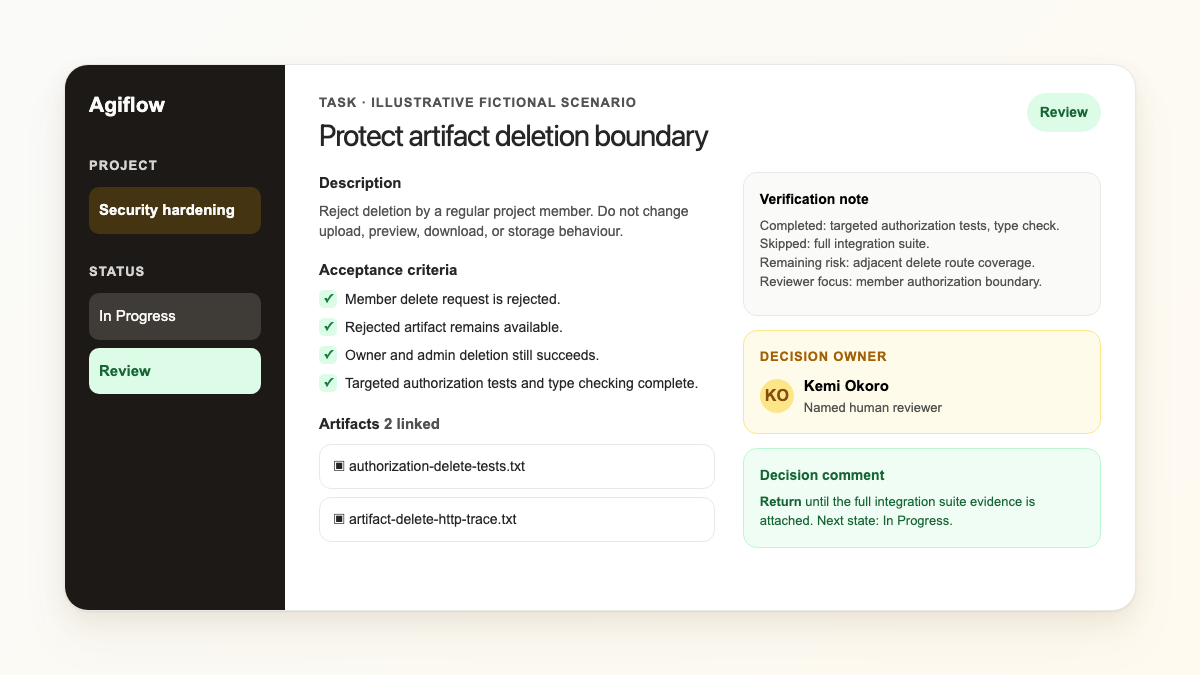
The Artifacts section contains real demonstration outputs, not a summary. A comment separates completed from skipped checks and names the reviewer focus. The assignee is a real project member, or the capture labels the reviewer as fictional.
Read in sequence, the task should answer six questions:
- Does the description state the authorised behaviour and non-goals?
- Are all four completion conditions visible and checkable?
- Can the reviewer open the test output and response trace?
- Does the comment distinguish completed checks, skipped checks, remaining risk, and reviewer focus?
- Did the card enter Review after the packet was assembled?
- Did a named human record advance or return, the reason, and the next state?
This sequence is the product proof. Agiflow can keep the task description, acceptance criteria, comments, linked artifacts, assignee, and queue state together in one scoped work record. Its task scope can be limited to one task, its comments, linked artifacts, and explicitly enabled tools. [5]
The capture does not prove faster review, better code, fewer incidents, or superiority to a pull request template. No checked source supports those outcomes. It proves that the handoff record and unresolved question can be visible together.
That is enough to test the workflow. It is not enough to declare the pattern sufficient for every team or every change.
Scale machine inspection without making acceptance anonymous
The strongest objection is practical: mandatory human review of ever-growing AI output may not scale. Martin Monperrus argues in a June 2026 preprint that coding agents can serve the traditional goals of review at lower cost and higher throughput, making mandatory human review a dead end. This is an argument, not an empirical result proving agent review is superior. [7]
I agree with the pressure behind it. People should not manually repeat every deterministic check that CI, static analysis, or a capable review agent can run reliably. A human line-by-line ritual can become theater if nobody is making a real decision.
The part I would keep human is narrower: deciding whether the available evidence is sufficient for the consequence, then owning the advance-or-return decision. The Linux kernel draws a strict version of this boundary. Its published policy says an AI agent must not add the Signed-off-by tag, while a human submitter must review the generated code, certify the Developer Certificate of Origin, and take responsibility. Related guidance expects submitters to understand and defend their contributions. That is one community's policy, not a universal mandate. [8]
For the artifact-deletion scenario, responsibility stays legible:
| Surface | What it remains responsible for |
|---|---|
| Git and the code host | Repository history, diff, pull request, and merge decision |
| CI and analysis tools | The checks they actually ran and the outputs they produced |
| Coding assistant | Producing the scoped change and any repeatable inspection it was asked to perform |
| Agiflow | Task intent, acceptance criteria, comments, linked artifacts, assignee, and queue state |
| Named human reviewer | Deciding whether to advance or return the task |
Scale the machine inspection as far as the evidence supports. Keep the remaining decision named.
Make decision-ready the admission rule
For a small engineering team, an AI code review workflow can fit in one sentence: no move to Review until intent, criteria, evidence, gaps, and a human owner are present.
That rule will not make every change safe or every review quick. It will stop a green checkmark from silently standing in for a contract, an artifact, and a decision. The card tells the next person what changed, what was checked, what remains open, and who can act.
See the Agiflow developer workflow and map your first review packet.
References
- GitLab. “GitLab Research Reveals Organizations Are Generating AI Code Faster Than They Can Control It.” https://about.gitlab.com/press/releases/2026-06-23-gitlab-research-reveals-organizations-are-generating-ai-code-faster-than-they-can-control-it/ . Published 23 June 2026. Verified 2026-07-19. Used for the disclosed Harris Poll sample and review-bottleneck survey claim.
- Sonar. “State of Code Developer Survey Report: The Current Reality of AI Coding.” https://www.sonarsource.com/blog/state-of-code-developer-survey-report-the-current-reality-of-ai-coding/ . Published 8 January 2026. Verified 2026-07-19. Used for the disclosed survey sample and effort reported for reviewing AI-generated code.
- GitHub Docs. “Review AI-generated code.” https://docs.github.com/en/copilot/tutorials/review-ai-generated-code . Verified 2026-07-19. Used for official guidance on functional checks, intent, code quality, dependencies, structured artifacts, and human judgment.
- De Vos, Thomas. “Claude Code diffs need review packets, not trust.” https://thomasdevos.com/posts/2026-07-16.11.08.00-claude-code-diffs-need-review-packets-not-trust/ . Published 16 July 2026. Verified 2026-07-19. Used for the practitioner review-packet pattern, not for an outcome claim.
- Agiflow. “Task use cases,” “Manage project files,” and “Agiflow full product reference.” https://agiflow.io/guides/mcp/plugin/scopes/task/use-cases and https://agiflow.io/guides/project-artifacts/manage-files and https://agiflow.io/llms-full.txt . Verified 2026-07-19. Used for documented task fields, task scope, comments, linked artifacts, and assistant access boundaries.
- Agiflow. “Workflows.” https://agiflow.io/docs/features/workflows . Verified 2026-07-19. Used for the documented status model in which Review is started rather than completed or terminal.
- Monperrus, Martin. “The End of Code Review: Coding Agents Supersede Human Inspection.” https://arxiv.org/abs/2606.13175 . June 2026 preprint. Verified 2026-07-19. Used as a contrarian argument about the scaling limits of mandatory human review, not as empirical proof.
- Linux Kernel Documentation. “Coding Assistants” and “Generated Content.” https://kernel.org/doc/html/next/process/coding-assistants.html and https://kernel.org/doc/html/next/process/generated-content.html . Verified 2026-07-19. Used for one community's published responsibility boundary for AI-assisted contributions.
More to read
Gemini 4 Argon Overnight Runs: Review Each Proposal in Three Layers
Review each overnight Gemini 4 Argon proposal against repository tests, consumer contracts and a reserved workload before deciding what to merge.
9 min readClaude Code Tasks Limitations: Where Native Tasks Stop for Teams
Claude Code Tasks is useful local orchestration, but it is not a shared system of record. This refreshed guide maps what Tasks stores, how it differs from sessions, memory, and artifacts, and when teams need an MCP-readable project board.
13 min readHow To Run AI Coding Agents Across Machines Without Duplicate Work
More AI coding agents only help when ownership, state, and proof survive outside a single session. This refreshed guide shows how Agiflow uses CLI runners, workflow locks, atomic claims, device identity, and artifacts to coordinate agent work across machines without duplicate branches or lost handoffs.
12 min read