Gemini 4 Argon Overnight Runs: Review Each Proposal in Three Layers
Review each overnight Gemini 4 Argon proposal against repository tests, consumer contracts and a reserved workload before deciding what to merge.
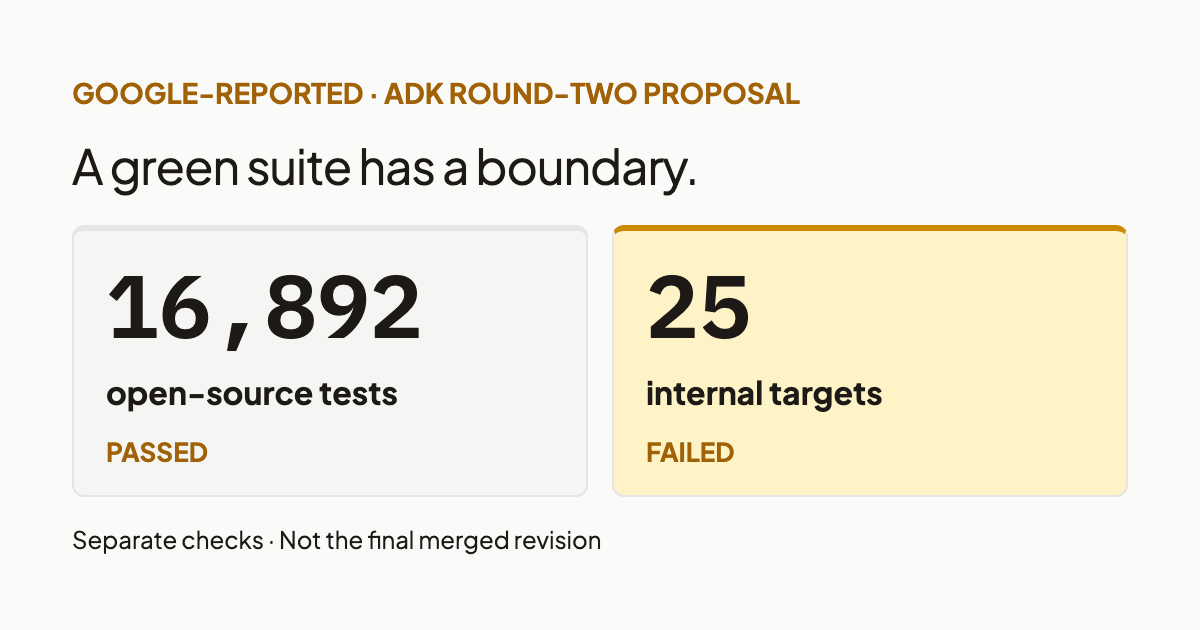
Google reports a green open-source suite alongside failed internal targets; the two checks covered different boundaries.
Google reports that all 16,892 open-source tests passed on its round-two Gemini 4 Argon proposal, while 25 internal Google test targets failed. The change removed module attributes that consumers still patched. Those are different units and review boundaries, not a failure rate for the final shipped revision. [1]
For an engineering lead reviewing a pull request from an AI agent after an overnight AI coding run, the problem is specific: which evidence justifies keeping each optimization? A larger local test count cannot answer an untested consumer question. I would plan the review before the run, then approve proposals separately rather than accept the overnight diff as one package.
TL;DR: Review each proposal through repository behavior, downstream compatibility and representative performance. Keep missing evidence visible and unsupported proposals unmerged. This three-layer decision rule is my practical synthesis of Google's case, not Google's named methodology or a guarantee of correctness.
Green tests can still leave a consumer contract broken
Read a green suite as evidence of the behavior it exercised. In Google's Agent Development Kit (ADK) repository, google/adk-python, removing three internal flow imports from llm_agent.py broke internal consumers that patched those exact module attributes. The open-source suite did not expose that dependency. Google's shipped solution used lazy module accessors, preserving patchability while loading heavy packages on demand. [1]
The failed boundary was concrete: consumers expected those attributes to remain patchable. It would be a mistake to dismiss the local tests as useless. It would also be a mistake to treat their success as evidence that those consumers still worked.
Google says the 11-hour overnight run proposed six optimizations across 32 files. Its maintainers retained two and rejected four. That is proposal selection, not a model accuracy score. [1]
For launch context, Google announced Gemini 4 Argon on 30 September 2026 and published its general-availability announcement on 13 October 2026. [3] [4] This article uses sources captured on 16 October 2026. The Google pages are vendor accounts, not independent replications of the results.
The useful preparation is to name that consumer expectation before the agent starts removing imports.
Before: write the acceptance boundary and reserve a holdout
Write what must remain true before authorizing exploration. Google reports that round one altered a public JSON schema and ran only 216 nearby tests. Round two included maintainer guidance under .agents/skills. The team also wrote bench_turn.py before either round and never showed it to Argon. [1] That supports preparation, without proving rulefiles alone caused the better result.
Here is the pre-run contract I would use:
- Goal and non-goals: name the outcome to improve and the adjacent work to leave alone.
- Compatibility boundaries: preserve the public schema, consumer import and patch points, and session-state semantics.
- Baseline and checks: record the starting revision, environment and required repository commands.
- Evaluation: name a reviewer-owned representative workload and define the behavior and performance comparisons in advance.
- Owner and delivery: name the reviewer and say “open a PR, do not merge.” Where supported, deny merge authority in the execution setup; the sentence alone is not enforcement.
An unattended coding agent should submit separable proposals whose evidence the owner can inspect. That is the admission budget; there is no universal file-count threshold. A lazy-import proposal and a cache redesign should arrive with distinct evidence even if they share one pull request. The existing review-packet and queue setup guide covers assembling the handoff; this method decides whether its evidence is sufficient.
My recommendation is to keep the reserved workload outside the agent's accessible workspace and tools, not merely label a file “do not read.” Run the comparison under reviewer control. Do not repeatedly feed its results back as optimization instructions. If it becomes tuning feedback, reserve fresh evaluation material rather than continue calling it a holdout.
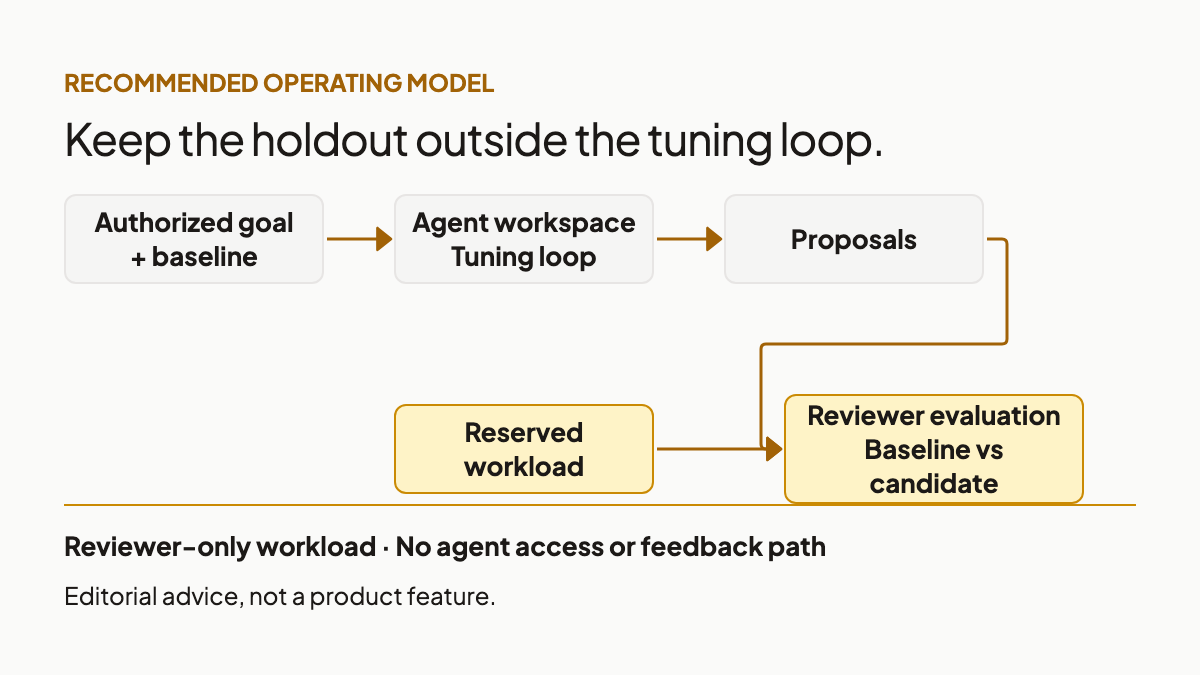
That separation takes access control and extra evaluation work. A written contract is only the beginning: its goal and evidence record still need to survive the session.
During: keep the goal pinned and the evidence candid
Keep the original goal available as the session grows. Google's ADK account describes using the /goal mode in Google Antigravity to preserve the goal across context compactions. [1] A persistent goal still needs a candid account of what happened.
Require command outputs tied to candidate revisions, benchmark setup, skipped checks and failed attempts. An illustrative incomplete handoff might say:
Consumer patch-point checks: not run. Required next evidence: consumer smoke-test output on the candidate revision. Review owner: the named maintainer.
“Not run” leaves a question open. It must not become “passed” in the final summary. Inspect changes to the checks themselves too: GitHub's review guidance explicitly calls weakened CI a blocker. [5]
Google's separate Antigravity account reports closing 97 stale or duplicate bugs from a queue of 134 reports, with documented commit proof, and assigning the remaining 37. Its support-ticket example describes replies drafted for human approval. [2] These are different workflows. They illustrate evidence and ownership, not proof that the ADK changes were correct.
A pinned goal is also different from runtime enforcement. Google's disclosure of reasoning and action monitoring, with execution stopped when necessary, does not establish that those controls exist in your runner. [3] Name the actual stop and escalation owner; bounded agent controls and stop authority cover that separate design problem.
Even a candid handoff can contain incompatible findings. The reviewer needs to keep them separate.
After: review a Gemini 4 Argon run through three evidence layers
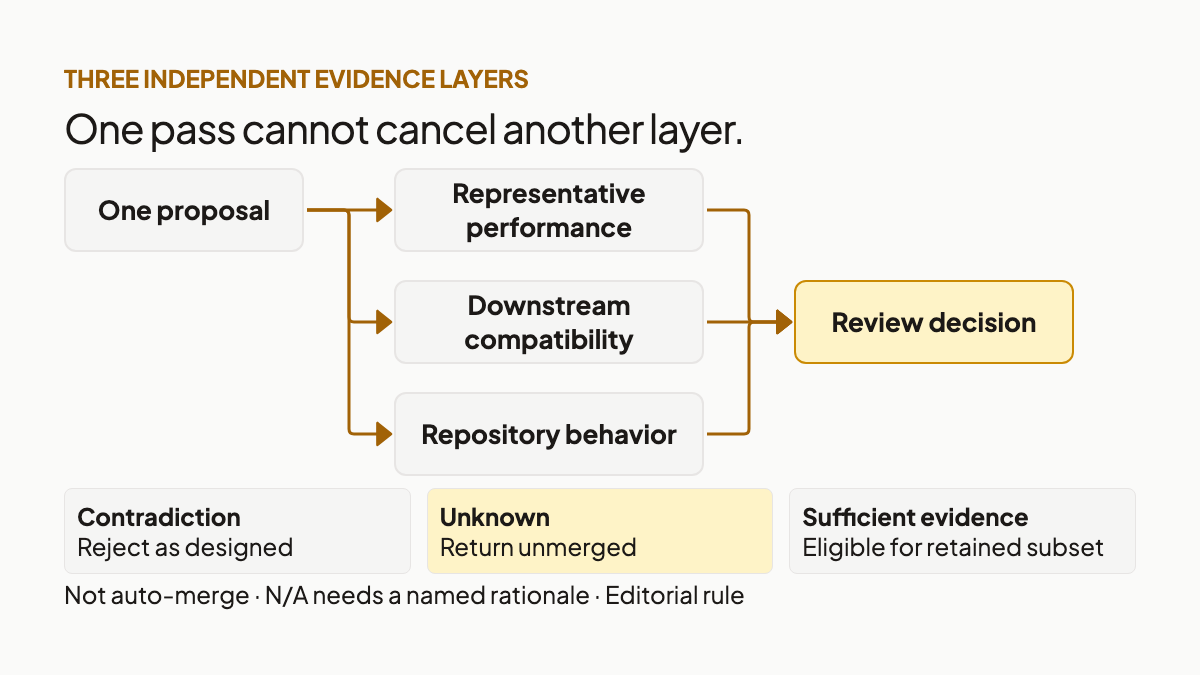
Give each relevant evidence layer its own decision. Google's consumer patch-point failures answered a question the repository suite had missed. Its separate holdout answered another: did the change improve the intended workload? Google says bench_turn.py used instant model and tool responses, byte-identical model requests before and after, and medians of 6 to 12 runs. Those conditions isolate framework overhead, not ordinary LLM response latency. [1]
| Layer | Evidence to inspect | Limit of that evidence |
|---|---|---|
| Repository behavior | Commands, baseline and candidate revisions, regression coverage, unchanged checks | Does not establish unexercised consumer contracts |
| Downstream compatibility | Consumer smoke tests, public schema, patch/import points, state-lifecycle checks | Does not establish a useful performance benefit |
| Representative performance | Independent workload, comparable behavior and environment, repeated baseline/candidate measurements | Does not establish universal speed or future behavior |
Choose the metric that answers the authorized goal. Google reports 21% faster package imports, but new-process time to first model request stayed essentially flat: 3.07 seconds to 3.09 seconds. Deferred imports still loaded on the first turn. [1] If the assignment is to improve a cold first request, import timing alone does not demonstrate success. Nor should framework-overhead savings be presented as total model-latency savings.
My disposition rule is deliberately strict about substitution. Sufficient evidence within the stated scope makes a proposal eligible for the retained subset, not automatically approved. Contradictory evidence means reject it as designed. Missing evidence means return or defer it, unmerged. No aggregate score lets a performance gain cancel a compatibility failure.
A layer can be not applicable only with a reviewer-owned rationale naming the absent boundary. A change with no consumer-facing effect may justify a narrow compatibility check. Consumer tests you cannot access are an unknown, not evidence that no consumer boundary exists.
The strongest objection is reasonable: why add human process when CI and automated review can run the checks? Automate every repeatable check you can. Keep the owner's decision focused on whether those checks cover this proposal's boundaries. Narrow evidence for a narrow change is enough; an untested patch point is still untested after another thousand local tests.
The remaining task is to recognize which tempting optimizations deserve rejection.
Apply four rejection questions before keeping an optimization
Use Google's four review cuts as questions about a submitted design, rather than as a verdict on the model. Each points to a different reason a locally attractive change might not meet the assignment. [1]
- Can lifecycle or identity reuse serve stale state? Google's proposed multi-agent cache improved a synthetic benchmark by 17%, but could return stale data across sessions if Python reused a memory address after garbage collection. This was a reported risk, not a reported production incident. Request session-replacement, invalidation and object-reuse checks. Reject a design that leaves that stale-state path unresolved. [1]
- Does the shortcut depend on a private library detail? Google rejected a telemetry check that read a private attribute of OpenTelemetry's tracer implementation. A minor upgrade could break that assumption. Require a supported boundary or redesign; the issue is this fragile dependency, not a universal prohibition on all private code. [1]
- Does added complexity buy the intended end-to-end benefit? Google says its proposed conversation-history formatter made a core path harder to read without improving latency on the independent holdout. Reject that trade when no other authorized benefit justifies it. [1]
- Does the representative workload benefit, or only the constructed test? Google's workflow-replay index added state-tracking complexity that helped synthetic replay tests, not everyday agent runs. Return missing representative evidence. Reject synthetic-only complexity when the authorized goal concerns the everyday workload. [1]
The state and dependency questions probe behavior and compatibility. The other two test whether the complexity earns its place. None guarantees complete safety. A morning packet may leave several questions unanswered, and that deserves a decision too.
Work an incomplete morning packet to a clear decision
Consider a fictional Python service with three proposals: lazy imports, a cross-session cache keyed only by object identity with no lifecycle invalidation, and a more complex history formatter. These are teaching inputs. No tests, timings or measured wins are claimed.
| Submitted proposal | Evidence to request | Morning disposition |
|---|---|---|
| Lazy imports | Local regression output, consumer patch/import checks and cold-first-request measurements | Defer until evidence supports the intended boundary and benefit; import timing alone is insufficient |
| Identity-keyed session cache without lifecycle invalidation | Session-replacement and object-reuse tests, plus a redesign addressing stale state | Reject the submitted design for its unaddressed stale-state path, regardless of a speed claim |
| More complex formatter with only a constructed replay offered | Behavior-equivalence checks and representative workload measurements | Return for evidence; reject extra complexity if the intended benefit does not appear and no other authorized benefit exists |
Record each decision against a revision. This plain-text template is an editorial tool, not a product feature:
Proposal and candidate revision:
Repository evidence:
Consumer evidence:
Representative-workload evidence:
Gaps or justified non-applicability:
Disposition and reason:
Decision owner and next evidence required:
For the lazy-import row, the next request is specific: attach consumer patch-point checks and a baseline/candidate cold-first-request comparison. It is not “please validate more.” If that evidence later supports retaining the proposal, the decision still applies only to the revision inspected.
Removing the cache and formatter creates a different combined revision. That combination has not passed merely because one proposal became eligible.
Recheck the retained subset and name the merge decision
Check the exact combination you intend to merge. Google's ADK account puts its division of labor plainly: “the agent explores, the maintainer subtracts.” Google says it combined work from both rounds into a 22-file change backed by 17 new test functions. [1] The 25 failed internal targets described earlier concerned the round-two proposal, not that final merged revision.
After removing rejected proposals, rerun the relevant repository and consumer checks on the retained combined revision. Make the final independent workload comparison without turning it into another tuning loop. If earlier feedback exposed the holdout to optimization, reserve fresh evaluation material.
The named reviewer should record the accepted scope and remaining uncertainty, with rollback and stop ownership. Missing required evidence keeps the affected proposal out; a polished run summary cannot supply it.
This protocol costs work: known consumers need checks, a holdout needs separation, and the retained subset needs another evaluation. Apply it to unattended optimization proposals with measurable outcomes. A comment-only edit does not need an enterprise-sized review ceremony, and the method does not establish that overnight delegation suits every repository or that human review guarantees correctness.
For an overnight Gemini 4 Argon run, approve a revision whose evidence you can defend. Leave the unfinished evidence request outside it.
Which change would you always reject from an overnight agent run?
References
- Google Developers Blog. “Optimizing a 200,000-line Python codebase overnight with Gemini 4 Argon.” https://developers.googleblog.com/optimizing-a-200000-line-python-codebase-overnight-with-gemini-4-argon . Published 13 October 2026. Captured 2026-10-16. Primary vendor account for the ADK run, proposal selection, repository and consumer checks, rejection reasons, maintainer quote and scoped benchmarks. Outcomes are Google-reported, not independently replicated here.
- Google Antigravity. “Gemini 4 Argon in Google Antigravity.” https://antigravity.google/blog/gemini-4-argon-in-google-antigravity . Published 12 October 2026. Captured 2026-10-16. Vendor account for commit-proof bug triage, assigned ownership and support replies drafted for human approval; a separate workflow, not independent ADK validation.
- Google. “Gemini 4 Argon: our next era of frontier intelligence.” https://blog.google/innovation-and-ai/models-and-research/gemini-models/gemini-4-argon/ . Published 30 September 2026. Captured 2026-10-16. Dated announcement and provider disclosure of monitoring and stopping; not evidence of controls available in a reader's runner.
- Google. “Gemini 4 Argon: Built to solve your hardest problems.” https://blog.google/innovation-and-ai/models-and-research/gemini-models/introducing-gemini-4-argon/ . Published 13 October 2026. Captured 2026-10-16. Dated general-availability announcement, not a plan-eligibility guide or a claim of identical availability across surfaces.
- Griffiths, Andrea. GitHub Blog. “Agent pull requests are everywhere. Here's how to review them.” https://github.blog/ai-and-ml/generative-ai/agent-pull-requests-are-everywhere-heres-how-to-review-them/ . Published 7 May 2026. Captured 2026-10-16. Practitioner guidance on review evidence and blocking weakened CI; independent publisher, not independent corroboration of Google's Argon results.
More to read
How to Build an AI Code Review Workflow in Agiflow
Build a decision-ready review queue for AI-generated code with a clear task contract, inspectable evidence, visible gaps, and a named human decision.
11 min readClaude Code Tasks Limitations: Where Native Tasks Stop for Teams
Claude Code Tasks is useful local orchestration, but it is not a shared system of record. This refreshed guide maps what Tasks stores, how it differs from sessions, memory, and artifacts, and when teams need an MCP-readable project board.
13 min readHow To Run AI Coding Agents Across Machines Without Duplicate Work
More AI coding agents only help when ownership, state, and proof survive outside a single session. This refreshed guide shows how Agiflow uses CLI runners, workflow locks, atomic claims, device identity, and artifacts to coordinate agent work across machines without duplicate branches or lost handoffs.
12 min read