Vibe Kanban Alternatives: Find the Half You Actually Lost
Vibe Kanban still runs locally and shipped v0.1.46 on November 15, 2026. The shutdown removed the hosted shared record. Pick a replacement for that half.
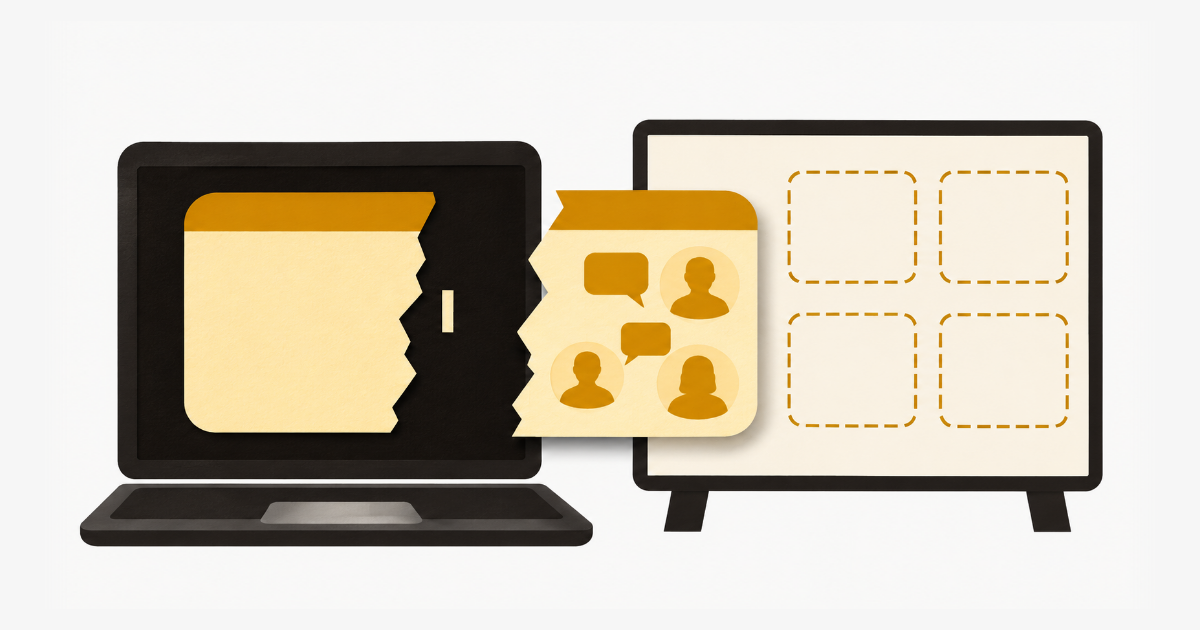
The laptop half kept running. The shared half came off the board.
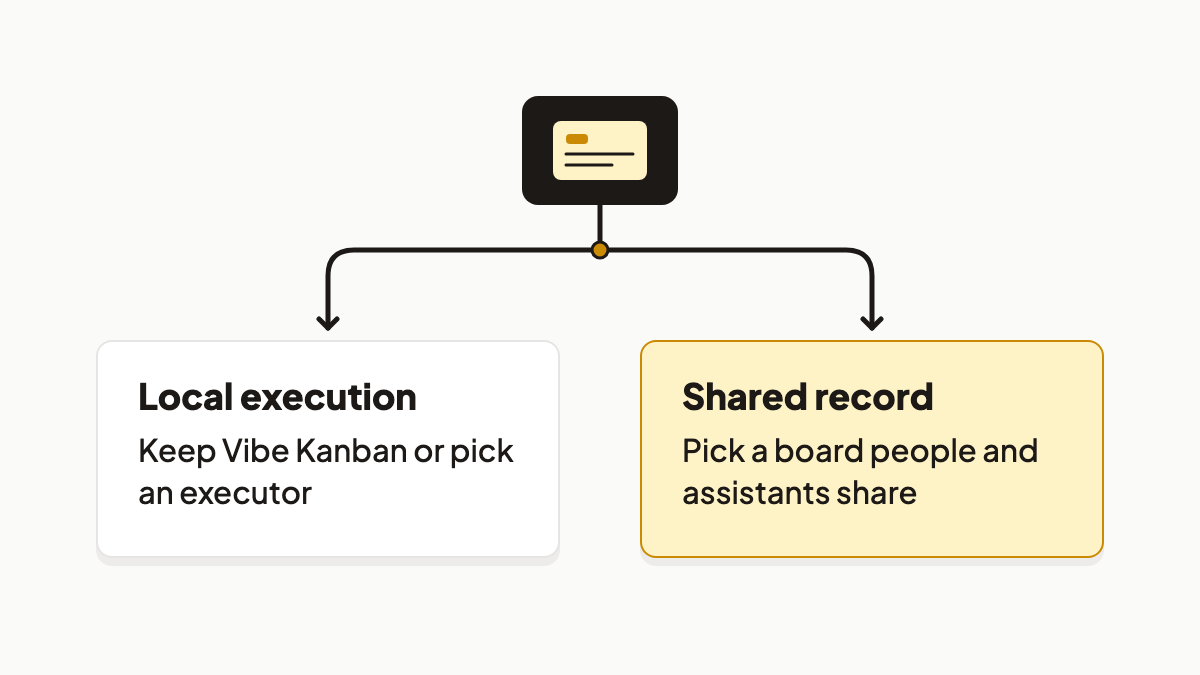
The best Vibe Kanban alternatives depend on which half you lost. If local execution still works, keep Vibe Kanban: its local workspaces continue, and it shipped v0.1.46 on November 15, 2026. [1] [2] If you lost the hosted shared record (issues, comments, projects, organisations), Agiflow is one option: a shared board that ChatGPT and Claude Desktop connect to through OAuth-scoped access, with duplicate-claim locks and required approvals that a different owner or admin must sign off. [1] [10] [11] [12] Its documentation describes no Vibe Kanban import.
Nearly every tool in the three vendor comparisons cited below is a way to run coding agents. That answers the execution question, which may not be the one your team has.
Is Vibe Kanban still maintained?
Yes, as a community project. Its GitHub repository released v0.1.46 on November 15, 2026, and it was still marked Latest when checked on November 21. [2]
On April 10, 2026, Louis Knight-Webb wrote: "Today we're shutting down bloop, the company behind Vibe Kanban. The Vibe Kanban project will live on, open source and community maintained." [1] The business reasons sit in that post, and we covered the market side of the story in MCP Project Management: Vibe Kanban Proved the Gap. This piece is about the practical part.
The same post draws a clear line: "For the avoidance of doubt, local workspaces will continue to function." [1]
The release notes show the execution half being kept current. They bump the Copilot and Codex executors, add support for installing and running agents from the ACP registry, and turn off usage analytics and crash reports. Five new contributors are listed. The release before it, v0.1.44, came out on April 24, 2026, so the gap was almost seven months. [2]
So if you were a solo user running agents in local workspaces, the honest answer may be that you do not need an alternative yet. Shuriken's comparison page, written by a competitor, opens with the same advice: "You may not need an alternative." [4]
What did the Vibe Kanban shutdown remove?
The hosted half. The shutdown post lists the removed remote services in one sentence: "kanban issues, comments, projects and organisations." [1]
Picture one card on a team's hosted board. This is an illustration, not a case from a real team. The card is an issue called "Checkout test fails on Safari". Under it sits a comment thread where a designer, a product lead and two engineers settled what "fixed" meant. The card belongs to a project, and the project belongs to an organisation that decided who could see any of it. The agent that wrote the patch ran in a local workspace on one engineer's laptop.
After the shutdown, the laptop half is fine. The workspace, the branch and the diff are still there. The other half is the four things on the removed list. That half was the only part the designer and the product lead ever touched.
The April shutdown notice also said the latest version included a data export feature. [1] This guide has not tested that export or checked what hosted data can still be retrieved today.
What Vibe Kanban comparison pages cover
The three vendor comparisons cited here are useful, and they lean toward the laptop question. Shuriken focuses on agent runners and worktrees. Crewmark and Nimbalyst also describe collaboration.
Shuriken ranks six tools and, to its credit, marks what each one carries over from Vibe Kanban and what it does not. By its own notes, none of the six keeps a board of its own: Emdash and Orca have no board on their pages (Orca can show GitHub Projects boards in-app), Paradev, Conductor and Claude Squad don't carry over a board, and Shuriken says it "has no kanban board". [4] That is an honest list of agent runners and worktree apps.
Two pages do speak to the shared side. Crewmark lists "the hosted kanban issues, comments, projects and organisations that teams shared" as gone, tells readers to recreate open issues "in GitHub Issues or in the board of the tool you pick", and sells its own hosted board. [3] Nimbalyst pitches real-time collaboration on its workspace and says Vibe Kanban is the better fit "when you only want a focused board." [5] Both are vendor claims, and this guide has not tested either product.
One detail dates quickly. Crewmark's table says its facts were checked on November 7, 2026, and it says there has been no release since v0.1.44. That was true on November 7. Eight days later v0.1.46 shipped. [2] [3] Every page in this space, this one included, is a snapshot, so open the releases page before you decide the project is dead.
Vibe Kanban alternatives by what you lost
Keep Vibe Kanban if its local workspaces still do the job. Look at a new runner only if execution is the problem. Choose a shared board if collaboration is what you lost.
The question one CrewAI forum post asked in October is a good test of which half you need: "How do you handle task ownership, agent failures, and progress tracking in your multi-agent projects?" [6] Agent failures live on the laptop. Ownership and progress tracking live on the wall.
| How you used Vibe Kanban | What still works | What to replace |
|---|---|---|
| Solo, local workspaces only | Local workspaces and agent execution | Nothing yet. Watch the releases page. |
| Local workspaces, but your agent misbehaves inside it or you want a vendor behind the tool | Execution, with some risk of drift | The executor. Shuriken's list includes Emdash, Orca and Conductor to investigate. [4] |
| The hosted board, shared with teammates | Your workspaces and branches | The shared record: GitHub Issues for a code-only team, or a shared board such as Agiflow. Keep whatever runs your agents. |
Treat this as a recommendation. Nobody has measured it. Plenty of teams will want a new runner and a new record at once. Deciding them separately still stops you from picking a desktop app and finding out a month later that the product lead has nowhere to read the thread.
Four questions a replacement record has to answer
Each removed object turns into one question. Ask all four of any tool you are considering, including GitHub Issues.
- Issues. Where does a piece of work live so that someone who never opens a terminal can find it and see its status?
- Comments. Where does the discussion sit, and can an assistant read it in its next session instead of starting cold?
- Projects. What groups the work, and who is allowed to change that grouping?
- Organisations. Who is in, who can approve, and what exactly can each AI assistant reach?
If everyone on your team is an engineer and your assistants work inside the repository, GitHub Issues may answer all four well enough. That is Crewmark's suggestion too. [3] The gap shows up when a non-coding teammate needs the thread, or when a chat assistant such as ChatGPT or Claude Desktop needs scoped access to the same work.
Where Agiflow fits, and where it doesn't
Agiflow is a shared project board for AI agent task management. It is an option for teams replacing a hosted work record. Its documentation does not describe it as a runner for local coding agents, and it describes no Vibe Kanban importer. Here is what the product documentation does describe, mapped to the four questions. This is documented behaviour, not a live test in this article.
- Issues: tasks sit on a kanban board with status columns, and creates, updates, reorders and status changes are broadcast to every connected client in real time. [7]
- Comments: the mobile app's task detail shows comments next to the task's evidence. [8]
- Projects and organisations: team leads create projects and invite members, and project management controls are limited to owners and admins. [9]
- Assistant access: ChatGPT and Claude Desktop connect through OAuth with a consent screen, and the person connecting chooses a project, task or work unit to scope that access. [10] Setup and permissions still differ from one client to the next, which our guide to keeping one project board across several assistants walks through.
Two documented behaviours matter once agents and people share a record. If a second agent tries to claim work that is already locked, the claim is refused rather than duplicated. [11] And when a task workflow requires approval, it has to come from a different owner or admin in a signed-in browser session. Self-approval is forbidden, and an assistant connected through task-scoped Model Context Protocol (MCP) tools has no approve action. [12] Members and automation runners can also attach execution evidence to a task, with uploads checked by SHA-256. [13] For a worked example of making the approver explicit, see how to name the person who can decide.
Its documentation describes no Vibe Kanban import and no tested export-to-Agiflow path, so plan to recreate open issues yourself. It describes no worktree management or coding-agent runner either. Keep Vibe Kanban's local mode, or whichever runner you pick, for that half. And nothing in this article compares speed, price or feature parity with the old hosted service.
If the shared record is your gap, test it on one real card. Connect ChatGPT or Claude Desktop to an Agiflow board, recreate a single open issue with its comment thread, and see whether it answers the four questions above for your team.
Two objections worth taking seriously
"Community projects drift." Shuriken puts it well: "agent CLIs change their flags and output often, and a community project may take a while to catch up." [4] That risk is real. The November release updated the Copilot and Codex executors. That does not guarantee the next CLI change will be supported. Treat the releases page as the signal, and replace the executor when your own agent starts misbehaving inside it.
"Execution tools have boards now." Some do, or borrow one: Orca shows GitHub Projects boards in-app, and Crewmark and Nimbalyst describe shared spaces. [3] [4] [5] A board somewhere in the tool is not enough. The test is whether the teammate who never runs an agent can read the thread, and whether your assistants can reach the same record with access you scoped on purpose.
Before you compare Vibe Kanban alternatives, write down which of the four removed objects your team actually used. If the list is empty, keep Vibe Kanban running. If it isn't, that list is your shopping list, and one recreated card on a board your assistants can connect to is enough to check a candidate against it.
References
[1] Louis Knight-Webb, "Goodbye bloop", Vibe Kanban blog, April 10, 2026. https://www.vibekanban.com/blog/shutdown (accessed 2026-11-21). Supports the shutdown, community maintenance, the removed remote services, continuing local workspaces and the data export.
[2] BloopAI/vibe-kanban, Releases, GitHub. https://github.com/BloopAI/vibe-kanban/releases (accessed 2026-11-21). Supports v0.1.46 released November 15, 2026 and marked Latest, its change notes, and v0.1.44 on April 24, 2026.
[3] Crewmark, "Vibe Kanban alternatives: where to run your agents from a board now". https://crewmark.ai/blog/vibe-kanban-alternatives (accessed 2026-11-21). Vendor page; facts dated November 7, 2026.
[4] Shuriken, "Vibe Kanban alternatives (2026)", updated October 27, 2026. https://shuriken.sh/compare/vibe-kanban-alternatives (accessed 2026-11-21). Vendor page.
[5] Nimbalyst, "Nimbalyst vs Vibe Kanban". https://nimbalyst.com/compare/nimbalyst-vs-vibe-kanban/ (accessed 2026-11-21). Vendor page.
[6] "Vibe Kanban alternatives and multi-agent coordination", CrewAI Community, October 21, 2026. https://community.crewai.com/t/vibe-kanban-alternatives-and-multi-agent-coordination/7942 (accessed 2026-11-21). A single community post, possibly promotional; quoted for its question only.
[7] Agiflow task lifecycle flow, products/agiflow/docs/architecture/dataflows/project-management/task-lifecycle-flow.flow.yaml, and real-time organization updates flow, products/agiflow/docs/architecture/dataflows/project-management/realtime-organization-updates-flow.flow.yaml. Supports the kanban board with status columns and real-time broadcast to connected clients.
[8] Agiflow native task detail flow, products/agiflow/docs/architecture/dataflows/project-management/native-task-detail-flow.flow.yaml. Supports task comments shown with completion evidence.
[9] Agiflow team project management journey, products/agiflow/docs/architecture/journeys/team-project-management.journey.yaml. Supports projects, member invitations and owner/admin-gated management controls.
[10] Agiflow MCP OAuth authorization flow, products/agiflow/docs/architecture/dataflows/mcp-integration/mcp-oauth-authorization-flow.flow.yaml. Supports OAuth consent for ChatGPT and Claude Desktop and project, task or work-unit scoping.
[11] Agiflow workflow lock flow, products/agiflow/docs/architecture/dataflows/project-management/workflow-lock-flow.flow.yaml. Supports refusal of a second claim on a locked project, work unit and task composition.
[12] Agiflow task workflow lifecycle flow, products/agiflow/docs/architecture/dataflows/project-management/task-workflow-lifecycle-flow.flow.yaml. Supports approvals reserved for a distinct owner or admin in a signed-in browser session, with no approval action over task MCP.
[13] Agiflow task result verification flow, products/agiflow/docs/architecture/dataflows/project-management/task-result-verification-flow.flow.yaml. Supports task execution evidence with SHA-256 verified uploads.
Put this project board inside ChatGPT
Open Agiflow in ChatGPT to plan campaigns, create tasks, and check what needs attention. Create a free Agiflow account when you are ready to keep the board for your team.
More to read
MCP Project Management: Vibe Kanban Proved the Gap
Vibe Kanban is sunsetting, and the alternatives lists that followed show a young MCP project management market still naming the job, the paid layer, and the proof buyers need.
5 min readClaude Code Tasks Limitations: Where Native Tasks Stop for Teams
Claude Code Tasks is useful local orchestration, but it is not a shared system of record. This refreshed guide maps what Tasks stores, how it differs from sessions, memory, and artifacts, and when teams need an MCP-readable project board.
5 min readHow to Keep One Project Board Across ChatGPT, Claude, Cursor, and Codex
Use MCP to connect ChatGPT, Claude, Cursor, and Codex to the same project board, then keep the board as the narrow source of truth for scope, status, evidence, and next action.
5 min read