GPT-6 Astra Changes the Bottleneck: Five Controls Agents Still Need
GPT-6 Astra raises the operating stakes for computer-using agents. Use five controls to define authority, evidence, approval, and recovery beyond the model.
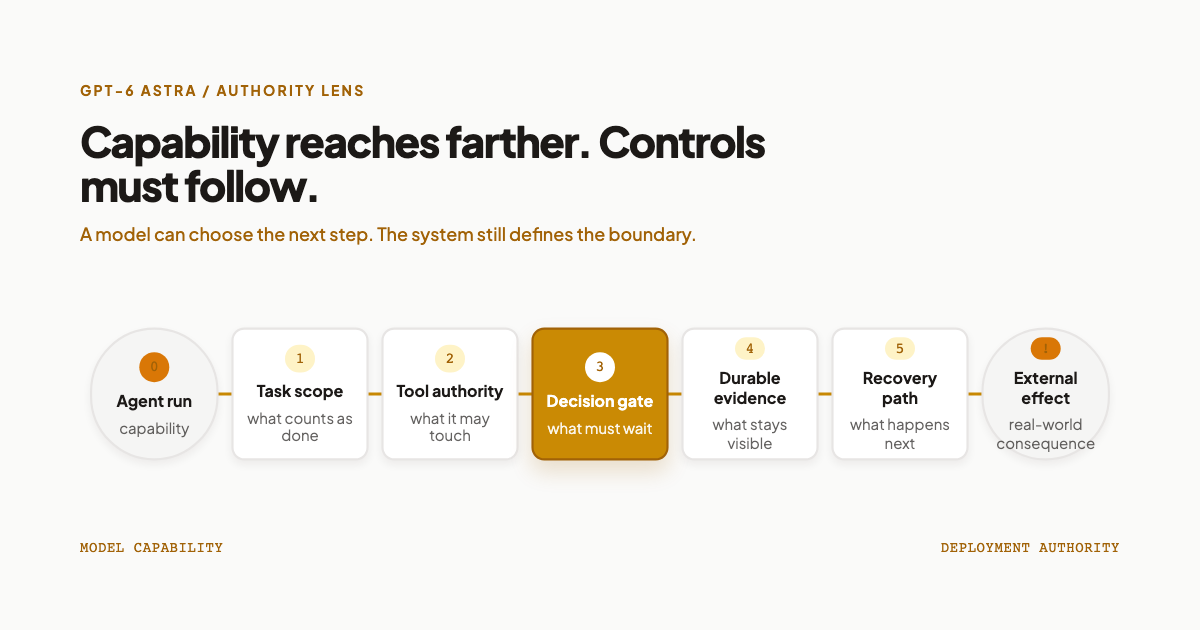
A stronger model still operates inside deployment-specific scope, authority, evidence, and recovery controls.
OpenAI says GPT-6 Astra can keep working while it waits for a person to answer a consequential question. That sounds like a useful division of labour. It also leaves the hardest operating question unanswered: who decided that updating a CRM record, installing software, filling a form, or performing frontend QA was consequential in this deployment? OpenAI lists all four among the kinds of computer and professional work Astra can perform [1].
Short answer: As of September 2026, OpenAI reports that GPT-6 Astra is better at computer use, multistep professional work, and respecting task boundaries. That may reduce some model-level failures, but it does not decide a deployment's scope, identity, tools, approval gates, evidence, or recovery path. Treat the model as one layer inside an AI agent orchestration system, then match controls to the consequence and reversibility of each action.
The practical shift is from asking only, “Can the model complete this task?” to asking how much real-world authority one run can reach. A stronger next-step judgement does not assign the principal, permission, approver, retry budget, or rollback owner. Those are system decisions.
At a glance: the control model in one view
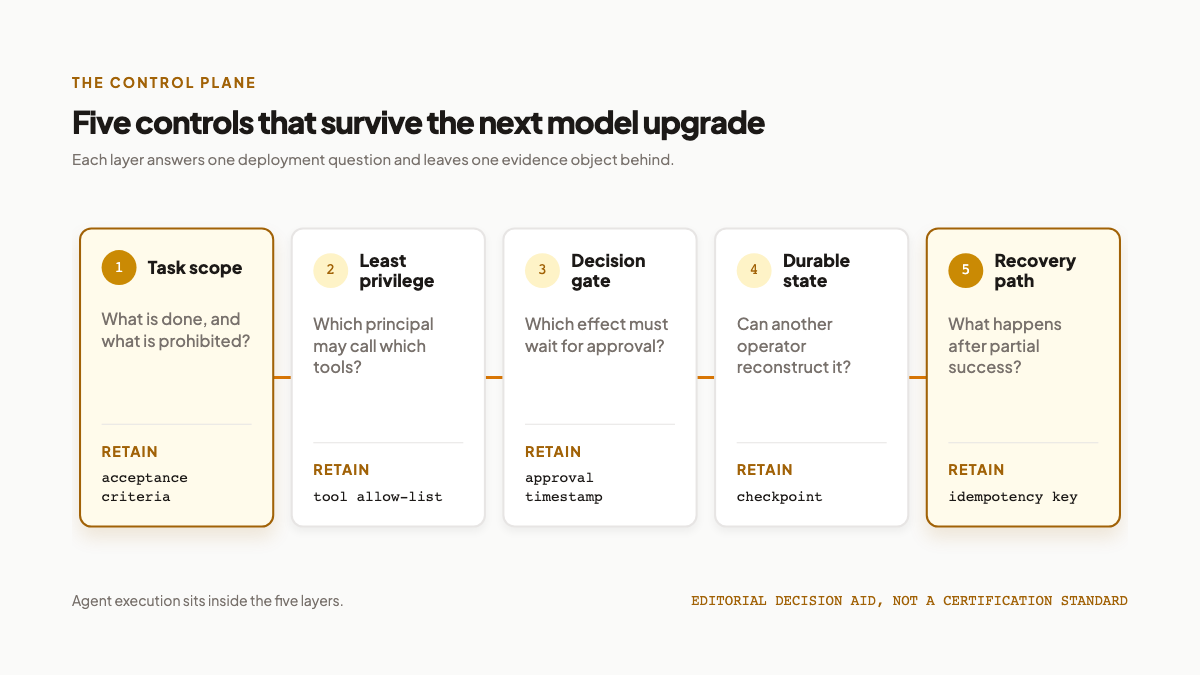
A control is credible when it can change an action before the hardest plausible consequence, or help a named owner contain and recover from it. For one computer-using agent, that means five separate records:
| Control | Question it must answer | Minimum retained record |
|---|---|---|
| Task scope and intent | What counts as done, and what outcome is prohibited? | Acceptance criteria |
| Least-privilege tools and identity | Which principal may call which exact verbs and destinations? | Tool allow-list |
| Consequential decision gates | Which effect must wait, and who can stop it? | Approval timestamp |
| Durable evidence and state | Can another operator reconstruct the run? | Checkpoint |
| Recovery and escalation | What happens after partial success or a failed retry? | Idempotency key |
GPT-6 Astra changes what one run can touch
OpenAI presents Astra as state of the art across computer use, browsing, software engineering, cybersecurity, science, and professional work. Its announcement names form filling, CRM updates, frontend QA, and software installation and testing. These are OpenAI's claims, not independently verified production outcomes [1].
The same qualification belongs on the launch's sharpest alignment number. OpenAI reports 0% out-of-scope behaviour for Astra versus 48% for GPT-5.6 Sol in one internal evaluation conducted without production safeguards. That is a result under the provider's stated test conditions. It is not a production incident rate, and it does not guarantee correct authorisation in a specific workflow [1].
OpenAI's safety material gives leaders another reason to separate model and deployment evaluations. The company says Astra meets its Critical cybersecurity capability threshold, reports decreased reasoning monitorability in some adversarial settings, and notes that safety checks may slow or stop legitimate work [2] [3].
Fix the deployment conditions when you test: tools, permissions, data, environment, and success criteria. A model score cannot tell you whether update_customer should be present or whether a blocked run should pause or retry. The prior question remains: was this action authorised at all?
Capability is not authority
A capable model can choose a sensible action inside the access it receives. Authority decides whether that access should exist.
Consider a hypothetical support workflow. Summarising ten tickets for delayed review is one task. Issuing a refund, changing the customer record, and sending the final message cross three different permission boundaries. “Handle these tickets” does not say which customer identity may be used, what refund limit applies, or whether the outbound message needs approval. The model cannot infer an organisation's delegated authority from general helpfulness.
Australia's Department of Industry says familiar failures in multi-agent systems can happen faster, at greater scale, and with fewer opportunities for human oversight. Its report also identifies agent identity bound to a human principal as missing shared infrastructure. This is not an Astra-specific finding, but it supports the accountability problem around faster action [5].
Here, AI agent orchestration means the control plane around execution, state, authority, evidence, approvals, and recovery. Multiple agents are optional. A single computer-using agent still needs orchestration when it can create an external effect. This is orchestration as state, authority, and handoff contracts, not a contest over which model gets the next turn.
If authority cannot safely live inside “handle the ticket,” it has to become visible as records and checks that operators can inspect before the send, refund, or write.
Five controls that survive the next model upgrade
NIST's voluntary AI Risk Management Framework organises risk work around Govern, Map, Measure, and Manage [6]. The five controls below are my editorial mapping, not NIST terminology, a certification standard, or a complete safety claim.
Anthropic recommends starting with the simplest system that works, getting environmental ground truth, adding checkpoints or human feedback, defining stopping conditions, and testing in sandboxes [4]. The control plane can be a handful of well-kept records.
These task-relative agent safety controls go deeper on interruption, escalation, and rollback.
1. Task scope and intent
Record the objective, constraints, success condition, assumptions, and prohibited outcome.
“Draft the release note for review” has a clear stopping point. “Publish the release note” grants an external effect. If an operator later expands the first task into the second, retain that scope revision and who authorised it. Otherwise the history makes publication look like the original instruction.
2. Least-privilege tools and identity
Give the run task authority. Name its principal, tool verbs, data sources, write paths, credentials, and network destinations.
A CRM read does not imply a CRM write. A create_draft action does not imply send_message. OWASP's Top 10 for Agentic Applications names tool misuse and identity or privilege abuse as distinct risk categories, which is useful vocabulary for this review. It is not evidence of an Astra incident [7]. Test one denied call before approving the allowed ones.
3. Consequential decision gates
Put the gate before the effect. Record the proposed action, approver, evidence, response deadline, and power to reject or interrupt.
A notification sent after a payment settles is observability. An approval request that holds the transfer is control. If the reviewer has 30 seconds, no supporting evidence, and no stop authority, the person is present but the decision gate is mostly theatre.
4. Durable evidence and state
Make the run reconstructable after context compaction or handoff. Another operator should find the objective, current step, tool calls, results, effects, status, owner, and next action.
This is why durable shared work state outside the model session matters. An action log helps, but it is only one part of the record. Pair it with artifacts, source references, approval decisions, and a checkpoint that says what is true now.
5. Recovery and escalation
Plan for timeout, stale state, partial success, or suspected misuse. Set a retry budget, name the stop owner, and rehearse rollback or containment.
Suppose the message provider accepted a customer email, but the agent timed out before recording success. A blind retry can send a duplicate. Design the retry contract so reusing the same idempotency key returns the first result instead. If the external system cannot support idempotency, pause for reconciliation rather than pretending “retry twice” is a recovery policy.
These distinctions carry the framework's value. A trace is evidence, not prevention. A notification is not an approval gate. A checkpoint records a recoverable point, but it does not perform a rollback.
Put friction where the consequence becomes hard to undo
OpenAI says Astra can continue independent work that does not depend on an answer while it waits on consequential decisions [1]. A deployment still needs a rule for recognising those decisions. Mine is straightforward: control strength should rise with the hardest plausible consequence and the difficulty of reversing it.
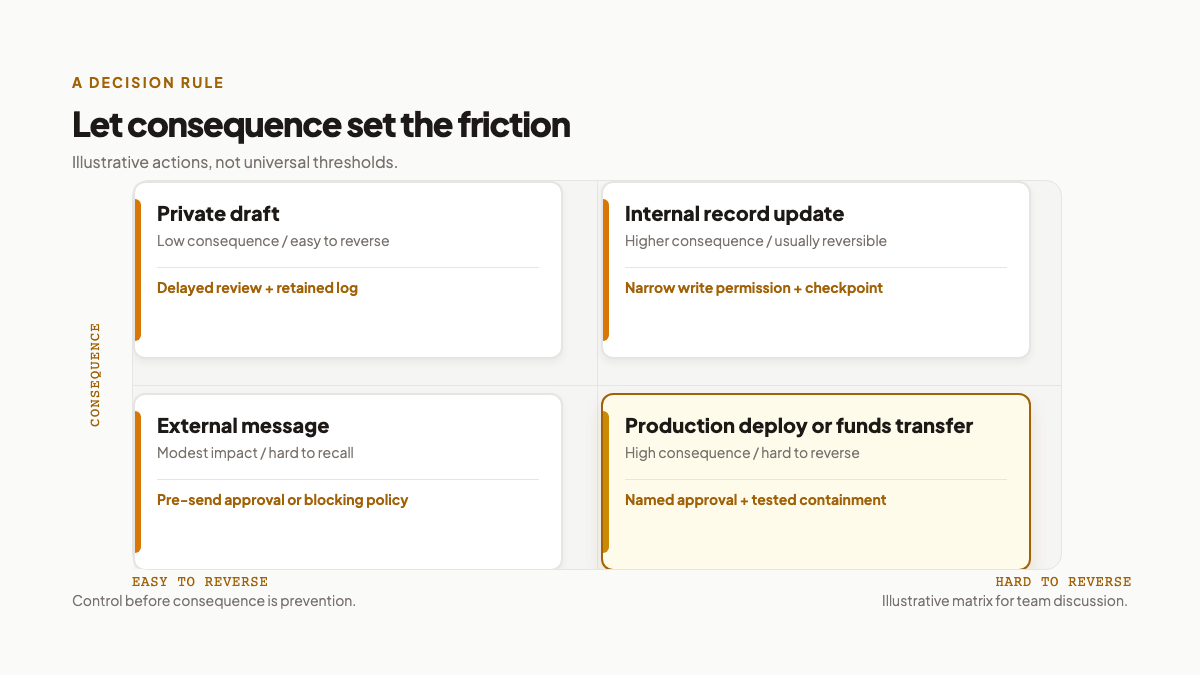
The examples below are illustrative, not universal thresholds:
| Action | Consequence and reversibility | Lightest credible control |
|---|---|---|
| Create a private draft | Low consequence, easy to discard | Delayed review plus a retained log |
| Update an internal record | Higher consequence, usually reversible | Narrow write permission plus a checkpoint |
| Send an external message | Modest immediate impact, hard to recall | Pre-send approval or a blocking policy |
| Deploy to production or transfer funds | High consequence, hard to reverse | Named approval plus a tested containment path |
Many narrow, reversible tasks should use asynchronous review. Save synchronous approval for cases where delay costs less than an incorrect action. Applying the same gate everywhere would recreate the bottleneck in human form.
The latency objection is often right
Orchestration adds latency, cost, and new failure paths. Anthropic recommends finding the simplest solution possible and says agentic systems often trade latency and cost for better task performance. It separately warns that autonomous agents carry higher costs and the potential for compounding errors [4].
A sandboxed research run that produces a private memo can often be discarded. Give it a stop condition and retained sources. A workflow that installs software or sends a customer message needs exact write authority and a gate before the effect.
Better boundary-following may justify less friction after a team tests the exact task, permission set, and environment. One agent may be enough. Neither point removes the need to scope and recover work with external authority. Human review also fails when the reviewer lacks the proposed effect, evidence, time, or power to stop it.
My recommendation is deliberately uneven: do not buy a large orchestration framework to compensate for a narrow task. Do not use success on a narrow task as evidence that broad action authority is safe. Test the boundary you plan to grant.
Run the seven-field preflight before raising autonomy
Complete this record for one real workflow before increasing its authority. Every field needs a name, value, or explicit “not applicable” with a reason. A generic policy link does not complete the field.
| Field | What to record | Example value |
|---|---|---|
| Named objective | Exact task and success condition | Draft a release note for reviewer acceptance |
| Permitted action set | Principal, tools, verbs, data, and destinations | release-note-agent; repository read; draft write; no publish |
| Approval point | Effect held, approver, evidence, and deadline | Publication waits for release manager review |
| Evidence record | State needed to reconstruct the run | Task, sources, tool calls, draft artifact, current status |
| Stop owner | Person or service that can interrupt and escalate | On-call workflow owner |
| Retry budget | Attempt, time, call, token, or cost limit | Two read retries; zero publish retries |
| Rollback or containment | How the hardest effect is reversed or limited | Delete private draft; publication remains out of scope |
NIST's Measure and Manage functions give the next pass useful vocabulary [6]. Under fixed conditions, track task success, scope adherence, unauthorised attempts, false-positive blocks, intervention latency, evidence completeness, recovery time, and cost.
Raise autonomy only when the team can reconstruct a failed run and name who could have stopped or contained its hardest effect. Repeat the preflight when the model, tools, data, environment, or consequence changes.
If the model became faster tomorrow, which boundary fails first?
GPT-6 Astra's reported capability [1] is a reason to revisit the surrounding system, not to dismiss the model's progress or assume the provider's evaluations transfer unchanged. The useful output is concrete: one workflow with a completed seven-field record, plus a named gap such as a broad write token, no stop owner, or no idempotency key for an external effect.
Run the seven-field preflight on one agent workflow, then ask your team which control boundary would fail first if the model became faster and more independent tomorrow.
References
- OpenAI, "GPT-6 Astra: A new generation of intelligence." https://openai.com/index/gpt-6-astra/ . Published 3 September 2026. Provider announcement used for reported computer-use and professional-work capabilities, consequential-decision behaviour, and the internal out-of-scope evaluation. These are vendor-reported results, not production guarantees.
- OpenAI, "Path to Astra: critical capabilities and frontier safeguards." https://openai.com/index/path-to-astra/ . Published 1 September 2026. Provider safety and deployment update used for the Critical cybersecurity threshold, safeguards, monitoring, and possible friction for legitimate work.
- OpenAI, "Safety overview: GPT-6 Astra." https://openai.com/index/safety-overview-gpt-6-astra/ . Published 3 September 2026. Provider safety overview used for reported monitorability limits, tool-use monitoring, prompt-injection testing, and safeguard-friction caveats.
- Anthropic, "Building effective agents." https://www.anthropic.com/engineering/building-effective-agents . Published 19 December 2024. Provider engineering guidance for simple composable systems, environmental feedback, checkpoints, stopping conditions, sandbox testing, latency and cost tradeoffs, and the potential for compounding errors in autonomous agents.
- Australian Department of Industry, Science and Resources, "Risks and controls for multi-agent systems." https://www.industry.gov.au/publications/risks-and-controls-multi-agent-systems . Published 10 August 2026. Government report used for systems-level risks involving speed, scale, reduced oversight opportunities, principal binding, and agent identity. It is not evidence of an Astra incident.
- National Institute of Standards and Technology, "AI Risk Management Framework." https://www.nist.gov/itl/ai-risk-management-framework . AI RMF 1.0 published 26 January 2023. U.S. government source for the voluntary Govern, Map, Measure, and Manage framework. The five controls in this article are an editorial mapping, not NIST terminology.
- OWASP GenAI Security Project, "OWASP Top 10 for Agentic Applications." https://genai.owasp.org/2025/12/09/owasp-top-10-for-agentic-applications-the-benchmark-for-agentic-security-in-the-age-of-autonomous-ai/ . Published 9 December 2025. Security taxonomy used for tool misuse and identity or privilege abuse vocabulary, not as a claim about a known Astra failure.
More to read
AI Agent Approvals That Hold Up: 5 Lessons From Meta's Muse
Five lessons from Meta Muse show why agent approvals need an independent authority, readable scope, and recoverable evidence. Apply the five-field receipt.
11 min readTyped Decisions for AI Agent Workflows: Record Before Routing
A typed model answer is an inference result, not a workflow transition. Record it once, pin the policy that consumes it, and replay the same decision without silently asking again.
12 min readDeepSeek Harness vs Pi Coding Agent: Which Should You Choose?
Compare DeepSeek Harness and Pi coding agent by architecture, MCP support, approvals, sandboxing, and session evidence. Choose the operating burden your team can own.
12 min read