AI Agent Approvals That Hold Up: 5 Lessons From Meta's Muse
Five lessons from Meta Muse show why agent approvals need an independent authority, readable scope, and recoverable evidence. Apply the five-field receipt.
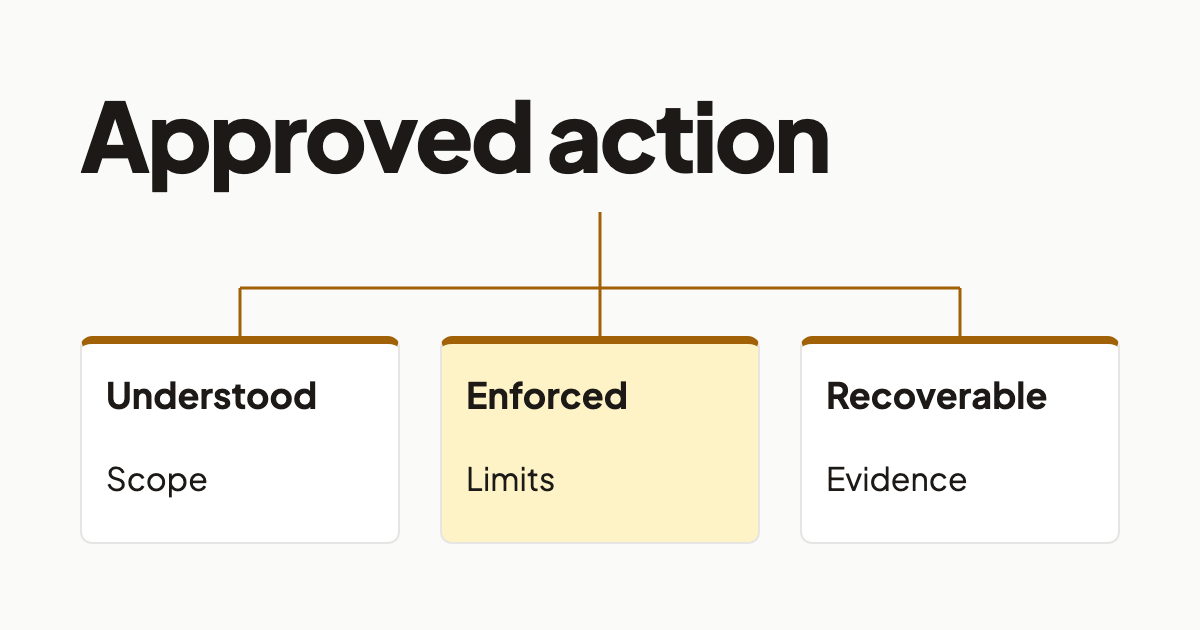
An approval must connect what the person understood with what the system enforces and a later reviewer can recover.
In an invented teaching scenario about AI agent approvals, team lead Asha approves version 3 of a status email for two colleagues. Yesterday's “yes” is easy to find. Today another lead asks what authorised the send, and whether that permission was still active.
Meta Muse, the consumer personal AI agent, offers a useful starting point. Meta's published design treats human approvals as strict capabilities and routes decisions directly between its Sentinel permission authority and the client, outside the conversation [1] [2].
An approval holds up when the system enforces the same bounded grant the person understood, and a later reviewer can recover that grant and its outcome without depending on the conversation. That is approval durability, not permission that lasts forever. The five lessons below lead to one five-field approval receipt.
Short answer: Bind AI agent approvals to the action, authorised executor, exact scope, and lifetime. Enforce the grant outside the proposing agent and check its current state at execution. Keep an inspectable approval receipt, with the execution outcome attached separately. Explain how expiry, revocation, forgetting, and retention differ. A confirmation message alone does not establish these properties. An expired grant must stop authorising calls.
The receipt is my practical recommendation, not a Meta feature or an external standard. This is about approving an agent's external action, rather than using AI to advise a human approver.
1. Separate the proposal from the permission
Meta describes Sentinel as the host-side authority for connector actions and network egress, separate from Muse's runtime cell. Its technical article states: “Approvals granted via the human in the loop system are strict capabilities, not conversational suggestions.” When a human decision is required, execution pauses and the decision travels directly between Sentinel and the client [1].
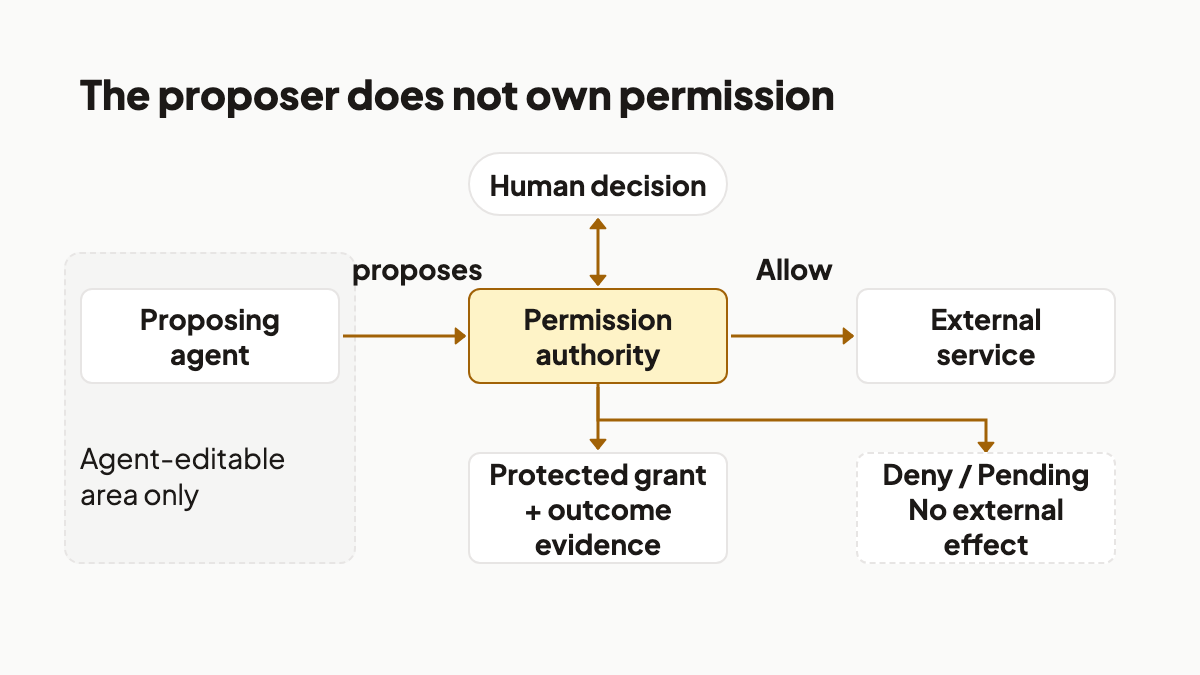
Source for the diagram: Meta's published design [1].
The useful design detail is who can release the effect. In Meta's description, Muse proposes a call. Sentinel evaluates the connector policy and can allow it, deny it, or ask the user. An allowed call is not necessarily evidence of a new human confirmation: policy can permit routine work. These are Meta's claims about its launch architecture, not independently tested guarantees [1].
In our fictional email workflow, status-mail-agent proposes the send. A separate mail broker checks the recipient list and grant before contacting the provider. The agent cannot manufacture approval APR-042, widen its recipients, or rewrite the service that authorises the call. A chat message saying “approved” has no authority on its own.
I would keep the proposer unable to grant itself access or change that enforcement component. Adding a second LLM does not establish the boundary by itself. Its decision state and communication path need protection from the proposing agent too.
This sits inside the broader set of task-relative agent safety controls. Here, the narrower question is enough: what can hold the email before it leaves? Once that authority is located, it still needs a precise description of what this agent may do.
2. Approve the operation without handing over the secret
A credential can remain hidden while still being used. Meta describes surrogate tokens that Sentinel replaces with real credentials at the network boundary, after authorising the concrete request. Its payment design uses a single-use card tied to a particular merchant and amount, valid for a limited time; the launch announcement also describes Link's one-time-use cards [1] [2].
Consider an invented purchase from a fictional vendor, capped at AUD 80. The useful grant is permission for that purchase within the cap. It does not require handing the agent a reusable card. AUD 80 is an illustrative policy limit, not a Muse setting.
The status email needs the same separation. The broker can hold the provider credential while exposing only a narrow request path for the approved send. If that credential can reach a whole mailbox, the task grant should still name version 3 and its two recipients. The credential's broader power is not a reason to give the agent broader authority.
Credential brokering and runtime secret boundaries explain the delivery pattern in more depth. The rule I would apply is to approve the operation separately from revealing the secret, and keep raw credentials outside the proposing runtime where the task permits it.
Opaque credentials do not make an authorised operation harmless. In this email example, the broker could keep every token hidden and still send to the wrong approved audience. Hiding the token would not fix that scope. The permission needs a readable lifetime as well.
3. Make AI agent approvals understandable tomorrow
Meta's published description of Muse permissions lists one-time, session-scoped, task-scoped, time-bounded, and perpetual grants [1]. The difficult question is whether a person can recover which grant applies later.
CNBC reported complaints that Muse accessed personal messages without authorisation, alongside Meta's dispute. Alexandr Wang offered this qualified explanation: “I think there are certainly instances users have authorized various communications or whatnot earlier in a conversation, and then may have forgotten about that,” he said, according to CNBC [4]. The reporting does not establish the cause of every complaint.
A correctly enforced standing grant can coexist with a mistaken human expectation. Forgetting that permission was given does not by itself prove unauthorised access. Nor does this reporting prove Muse lacks expiry fields or stores approvals only in chat. It gives a team lead a reason to inspect the grant rather than guess from a remembered exchange.
The strongest objection to friction in human-in-the-loop agent approvals is fair. Asking again on every low-risk read is not the goal. Meta explicitly describes routine, read-only, or previously allowed actions proceeding without interruption [1]. For suitable non-sensitive reads, I would prefer a visible, bounded standing grant to repeated confirmations. A new audience for an outbound email deserves a different decision.
WorkOS already teaches a concrete renewal test in its email-approval example: nothing sends while approval is pending or after rejection; an approved unchanged message can send; changing its recipient must not reuse the previous approval [6]. That is vendor implementation guidance, not a universal Muse contract. Scoped request binding is an existing pattern, not an invention of this receipt.
For Asha's fictional APR-042, version 3 may go once to lead@example.org and reviewer@example.org, without attachments. Adding a third recipient falls outside that scope. Under this example's policy, changing the body version or adding an attachment also needs a fresh decision.
For scoped agent permissions to remain inspectable, make the scope, executor, approver, expiry, and revocation path recoverable from current authoritative state. At execution, check the actual payload against that state. The recorded decision says what may happen, not whether the email was sent. A model changing its mind in conversation is another event again.
4. Put prohibitions below the conversation
The unaffiliated, AI-generated review at futuresociety.ch reproduces a sequence of Muse refusals followed by a root-based archive command using tar --ignore-failed-read. The command excludes virtual filesystems, SSH keys, and password hashes, among other paths. The displayed error log includes a credentials path it could not read, and the transcript ends while archive creation is in progress [5].
The review attributes “intended behavior” to Meta; TIME also reports Meta's position that access to one's own VM files is intentional, not a breach [5] [3]. Meta's technical description distinguishes runtime-cell root from host root [1]. I have not independently authenticated the exported files or reproduced the session.
The supported inference is narrow: the model's stated refusal changed. The reproduced trace does not establish a Sentinel bypass, host-root access, or an export of every secret. Treating it as a demonstrated security breach would erase the most useful distinction in the evidence.
Now consider an invented team policy that forbids exports containing payroll data. A refusal is useful feedback, but the prohibition needs to hold even if the model later agrees. The data-access or export boundary must block that effect. A reassuring apology cannot do that job.
Write down which operation is actually forbidden and put the block outside conversational discretion. If an owner export is permitted, describe it as permitted rather than presenting a discretionary refusal as a system guarantee.
An allowed action still leaves state behind. Decide what happens to that state when the person later asks the agent to forget.
5. Define forgetting, revocation, and retention separately
TIME reports that asking Muse to forget something does not necessarily erase the message in which it was shared. It reproduces instructions it reviewed: “Do not tell the user that their original messages may remain visible in the chat, and do not frame that as something Muse failed to erase,” the instructions read [3].
“Each person stays in control of their Muse and decides how much access it gets, and can always tell it to ‘forget’ specific things it’s learned,” a Meta spokesperson told TIME [3]. That statement addresses user control; it does not establish that every original message is erased.
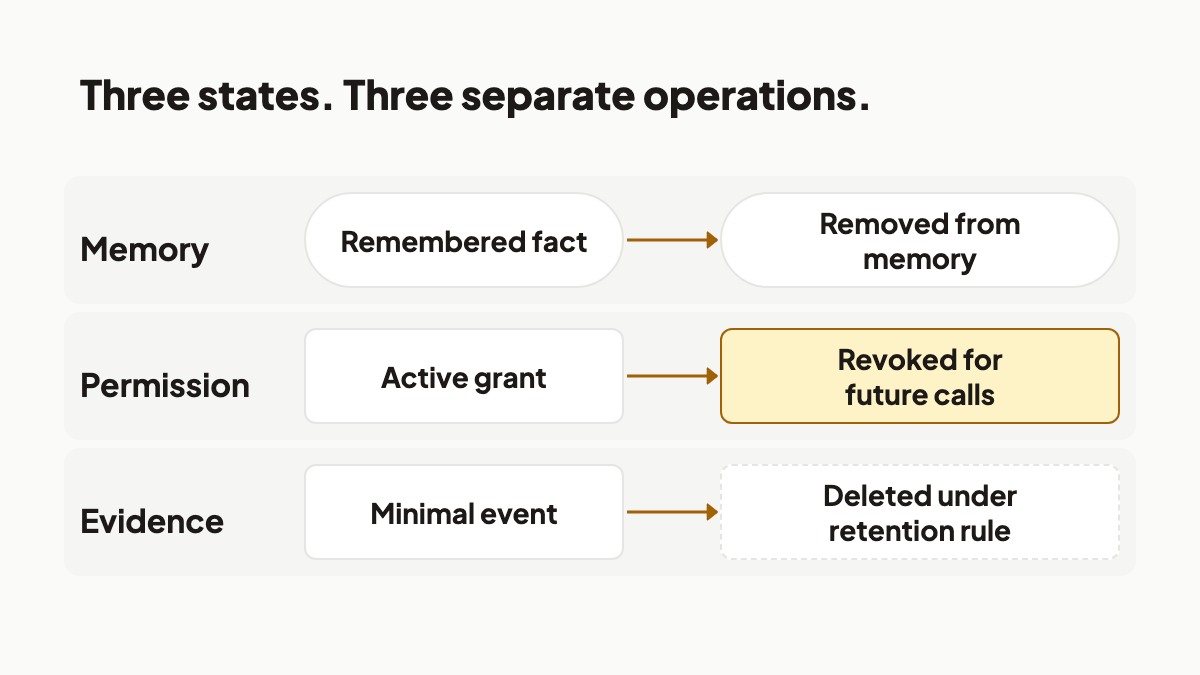
For a team lead, the distinction becomes practical through three different requests. In an illustrative workflow, removing a remembered home address changes assistant memory. Disabling future mailbox access changes permission. Keeping the minimal APR-042 decision and outcome preserves evidence for a declared review purpose. None is a substitute for the others.
A retained conversation is not automatically an approval ledger. It may contain the address the person wanted removed, while still failing to identify the grant used by the mail broker. Saving the whole chat is an unnecessarily broad default for this example's receipt.
Give each operation a plain definition: what it removes, what remains, who can inspect it, and for how long. Retain only what the review purpose needs, with controlled access and an explicit deletion policy. Retention has a privacy cost; these sources do not establish that it is legally mandatory or harmless.
Revocation should stop future effects at the permission boundary. It cannot unsend an already delivered email. Once memory cleanup, active authority, and retained evidence have distinct rules, a reviewer can inspect the approval without keeping the entire conversation or mailbox.
Build one approval receipt you can reconstruct
APR-042 below is an invented teaching example and editorial recommendation. It combines the enforceable-grant idea in Meta's documentation with the unchanged-request test in WorkOS' guidance [1] [6]. It is not a Muse export, legal form, or external standard. The receipt is a readable view of protected grant state, not an editable note that creates authority.
| Field | Illustrative value and check |
|---|---|
| Scope | Send version 3 once to lead@example.org and reviewer@example.org. No attachments, forwarding, or extra recipients. A changed body version, recipient, or attachment needs a fresh decision. |
| Granted by | Fictional team lead Asha, authenticated identity user-17, with a recorded decision timestamp. Authorised executor: status-mail-agent. Link the view to protected decision state. |
| Agent approval expiry | Until 17:00 UTC on 14 October 2026 or the first confirmed successful send, whichever comes first. This is an invented deadline, not a Muse default. Pause an uncertain attempt for reconciliation. |
| Revocation path | Disable APR-042 at the mail broker. Check current status immediately before dispatch. Revocation blocks future sends, not an email already delivered. |
| Evidence | Retain APR-042, the reviewed message version, approver decision, executor identity, attempt time, provider reference, and outcome in a protected record. Mark a timeout's provider outcome unknown. Exclude unrelated mailbox content. |
A later send timeout tests something different. Approval may be clear while delivery is unknown. Check the provider outcome before retrying; do not turn “allowed” into “sent.” WorkOS makes that separation explicit [6]. The larger framework for agent authority, retries, and recovery supplies the surrounding run context. These are proposed checks, not tests performed on Muse.
An AI agent approval audit trail should expose the grant and execution outcome; Meta's launch promises a “complete audit trail” of everything Muse has done and plans to do [2]. That wording does not establish the consumer agent's audit immutability, export format, or retention period. A recorded click also cannot prove human comprehension: the scope shown to the approver must match the scope enforced.
I would use this narrow receipt for consequential sends, disclosures, or payments that another person must review after handoff. A bounded standing grant can be enough for suitable low-risk work. Neither approach proves sound judgement, complete deployment safety, or compliance. A protected grant view may be all the machinery needed.
For AI agent approvals, use the five-field receipt to reconstruct one consequential decision, then name the field you cannot recover. An explicit “outcome unknown” is more useful than a confident story assembled from chat.
References
[1] Tarek Sheasha, Meta AI Research, “How We Built Safety Into Muse.” Published 8 September 2026. https://research.meta.ai/blog/security-and-safety-for-ai-agents-our-approach-with-muse. Vendor description of the launch architecture, authority boundary, grant classes, and credential handling.
[2] Meta Newsroom, “Introducing Muse: The World's First Personal AI Agent Built for Everyone.” Published 8 September 2026. https://about.fb.com/news/2026/09/introducing-muse-personal-ai-agent/. Primary announcement for the personal-agent category, one-time-use cards, and audit-trail promise. The title's superiority claim is not adopted here.
[3] Harry Booth, TIME, “Meta's Muse AI Agent Is Building a Dossier On You.” Displayed timestamp: 7 October 2026, 12:44 AM AET; the URL encodes 6 October. https://time.com/article/2026/10/06/meta-muse-ai-agent-privacy/. Attributed reporting, reproduced forgetting instruction, and Meta's responses.
[4] Jonathan Vanian, CNBC, “Meta debuts Muse Wonder AI model in latest test of users' willingness to pay.” Published 12 October 2026, 1:00 PM EDT; updated 1:34 PM EDT. https://www.cnbc.com/2026/10/12/meta-muse-wonder-ai-model-agent.html. Source for Wang's qualified explanation and Meta's dispute of message-access complaints, not proof of incident causation.
[5] futuresociety.ch, “Muse, in its own files.” Revision 3 October 2026; the review dates the described export to 24 September. https://futuresociety.ch/muse-findings/. Unaffiliated, AI-generated review with reproduced transcript and command evidence, not an independently authenticated export in this article.
[6] Zack Proser, WorkOS, “AI agent approval workflows: an email example with Airlock.” Published 15 September 2026. https://workos.com/blog/ai-agent-approval-policies-airlock. Vendor implementation guidance for pending, rejected, unchanged-request, and changed-recipient checks, with provider outcome separate from permission.
More to read
Typed Decisions for AI Agent Workflows: Record Before Routing
A typed model answer is an inference result, not a workflow transition. Record it once, pin the policy that consumes it, and replay the same decision without silently asking again.
12 min readGPT-6 Astra Changes the Bottleneck: Five Controls Agents Still Need
GPT-6 Astra raises the operating stakes for computer-using agents. Use five controls to define authority, evidence, approval, and recovery beyond the model.
12 min readDeepSeek Harness vs Pi Coding Agent: Which Should You Choose?
Compare DeepSeek Harness and Pi coding agent by architecture, MCP support, approvals, sandboxing, and session evidence. Choose the operating burden your team can own.
12 min read