Junior Developers and AI: Build the Discipline Agents Cannot Fake
Junior developer hiring is tighter, but AI has not erased the career path. It has moved the on-ramp toward specs, review, tests, permissions, and durable workflow state.

The useful career question is not whether AI can write code. It is whether the developer can prove the code should ship.
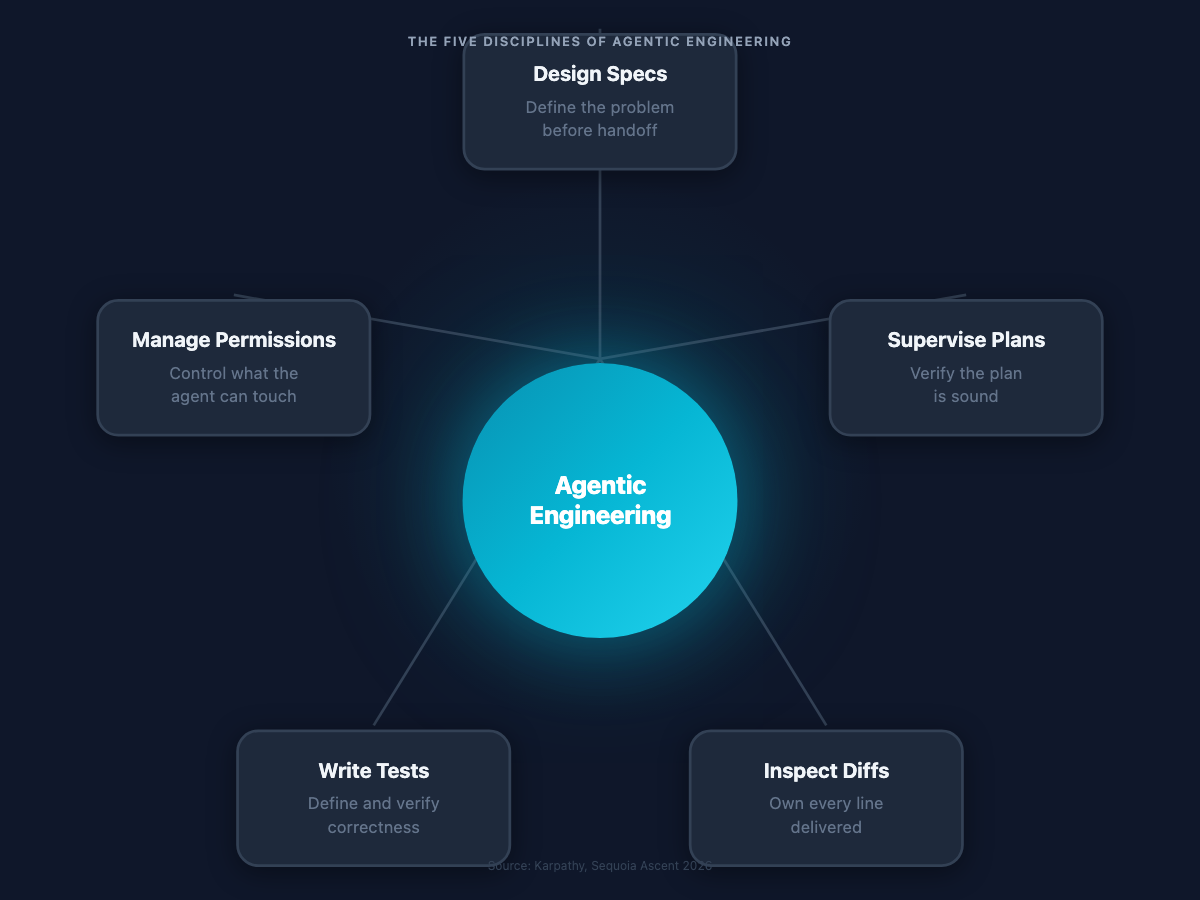
Short answer: junior developers and AI are not a replacement story. AI is compressing routine junior implementation work, which makes the old on-ramp narrower and shifts the career path toward agentic engineering: specifying work, supervising AI plans, inspecting diffs, designing tests, limiting permissions, and preserving workflow state so the human still owns correctness.
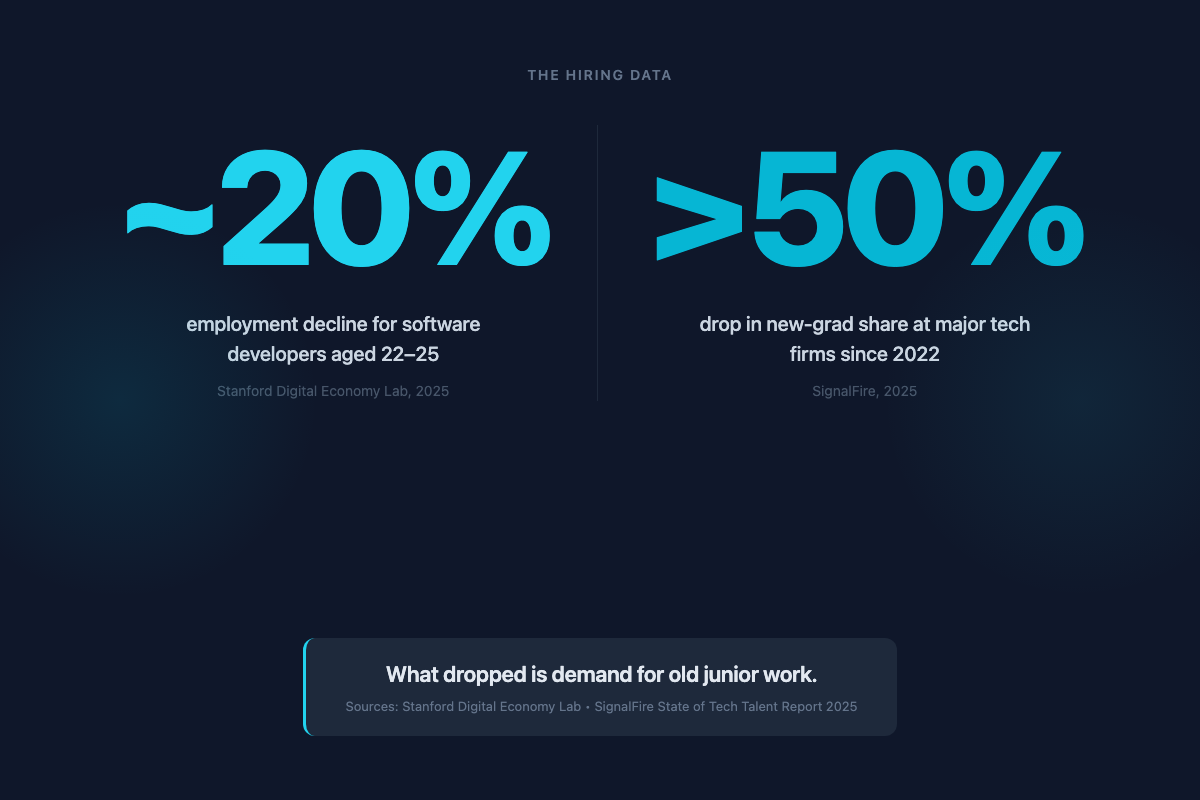
As of July 2026, the hiring pain is real. Stanford's Digital Economy Lab found that workers aged 22 to 25 in the most AI-exposed occupations saw a 16% relative employment decline after controls [1]. SignalFire's 2026 talent report says new-grad and entry-level hiring fell roughly 65% at Tech Majors and about 76% at early-stage startups compared with 2019 [3].
That evidence supports a hard claim, but not the lazy one. It supports "the old junior work is under pressure." It does not support "there is no junior career path." Stanford's follow-up cautions against treating AI as the only determinant of young-worker employment changes [2]. Ramp and Revelio found that high-intensity AI adopters grew headcount, including entry-level headcount, though those adopters were already larger, more technical, more venture-backed, and faster-growing than other firms [4] [5].
The real shift is more specific. AI compressed the work that used to give juniors their first flight hours. The next path has to create those hours deliberately.
Are Junior Developers Being Replaced by AI?
The junior developer job market is tighter than it was a few years ago. New grads do not need another article telling them to "just build projects" while pretending the market is normal. The market changed.
What changed is still worth naming precisely.
Stanford's strongest finding is concentrated pressure on young workers in AI-exposed occupations where AI automates tasks rather than augments the worker [1]. SignalFire's report makes a different kind of claim from company hiring data: entry-level hiring has fallen sharply at large technology companies and early-stage startups, while engineering has held up better than functions such as design, product, and marketing [3]. Treat SignalFire as a talent-market report, not a universal labor-market measurement.
The counter-evidence matters because it prevents a bad conclusion. Ramp and Revelio linked AI spend data with workforce records for 21,559 US firms and found that high-intensity AI adopters grew headcount roughly 10%, with entry-level headcount up 12% [4]. Revelio also notes that those firms were not average firms. They were already more technical, more likely to be venture-backed, and faster-growing [5].
So the honest read is narrow but useful: AI is not a single labor-market lever that simply deletes juniors. It is one force compressing the routine implementation work that used to justify many first jobs. Interest rates, hiring cycles, company size, venture funding, and role mix still matter. The career advice should start from that messier reality.
What AI Compressed In Junior Work
AI did not compress every part of junior engineering. It compressed the parts that are easiest to describe, generate, and check superficially.
That includes boilerplate, standard CRUD wiring, common endpoint patterns, first-pass ticket translation, simple UI state updates, and code that follows a familiar recipe. This is a practical inference from the labor-market evidence and from how AI coding agents are used, not a directly measured list from one study.
The problem is that those tasks were never only output. They were practice. A junior writing the third boring endpoint was also learning where validation belongs, how errors move through the stack, what the codebase considers normal, and which "simple" changes break tests somewhere else. The task looked small from the outside. Inside the developer's head, it was building a map.
When AI writes the first pass, the practice does not vanish by itself. It moves. The junior now has to practice the parts that happen around the generated code:
- Can I state the expected behavior before the agent starts?
- Can I tell whether the plan is scoped correctly?
- Can I read the diff and explain why it is right?
- Can I design a test that would fail if the agent cheated?
- Can I limit what the agent is allowed to touch?
- Can I leave enough state that the next human or assistant can continue without guessing?
That is the new on-ramp. It is less forgiving because it asks for judgment earlier. It is also trainable.
Agentic Engineering For Junior Developers
Agentic engineering is the discipline of coordinating fallible AI agents while preserving correctness, security, maintainability, and taste. Andrej Karpathy's Sequoia Ascent 2026 summary uses the category language of programmers becoming orchestrators of agents and distinguishes vibe coding from agentic engineering. Because the page says the summary and cleaned-up transcript were AI-generated and then read by Karpathy, the safer use is as category framing, not as a verbatim transcript [6].
For a junior developer, the useful definition is simpler:
Agentic engineering is using AI coding agents without giving up responsibility for the work.
That responsibility is where the career value lives. Stack Overflow's 2025 Developer Survey found that 84% of respondents used or planned to use AI tools, and 51% of professional developers used them daily. At the same time, 46% actively distrusted AI output accuracy versus 33% who trusted it [7]. High adoption plus low trust creates an obvious job: someone has to verify the work.
The agent can generate code faster than a junior can safely trust it. That is not an insult to the junior. It is the whole point. The developer who can slow the workflow down at the right moments becomes more valuable, not less.
The Practice Loop: Spec, Plan, Diff, Test, Permission, State
The loop is concrete enough to practice on one ticket this week.
Start with the spec. Before asking an AI coding agent to implement, write the behavior in plain language. Include the non-goals. Include the acceptance criteria. Include the command or test that will count as proof. If the spec is vague, the generated code may still look confident. It will just be confidently aimed at the wrong target. For the broader tool ecosystem around specs and memory, see Spec-Driven Development Tools: Where AI Project Memory Lives.
Inspect the plan before execution. Ask the agent what it will change and why. A weak plan often exposes the failure before the diff exists: wrong file boundary, missing test, vague data migration, or a permission request that is too broad. In multi-agent work, this is where role separation and handoff contracts matter. Multi-Agent Orchestration with Claude and Codex goes deeper on that layer.
Read the diff at the level of behavior. Do not ask only whether the patch is neat. Ask what user behavior changed, what data invariant moved, which error case is now possible, and what the agent did outside the requested scope. Addy Osmani's proof-focused framing is useful here: AI may write code faster, but the human still has to prove it works through evidence, tests, review, risk assessment, intent, and accountability [10].
Design the test that would catch a shortcut. The easiest generated test often asserts the happy path the implementation already satisfies. That is not enough. A good junior habit is to write the test that would fail if the agent misunderstood the edge case. Tests are not ceremony in AI-assisted work. They are the cheapest way to make the agent's claim falsifiable.
Limit permissions and scope. A junior developer should not learn agentic work by giving a tool the whole repo and hoping the summary is honest. Scope the task. Name the files or modules. Block unrelated refactors. Keep secrets out of prompts. The smaller the permission surface, the easier the diff is to review and the easier the failure is to contain.
Preserve state outside the chat. The agent's chat transcript is not a durable work record. Store the objective, acceptance criteria, status, artifacts, reviewer notes, and blockers somewhere the next session can read. This is where agentic engineering becomes a workflow discipline rather than a prompt trick.
AI Can Help Juniors Learn, Or Help Them Avoid Learning
The highest-risk version of AI-assisted junior work is not bad code. Bad code can be reviewed. The deeper risk is false fluency, the feeling that a developer understands a system because they can produce a working-looking patch.
Anthropic's coding-skills study is a useful warning. In an RCT with 52 mostly junior software engineers, the AI-assisted group scored 17% lower on a post-task quiz, with the largest gap on debugging questions. The same research found better outcomes when participants used AI in comprehension-focused ways rather than delegation-focused ways [8].
That does not mean juniors should avoid AI. It means they should use it in ways that force understanding.
Here is the difference:
| Delegation-focused use | Comprehension-focused use |
|---|---|
| "Implement this and tell me when done." | "Explain the plan, name the risky files, then wait." |
| "Write tests for your change." | "List the failure cases, then I will choose tests." |
| "Summarize the diff." | "Ask me three questions that prove I understand the diff." |
| "Fix the error." | "Explain the error path before proposing a patch." |
The test is blunt: if you cannot explain why the generated diff is right, you are not supervising it yet.
Review Is The New Bottleneck
If AI changes the speed of code generation, the bottleneck moves to proof.
GitLab's 2026 AI Accountability Report, based on a Harris Poll survey of 1,528 developers and technology buyers, says 85% agreed AI shifted the bottleneck from writing code to reviewing and validating it. The same release says 82% reported that AI-generated code risks introducing new technical debt [9]. Treat that as vendor-sponsored survey evidence, but take the shape seriously. It matches the practical problem junior developers are facing: writing code is less scarce than proving code.
Stack Overflow's survey points to the same tension from another angle. Many developers use AI tools often, but more respondents distrust AI output accuracy than trust it [7]. That gap creates a review market inside the engineering workflow.
The productivity evidence is also less settled than the marketing copy suggests. METR's early-2025 study found that 16 experienced open-source developers took 19% longer when AI tools were allowed across 246 tasks, but METR now labels that result out of date [12]. Its 2026 update says measurement became harder as AI adoption widened, selection effects changed the sample, and early-2026 developers are probably more sped up than early-2025 estimates suggested [13].
That uncertainty strengthens the case for proof skills. If AI speed varies by task, codebase, developer, model, and workflow, the durable skill is not blind optimism or blanket rejection. It is knowing when the agent helped, when it hid work, and what evidence would settle the question.
Practitioner Objections, Answered Honestly
The first objection is the hardest one: "Companies no longer want to invest in juniors."
Some do not, at least not in the same way. The hiring data supports a narrower on-ramp. A junior developer should not plan around the fantasy that routine ticket work will return unchanged. The better plan is to show evidence of judgment earlier: scoped specs, reviewed diffs, test design, incident notes, and small projects where the acceptance criteria are visible.
The second objection is practical: "If AI can do the first-pass code, how do I get experience?"
You get experience by refusing to let the first pass be the work. Take one small feature and write the spec before the agent starts. Predict which files will change. Compare the agent's plan to your prediction. Review the diff without reading the summary first. Write one test that catches the most likely misunderstanding. Then write a short note explaining what changed and what still worries you. That is a practice rep.
The third objection is about tool shame: "Everyone says I am using AI wrong, but nobody explains the right loop."
The right loop is not a magic prompt. It is spec, plan, diff, test, permission, state. The words are boring because the job is boring in the best possible way. A trustworthy engineer makes the work checkable.
The fourth objection is fair: "If even experienced developers can be slowed down by AI, why should I use it?"
Because the question is not whether AI is always faster. It is whether you can learn to control when it is useful. METR's own update shows why blanket conclusions age quickly [13]. The junior advantage is that your habits are still being formed. Build the habit around proof now.
What This Looks Like In Agiflow
Agiflow's role in this workflow is narrow on purpose. It is not the agent. The external assistant remains the agent. Agiflow supplies the project board, scoped MCP tools, shared task state, artifacts, vault entries, workflow locks, and review gates the assistant can use after approval.
That distinction matters for junior developers because agentic engineering depends on durable state. A chat can hold a plan for a while. It cannot reliably be the source of truth for objective, scope, acceptance criteria, artifact references, status, blocker, and review gate across sessions.
In an Agiflow-style loop, the task record carries the contract:
| Field | Why it matters for AI-assisted junior work |
|---|---|
| Objective | Prevents the agent from optimizing for the wrong outcome. |
| Scope | Names what the assistant may and may not touch. |
| Acceptance criteria | Defines what "done" means before code exists. |
| Test notes | Turns correctness into something checkable. |
| Artifacts | Keeps logs, screenshots, generated files, and reports attached to the work. |
| Workflow lock | Reduces collision when more than one agent or person could modify the same area. |
| Review gate | Forces the human proof step before the work is treated as complete. |
FAQ
Are junior developers being replaced by AI?
No, not as a complete category. AI is compressing routine junior implementation work and narrowing the old on-ramp. The stronger career path is agentic engineering: specifying tasks, supervising plans, reviewing diffs, designing tests, constraining permissions, and preserving state. The market is harder, but the path is not closed [1] [3].
What is agentic engineering for a junior developer?
Agentic engineering is using AI coding agents while keeping human responsibility for correctness. For juniors, that means practicing six habits: spec, plan, diff, tests, permissions, and state. The agent can draft the code. The developer still has to understand and prove the result.
What skills should junior developers practice with AI coding agents?
Practice writing acceptance criteria, reviewing plans before execution, reading diffs for behavior, designing tests that catch edge cases, limiting tool scope, and recording task state outside the chat. These skills make AI-assisted work inspectable, which matters more as generated code becomes easier to produce.
Does AI help or hurt junior developers learning to code?
It can do either. Anthropic's study found worse post-task quiz performance for an AI-assisted group of mostly junior engineers, especially on debugging, but also found better outcomes from comprehension-focused AI use [8]. The dividing line is whether the junior uses AI to understand or to skip understanding.
Why is code review more important when AI writes code?
AI can speed up code generation faster than teams can speed up validation. GitLab's 2026 survey release says 85% agreed the bottleneck shifted from writing code to reviewing and validating it [9]. Review is where humans check behavior, scope, tests, risk, and accountability.
How can an MCP-connected project board help AI-assisted development?
An MCP-connected project board can keep objective, scope, acceptance criteria, artifacts, status, blockers, and review gates outside the model context window. That gives the assistant readable state and gives the human a durable record to inspect. The board is not the agent. It is the work-state layer.
The Career Path Is Open, But The Practice Changed
The old on-ramp is narrower. That is the uncomfortable truth.
The useful response is not denial. It is practice. A junior developer who can define the work, supervise the agent, inspect the diff, write the test, limit the blast radius, and preserve the state in an AI-assisted workflow is building the judgment AI cannot supply for itself.
Do one small task that way. Write the acceptance criteria before prompting. Make the agent wait after the plan. Read the diff before the summary. Add the test that would catch the shortcut. Store the artifact. Leave the next reviewer enough state to trust the handoff.
That is the new flight time.
Share the agentic engineering practice loop with a junior developer or team lead who is trying to make the next on-ramp real.
The short version: junior developer hiring is tighter, but AI has not erased the career path. It has compressed routine implementation work and made proof skills more important. The new junior practice loop is spec, plan, diff, tests, permissions, and state. Juniors who use AI to build comprehension and evidence can compound. Juniors who use AI to skip understanding risk losing the exact judgment they need.
References
- Erik Brynjolfsson, Bharat Chandar, and Ruyu Chen, "Canaries in the Coal Mine? Six Facts about the Recent Employment Effects of Artificial Intelligence" , Stanford Digital Economy Lab, November 2025.
- Stanford Digital Economy Lab, "Canaries, Interest Rates, and Timing: More on Recent Drivers of Employment Changes for Young Workers" , Stanford Digital Economy Lab.
- SignalFire, "SignalFire State of Tech Talent Report 2026" , signalfire.com, 2026.
- Ramp Economics Lab, "A New Look at AI's Impact on Jobs" , ramp.com.
- Revelio Labs, "Greater AI Investment, More Hiring" , reveliolabs.com.
- Andrej Karpathy, "Sequoia Ascent 2026" , karpathy.bearblog.dev, April 2026.
- Stack Overflow, "2025 Developer Survey: AI" , survey.stackoverflow.co, 2025.
- Anthropic, "How AI assistance impacts the formation of coding skills" , anthropic.com.
- GitLab, "GitLab Research Reveals Organizations Are Generating AI Code Faster Than They Can Control It" , GitLab Investor Relations, 2026.
- Addy Osmani, "AI writes code faster. Your job is still to prove it works." , addyosmani.com.
- Addy Osmani, "Avoiding Skill Atrophy in the Age of AI" , addyo.substack.com.
- METR, "Measuring the Impact of Early-2025 AI on Experienced Open-Source Developer Productivity" , metr.org, July 2025.
- METR, "Update on Measuring AI Uplift in Software Engineering" , metr.org, February 2026.
More to read
The Human Role in Agentic Coding Workflows: A Responsibility Test
Keep humans responsible for promises, acceptance, exceptions, and consequences. Delegate coding work when it is bounded, inspectable, and reversible.
12 min readHow to Build an AI Code Review Workflow in Agiflow
Build a decision-ready review queue for AI-generated code with a clear task contract, inspectable evidence, visible gaps, and a named human decision.
11 min readClaude Code and Codex Orchestration: Handoff Contracts for AI Coding Teams
A practical guide to Claude Code and Codex orchestration, with role boundaries, evidence-based handoff contracts, MCP project state, and verification gates.
20 min read