Claude Fable 5.1 and Claude Mythos 5.1: 5 Use Cases, Honest Costs
Five practical Claude Fable 5.1 and Claude Mythos 5.1 workflows, plus an honest comparison of prompt caching, Ponytail, Caveman, and RTK token savings.
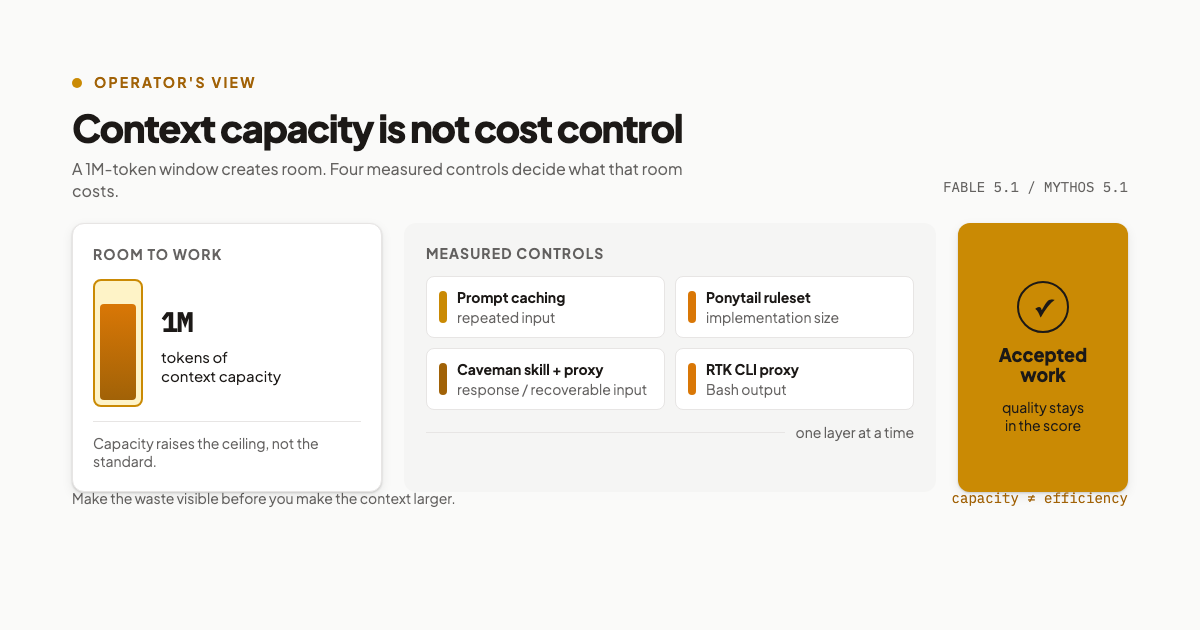
Claude Fable 5.1 and Claude Mythos 5.1 give an agent more room to work. They also give a poorly scoped run more room to wander.
Claude Fable 5.1 and Claude Mythos 5.1 are the same Anthropic model with different safeguards. Fable 5.1 is generally available. Mythos 5.1 is invitation-only through Project Glasswing for approved cybersecurity and life-sciences work. Both are documented with a 1M-token context window, 128K maximum output, adaptive thinking, and the same API pricing: $10 per million input tokens and $50 per million output tokens. [1] [2]
The useful upgrade is a longer coherent working horizon, not an automatic discount. Cache writes cost $12.50 per million tokens for 5-minute caches and $20 per million for 1-hour caches; cache reads cost $0.25 per million tokens. Those prices change the cost of repeated input, not the number of tokens your workflow creates. [2] [3]
TL;DR
- Fable 5.1 is the generally available model. Mythos 5.1 has the same specifications and pricing, but access and safeguards are different.
- The strongest use cases have a long coordination horizon: cross-service planning, checkpointed coding, large-corpus synthesis, terminal-heavy diagnosis, and lean implementation review.
- Prompt caching, Ponytail, Caveman, and RTK act at different layers. Their percentages cannot be added together.
- Test one intervention against a pinned baseline. Keep it only when provider-reported cost falls and accepted quality holds.
Claude Fable 5.1 and Claude Mythos 5.1: start with the workload
Fable 5.1 is best for work where continuity across files, tools, evidence, and checkpoints is the constraint. Anthropic lists slower comparative latency and high default effort, and Claude Code defaults the model to High effort. A narrow task that needs two files and one test may not earn that latency or token price. [1] [2]
The identifiers matter when you test it. The API model ID is claude-fable-5-1; Amazon Bedrock uses anthropic.claude-fable-5-1. Mythos 5.1 is not a choice available through an ordinary subscription. It requires Project Glasswing access. [2]
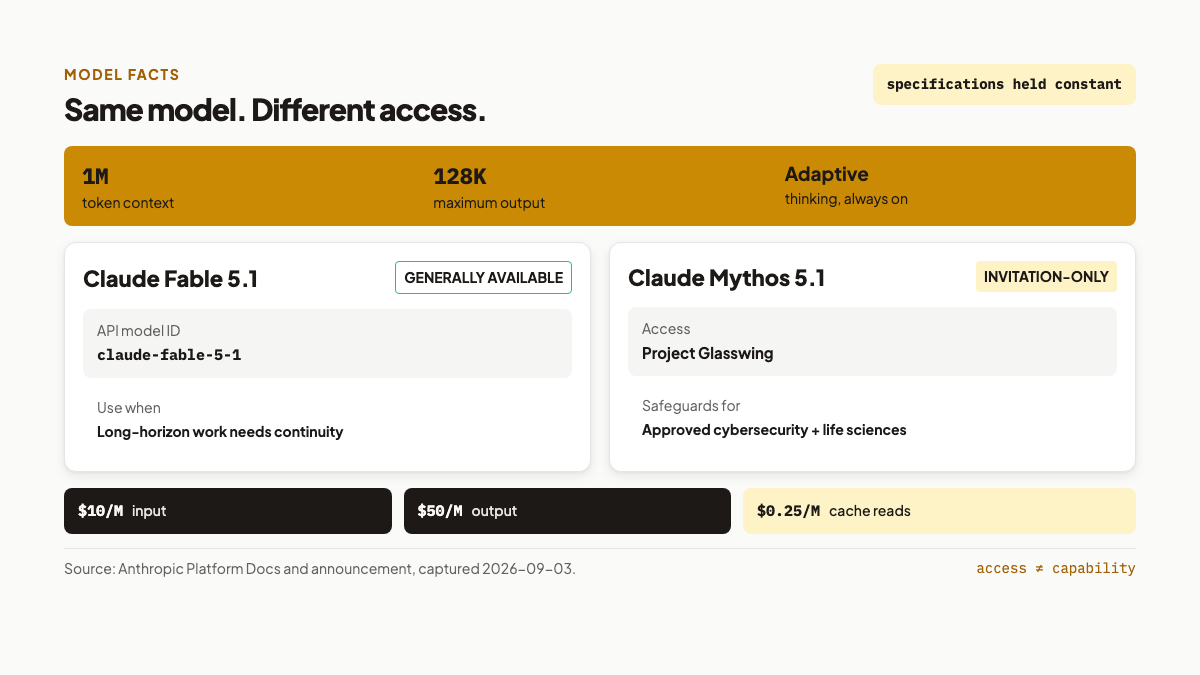
Figure: Fable 5.1 and Mythos 5.1 share specifications and pricing; access and safeguards differ.
Best for: long-horizon coding, evidence synthesis, or tool-using work where a missed dependency makes the handoff expensive.
Not best for: routine, low-risk work where a shorter session or lower-cost model category can meet the same acceptance test.
If you use Claude Code, first see how instructions, skills, hooks, and tool output enter different extension layers. A prompt ruleset and a shell-output proxy do not change context in the same way. That distinction shapes the five workloads below.
Five workflows that can earn the Fable 5.1 cost
Anthropic positions Fable 5.1 for coding, knowledge work, long-running problems, terminal work, and multidisciplinary reasoning. I would turn those broad categories into five bounded jobs, each with a visible result and a failure check. A benchmark score does not transfer automatically to a repository. [1]
1. Map a cross-service change before implementation
Use the long context for a dependency map, not a repository dump. For a billing-field rename, the deliverable might name the API schema, two handlers, a database migration, four callers, three test files, and the rollout note. A reviewer should be able to find a missed dependency before code changes.
Record files correctly mapped, missed dependencies, input tokens, cache-read tokens, and time to an approved plan. A 1M-token window makes a broad evidence pass possible. It does not remove the need for a file boundary or human review. [2]
Once the map is accepted, the harder question is whether the agent can execute it without turning a long run into an unreviewable one.
2. Run multi-step coding with explicit checkpoints
A useful run has gates: inspect the existing pattern, plan, edit declared files, run named tests, and stop before a destructive action. Fable 5.1 can emit progress updates between tool calls, and the platform documents a refusal stop reason that needs a fallback path. [3]
Migration needs its own checkpoint. Changing claude-fable-5 to claude-fable-5-1 is not the whole job. Forced tool_choice values of any or tool return an error. Earlier models cannot read Fable 5.1 thinking blocks, and editing an earlier turn invalidates those blocks. [3]
Measure passed checkpoints, retries, provider input, cache reads, output, elapsed time, and accepted quality. A long transcript can describe activity. It cannot substitute for a pass or fail at each gate.
3. Produce a traceable synthesis from a large document set
Prompt caching has a clean job here. Suppose a due-diligence run reads the same 200 specifications across several questions. Cache the stable source prefix, then judge citation accuracy, unsupported claims, correction time, and cost per accepted memo. Anthropic prices cache reads at 0.025 times the base input price for these models. [3]
Mythos 5.1 belongs in this use case only when the organisation has Project Glasswing approval and the cybersecurity or life-sciences safeguard profile fits the work. It is not the premium option for everyone else. [1] [2]
Stable documents reward caching. Debugging does not always cooperate, because the one line a filter removes may be the line that explains the failure.
4. Compress terminal-heavy debugging and test loops
RTK is the first intervention I would test when pytest, compiler output, Git diffs, or logs dominate the context. It is a Rust CLI proxy that filters command output before that output reaches the model. Its Claude Code setup can install a PreToolUse hook that rewrites Bash calls. [9]
The boundary is sharp. Built-in Read, Grep, and Glob calls bypass the Bash hook. RTK also estimates tokens as bytes divided by four because it does not ship a tokenizer. Compare the raw failing command with the filtered form, then record provider-reported input, recovery calls, diagnosis errors, and total cost. [9]
A compact green test summary is useful. A compacted stack trace that hides the first bad frame is not. Keep the raw path recoverable.
5. Keep implementation lean with layered controls
Ponytail, Caveman, and RTK do different jobs. Ponytail's ruleset tells the agent to skip unnecessary work, reuse what exists, prefer native features or installed dependencies, then write the minimum implementation. Its documentation keeps validation, security, accessibility, and data-loss handling in scope. [7]
Caveman's skill shortens response prose while preserving code, commands, paths, URLs, exact errors, dates, versions, and numbers. Its proxy or engine can compress selected recoverable input. RTK filters terminal output. [4] [5] [9]
For a small CRUD filter, Ponytail may prevent a new abstraction and three unnecessary files. Caveman may shorten the explanation. RTK may trim 400 passing-test lines. Measure diff size, tests, provider usage, time, and recovery separately. Stacking three advertised rates would describe no real invoice.
That last workflow exposes the accounting problem: every tool can report a smaller number while changing a different denominator.
How Claude token savings are actually measured
Caveman's own documentation gives the clearest warning. Its response skill reports 0% input reduction and adds roughly 1,000 to 1,500 input tokens per turn. It can cost more than it saves on terse work. The separate proxy reports 33.2% lower provider input across 18 paired runs over six deterministic 60 to 95 KB fixtures, not open-ended coding tasks or customer traffic. [5] [6]
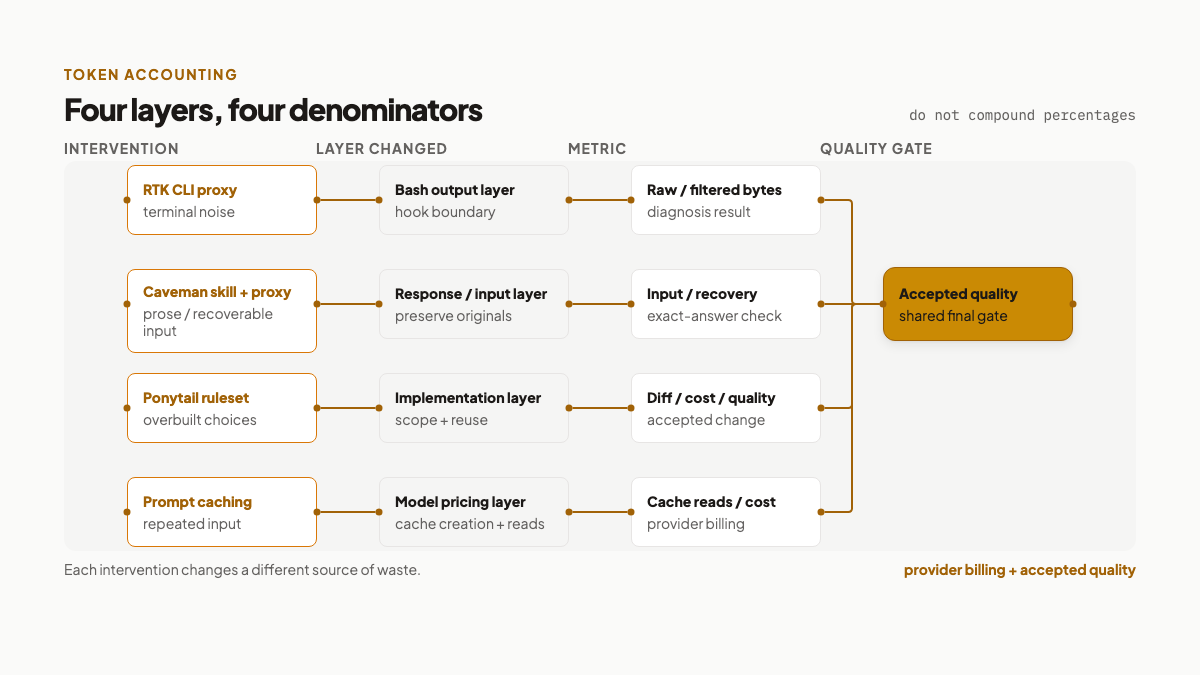
Figure: Prompt caching, Ponytail, Caveman, and RTK act on different layers and should not have their percentages compounded.
| Intervention | Layer changed | Best for | Not best for | Strongest evidence | Limitation | Metric to record |
|---|---|---|---|---|---|---|
| Prompt caching | Model pricing for repeated input | Stable prefixes reread across turns | One-shot or changing context | Anthropic lists $0.25 per million cache-read tokens and estimates lower costs for typical and highly agentic work [1] [3] | Cheaper rereads do not mean fewer tokens or better context | Cache creation, cache reads, provider cost, accepted result |
| Ponytail ruleset | Implementation decisions | Repositories where agents overbuild | Already-minimal tasks or hosts that do not inject the rules | JetBrains measured 15.4% less code and 10.3% lower cost across 80 paired tasks; its 7.5% total-token reduction was within noise [8] | The vendor's larger claims came from 12 hand-selected tasks, and passive installation may not activate the rules [7] [8] | Diff size, cost, time, test and review result |
| Caveman skill and proxy | Response prose or selected recoverable input | Verbose prose and large recoverable tool context | Terse work or exact text without a recovery path | Honest Numbers documents skill overhead; the proxy benchmark reports 33.2% less provider input on pinned fixtures [5] [6] | Skill and proxy evidence are not interchangeable | Provider input, output, recovery, exact-answer or quality result |
| RTK CLI proxy | Bash output | Test-heavy and log-heavy terminal loops | Built-in Read, Grep, Glob, or semantically fragile output | The project advertises 60% to 90% reduction for common commands or up to 90% of Bash output [9] [10] | Estimates use bytes divided by four and do not equal bill reduction | Raw bytes, filtered bytes, provider input, diagnosis result |
For the broader accounting model, input, output, context, and cost are different efficiency measures. Here, the practical consequence is narrower: never rank these interventions with one blended savings percentage.
The failure case is missing evidence, not a full context window
Compression earns its place only while the original evidence remains recoverable.
Picture a failing integration test. The filter returns 1 failed, 183 passed, but removes the stack frame showing that the request crossed the wrong authentication middleware. Re-running the same compact command does not improve the diagnosis. Recover the raw output, attach it to the failure, and turn filtering off for that command.
The other failure modes are less dramatic but just as costly. Caveman's skill can be net-negative on terse turns. Ponytail did not self-activate in ten sessions when JetBrains merely installed it and made it visible, so the evaluation used SessionStart injection. RTK misses built-in Read, Grep, and Glob calls. A Fable 5.1 migration can break forced tool use or thinking-block continuity. [3] [5] [8] [9]
My verdict is conservative: keep compression where exact originals can be recovered and quality checks sit outside the compression layer. Remove it when fixed prompt overhead, recovery calls, or missed evidence exceed the provider-reported saving. The only fair way to find that boundary is to hold the task and quality gate still.
Run one quality-held A/B test before stacking anything
Pick one representative task. Pin claude-fable-5-1, effort level, host, permissions, repository commit, prompt, and acceptance rubric. Changing High to Medium effort between runs makes the cost comparison ambiguous because effort changes the quality and cost tradeoff. [1]
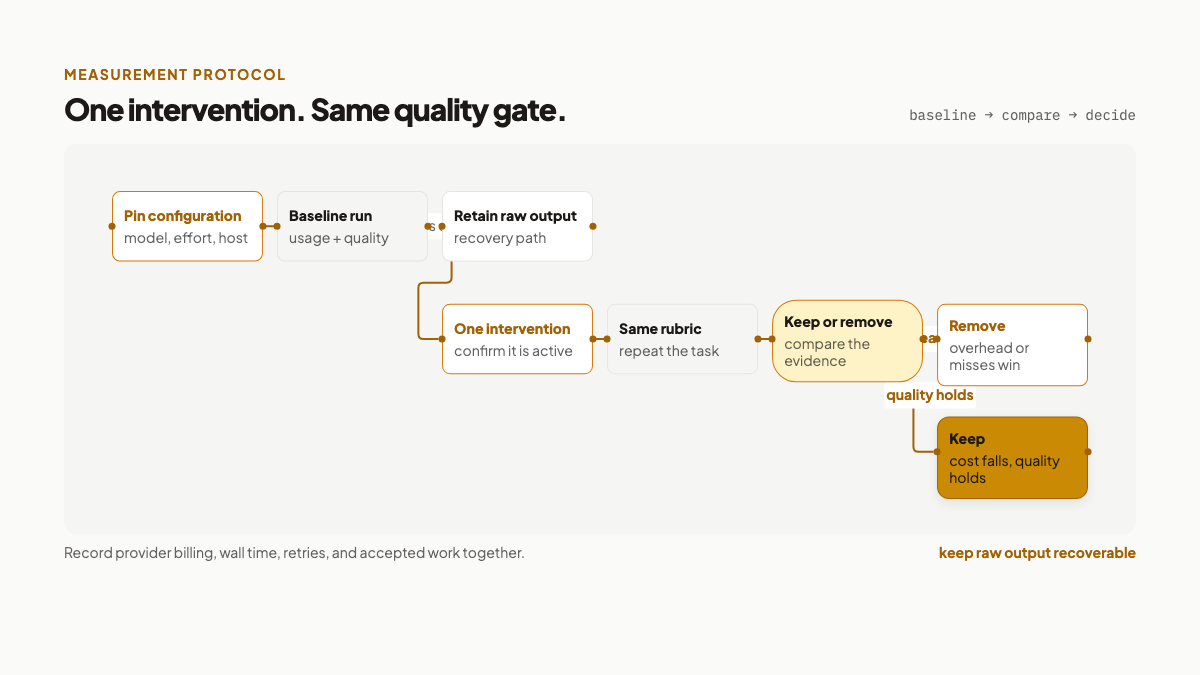
Figure: Compare one intervention against a pinned baseline, then keep it only when quality holds.
- Run the baseline. Record input, cache creation, cache reads, output, cost, wall time, retries, and the quality result.
- Enable one intervention and confirm it is active. Check Ponytail injection or RTK Bash rewriting rather than trusting installation status.
- Repeat the same task with the same acceptance rubric.
- If the tool can change the agent's path, use paired runs across more than one task.
- Keep output reduction, input reduction, context headroom, provider billing, and quality in separate fields.
- Include a no-op task and a failure case.
- Retain the raw output and accepted artifact so a smaller response cannot hide a missed requirement.
Turn the intervention off when prompt cost, recovery calls, or quality misses outweigh the provider-reported saving. A boring test beats a dashboard where four unrelated percentages appear to agree.
The test still falls apart if its scope and approval live only in the transcript being compressed.
Keep accepted work state outside the model context
A Fable 5.1 A/B run needs a durable record: pinned configuration, both results, owner, acceptance criteria, review decision, and restart point. The record should survive after Claude's session closes.
Agiflow's boundary is specific. It provides shared project state through MCP to external assistants. It does not host Fable 5.1, route the model, or run the benchmark. A work unit can hold the test scope and acceptance criteria; task comments and artifacts can carry results and review evidence while the provider usage record remains the billing source of truth.
The large context window in Claude Fable 5.1 and Claude Mythos 5.1 buys room. Recovery paths, explicit work state, and quality-held measurement decide whether that room produces accepted work at a lower cost.
Create an Agiflow work unit for your next Fable 5.1 A/B test, with scope, acceptance criteria, ownership, and evidence outside the chat transcript.
References
[1] Anthropic, Introducing Claude Fable 5.1 and Claude Mythos 5.1. Official announcement for model identity, availability, safeguards, defaults, positioning, and attributed cost estimates. Captured 2026-09-03.
[2] Claude Platform Docs, Fable 5.1 overview. Official documentation for model IDs, access, context and output limits, effort, latency, and pricing. Captured 2026-09-03.
[3] Claude Platform Docs, What's new in Fable 5.1. Official documentation for prompt-cache pricing, migration breakage, progress updates, refusal behavior, and fallback guidance. Captured 2026-09-03.
[4] Caveman official repository. Repository documentation for the Caveman skill, proxy or engine distinction, preservation scope, licensing, and vendor claims. Captured 2026-09-03.
[5] Caveman, Honest Numbers. Project documentation for the skill's input overhead, 0% input reduction, net-negative cases, and measurement cautions. Captured 2026-09-03.
[6] Caveman, Wrap Benchmark. Vendor-published benchmark for the 18 paired runs, six deterministic fixtures, 33.2% provider-input result, and stated reproducibility limits. Captured 2026-09-03.
[7] Ponytail official repository. Repository documentation for the ruleset, safety guardrails, installation modes, and vendor benchmark scope. Captured 2026-09-03.
[8] JetBrains, Ponytail Skill for Claude Code: Does It Really Cut Tokens?. Independent paired evaluation covering 80 tasks, code, cost, time, token, quality, and activation findings. Captured 2026-09-03.
[9] RTK official repository README. Repository documentation for the CLI proxy, Bash hook boundary, supported commands, estimated token method, setup, and recovery behavior. Captured 2026-09-03.
[10] RTK website. Vendor positioning and headline Bash-output reduction claim. Captured 2026-09-03.
More to read
OpenAI DevDay 2026: Choose What Your Team Delegates to ChatGPT
Read the September DevDay and October ChatGPT updates through their separate execution, account and usage limits, then choose a bounded draft for review.
11 min readClaude Code on Opus 5: What to Run, and How to Pace Limits Anthropic Never Publishes
A practical guide to Claude Code on Pro and Max after Opus 5: pick model tier and effort level by task shape, commit routing to subagents, and pace against limits Anthropic does not publish.
17 min readGPT-5.6 Codex: Sol vs Terra vs Luna and Thinking Effort
Choose GPT-5.6 Sol, Terra, or Luna in Codex, then set thinking effort for the task. Compare practical defaults, review risk, usage, and when to escalate.
18 min read