AI Tech Stack Migration: What Would Change My Mind
Easier prompting earns investigation. I would back a stack rewrite when accepted changes beat a better existing workflow enough to justify transition and support.

A successful exercise leaves the production commitment to be justified.
For an AI tech stack migration, I would not ask a team to replace a mature stack because an assistant handles course prompts better. A post on r/ExperiencedDevs describes that proposal: move an established C#/ASP.NET/Blazor Server/SQL Server stack to Python after better graduate-course prompting results. That is the author's account, not a demonstrated migration result. [1]
My bar would be accepted production changes that beat improved AI use in the existing stack enough to cover transition and support. Easier prompting earns investigation. It does not yet justify the rewrite.
If you are being asked to change your tech stack for AI, questioning the evidence should not make you the person against improvement. You should be able to welcome the experiment without volunteering your team for the replacement. The future maintainer deserves a reason that reaches beyond the exercise.
A course prompt cannot price an AI tech stack migration
Martin Fowler's Strangler Fig guidance asks what outcomes modernisation should achieve and describes transitional architecture that lets old and new systems coexist. Users still need changes during replacement. This is practitioner guidance, not proof that gradual migration always costs less. [2]
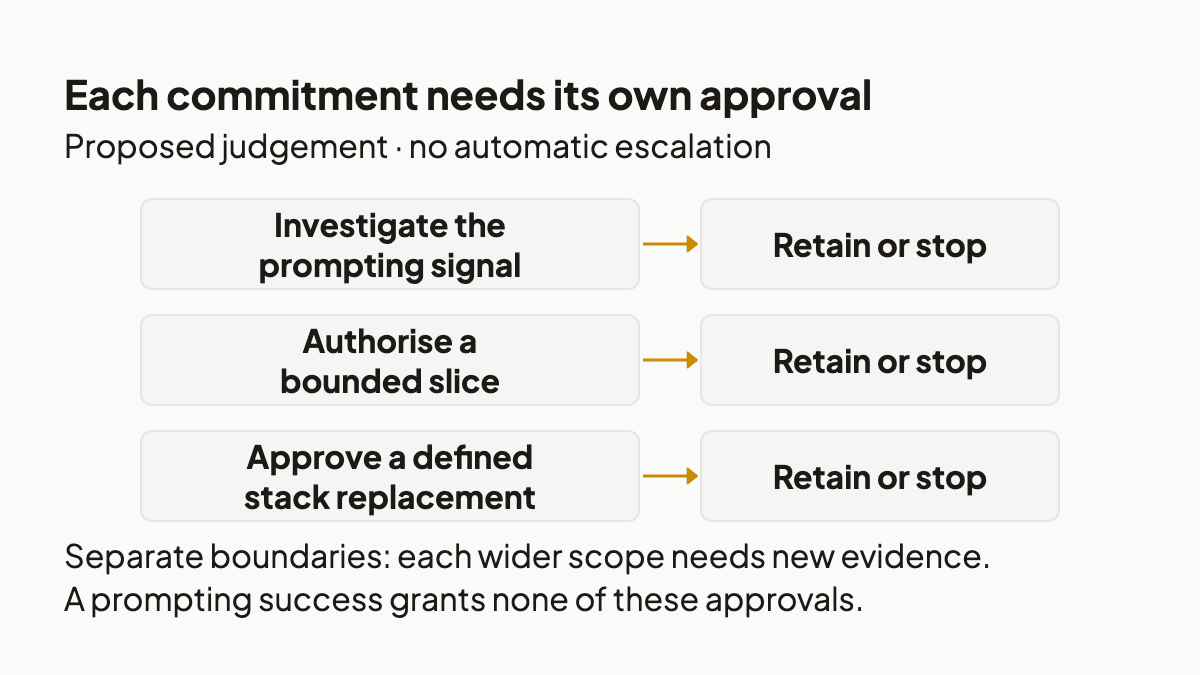
That is why I would separate permission to investigate a prompting difference, permission to try a bounded candidate-stack slice, and permission to replace the stack. Each needs its own approval, with room to stop or retain what already works. This is my proposed distinction, not a validated migration model.
A course exercise can provide a useful signal about that interaction. It cannot price the work of preserving the existing authentication requirement or tell me whether users will get the SQL Server behaviour they expect. Those would be questions for the replacement proposal, not claims about problems this team has.
Choosing that investment belongs with human responsibility in agentic coding, before delegating its implementation. Agreeing to investigate Python need not settle the investment decision.
For an AI tech stack migration, I would also want a fair alternative: the existing C# workflow given the same attention as the candidate.
I would compare against a better version of staying
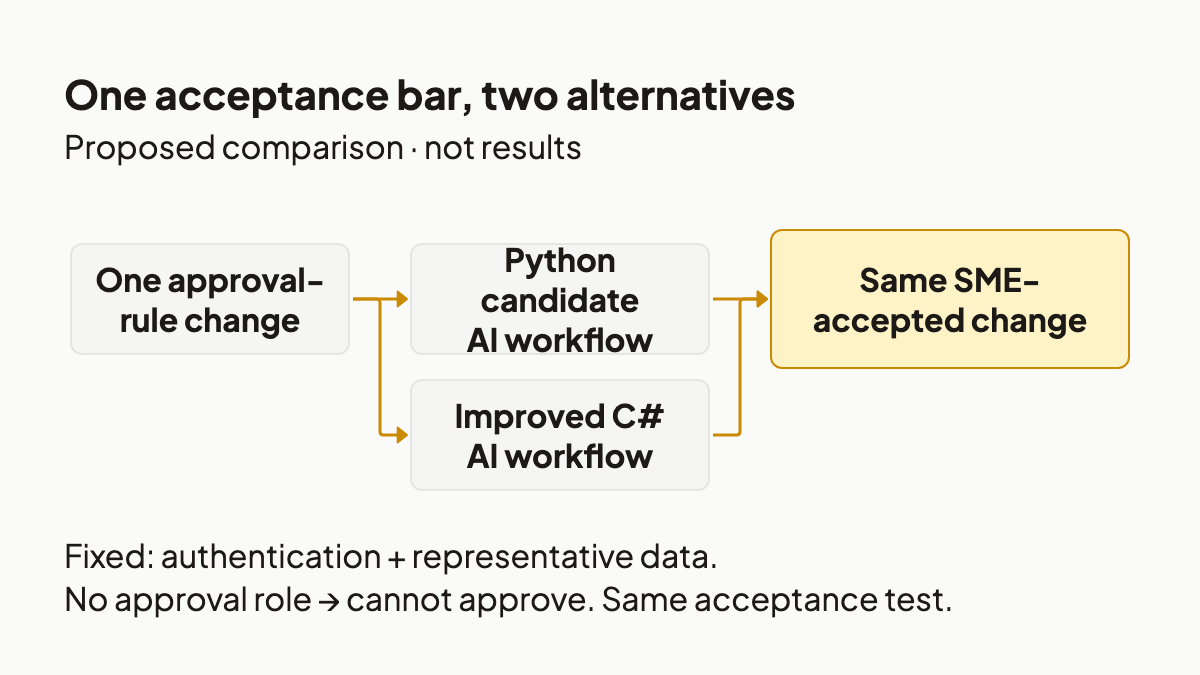
Here is the AI-assisted software delivery comparison I would want: change one approval rule in an internal application replacing an Excel process. This is a proposed example, not an experiment I have run. Compare AI-assisted work in the retained C# stack, with better repository context and tooling, against a Python candidate. The example is not the Reddit team's application.
Neither language is the established winner here. These sources cannot establish a universal AI code-generation language choice or provide a controlled Python/C# comparison.
Both alternatives would owe the same accepted change. Keep the intended approval behaviour, authentication requirement and representative data fixed, with the same subject-matter expert assessing acceptance. Include the negative case: a user without the approval role must still be unable to approve.
Keep assistant and model conditions comparable where feasible, and record differences. Preparing better context for the retained stack costs work too. I would count it, rather than quietly give my preferred option free preparation.
Faster generation alone would not answer the delivery question. The Reddit author reports generation in hours or days, but expert review, testing and adoption in weeks or months. Those are their reported ranges, not a forecast for this comparison. [1] I would record hands-on work, rework and reviewer effort separately from elapsed waiting for the expert. Future support obligations need their own note. The question of what developers owe reviewers remains even when an assistant produces the change quickly.
Scepticism deserves the same discipline. METR marks its early-2025 productivity result out of date. In its February 2026 update, METR calls its follow-up an unreliable signal of current productivity effects, citing selection and time-accounting problems. Neither publication measures language superiority or migration value. I would not use an old slowdown headline to veto the candidate. [4] [5]
Before seeing results, the team should define its decision horizon and what advantage would make further commitment worthwhile. I would keep the stack if a better existing workflow removed the apparent advantage. A candidate that failed the same acceptance conditions would not earn approval on speed alone.
Repeatable gains across representative accepted changes could persuade me to go further. One convenient approval-rule change cannot establish that durability, let alone pay for making the old stack unnecessary.
A better slice still leaves a replacement decision
AWS's Strangler fig guidance, specifically for monolith-to-microservices modernisation, warns that a routing layer can become a bottleneck or single point of failure. It also names data-consistency concerns. These are examples of coexistence costs, not diagnoses of the Reddit team or reasons for it to adopt microservices. [3]
Back at the proposed approval rule, a Python candidate might satisfy its acceptance conditions while leaving other behaviour, integration and deployment untested. Somebody would still need to explain how the old component retires and who supports the replacement. A software migration business case has to address that remaining scope.
I value existing expertise for a specific reason: someone needs to recognise a changed assumption in that rule and explain an unexpected approval later. Familiarity helps only if it serves that work. An unfamiliar language is not automatically unmaintainable; the proposal needs a credible support owner.
That is a different question from keeping generated code inside architectural patterns. Maintaining a chosen architecture does not establish that choosing a replacement was worthwhile.
I would ask whether the accepted-change advantage survives a conservative account of transition and continuing ownership over the chosen horizon. An unknown support obligation cannot be entered as zero. A promising slice could lead to stopping, more investigation, or approval of a defined replacement scope. Some applications may offer no affordable separation boundary at all.
But coexistence can also cost more than finishing the replacement. That possibility deserves a fair hearing.
A small application could make the rewrite sensible
AWS explicitly allows that smaller applications with low complete-refactoring complexity may be more efficiently rewritten than migrated incrementally. It does not say every small application is cheap to replace. [3] Fowler's desired-outcomes framing also keeps the judgement on what the change should achieve, rather than allegiance to a migration pattern. [2]
The strongest objection to my preference is that AI could make an unfamiliar stack less costly to learn and change. These sources do not quantify that reduction. I would still want to give it a fair test. Familiarity alone would be a poor reason to reject a continuing advantage in accepted work.
These are the choices I would defend, not a scoring model:
| Choice | Best for, under this proposed standard | Not best for / tradeoff |
|---|---|---|
| Retain the stack and improve AI use | A mature system where the improved workflow meets the need and no durable candidate advantage is shown | A demonstrated limitation that better context or tooling cannot resolve; familiarity alone is insufficient |
| Investigate a bounded candidate slice | A plausible advantage with uncertain acceptance or ownership costs | Work without a credible separation boundary, or a small application where coexistence overhead defeats the point |
| Approve a defined replacement | Representative accepted gains that justify transition and support, potentially in a small, low-complexity application | A course exercise offered as the whole business case, or replacement beyond the scope the evidence covers |
What evidence would make you approve the rewrite?
References
- r/ExperiencedDevs, "Has anyone changed their techstack due to AI usage?" https://www.reddit.com/r/ExperiencedDevs/comments/1xbtevr/has_anyone_changed_their_techstack_due_to_ai/ . Captured 25 October 2026. Workplace details are the author's uncorroborated account, not a verified migration outcome.
- Martin Fowler, "Strangler Fig." https://martinfowler.com/bliki/StranglerFigApplication.html . Published 22 August 2024. Practitioner guidance on outcomes, gradual modernisation and transitional architecture.
- AWS Prescriptive Guidance, "Strangler fig pattern." https://docs.aws.amazon.com/prescriptive-guidance/latest/cloud-design-patterns/strangler-fig.html . Captured 25 October 2026. Monolith-to-microservices guidance, including coexistence risks and the small-application rewrite exception.
- METR, "Measuring the Impact of Early-2025 AI on Experienced Open-Source Developer Productivity." https://metr.org/blog/2025-07-10-early-2025-ai-experienced-os-dev-study/ . Published 10 July 2025. The publisher marks the historical result out of date.
- METR, "We are Changing our Developer Productivity Experiment Design." https://metr.org/blog/2026-02-24-uplift-update/ . Published 24 February 2026. The authors explain why the follow-up is an unreliable signal of current productivity effects.
More to read
Why AI Projects Stall Near the Finish: Completion Is a Self-Report
Percent complete is a self-report, and self-reports are measurably unreliable at three levels of an AI-assisted build. What a definition of done has to prove instead.
16 min readThe Human Role in Agentic Coding Workflows: A Responsibility Test
Keep humans responsible for promises, acceptance, exceptions, and consequences. Delegate coding work when it is bounded, inspectable, and reversible.
12 min readAI Coding Team Norms: What Developers Owe Reviewers Now
AI coding team norms need to define ownership, disclosure, validation, and reviewer rights before AI-generated PRs reach review.
10 min read