AI Project Risk Management: Triage Drafted Risks by Evidence
An AI-drafted project risk needs a source and an uncertain event before anyone investigates it. Three evidence questions, worked through on the real Python 3.13.0 release delay, show which drafts deserve an investigator, which need more evidence, which are already issues and which to reject.
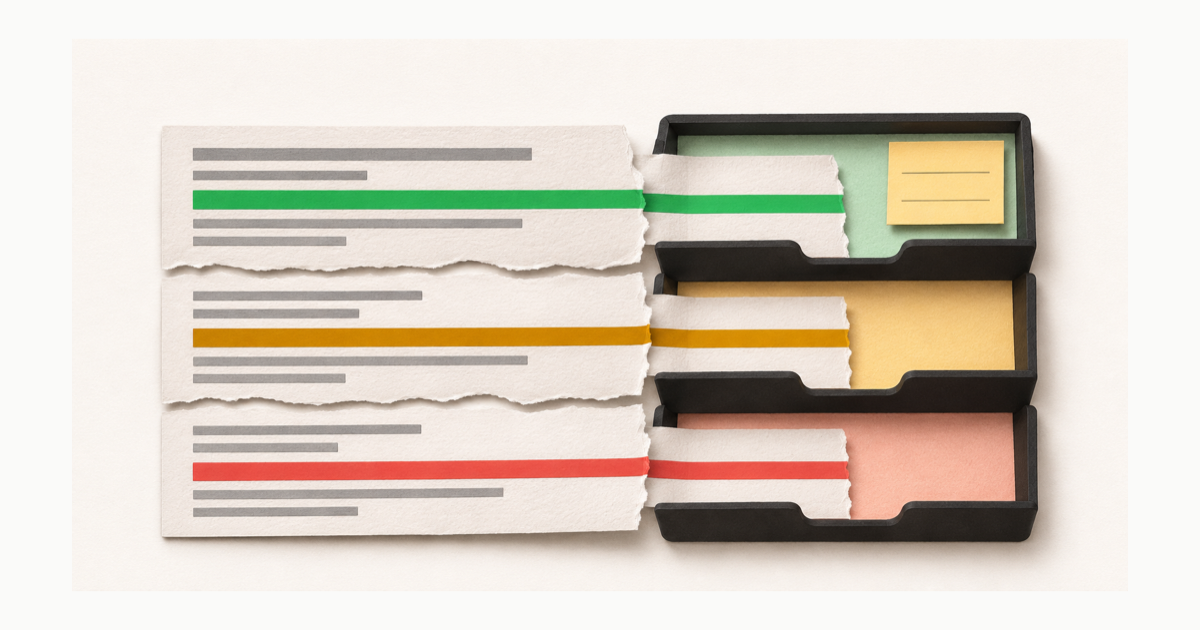
AI project risk management: which drafted risks deserve an investigator
Every risk your assistant drafted sounds equally serious. In AI project risk management, use it to draft candidate risks from your plan and recent status updates, then triage every draft before it reaches the risk list. Keep a risk only when it cites a specific change in the work and names an uncertain event that hasn't happened yet. Accept it with a named investigator, hold it with the missing evidence written down, or reject it if it's already an issue or has no source. Don't let the assistant assign probabilities it can't support. Severity and ownership stay human decisions.
Can ChatGPT or Claude build your risk register?
ChatGPT or Claude can draft a project risk register from your plans and recent status updates, but the team decides which candidates actually enter it. PMI's October 2026 guidance tells project managers to distinguish potential risks, current issues and missing information when they use AI to draft risks. The article suggests feeding the assistant plans, status, milestones, dependencies, assumptions and constraints, then asking it to "Distinguish between potential risks, current issues, and missing information" 1. Its next tip asks you to "Separate documented facts from inferred risks" and check with the teams affected 1.
That matches how people describe it in the wild. One project manager on r/projectmanagement said they use AI "to give me a start for the risk conversation/development, as it can usually pull some stuff out of my project documents" 6. One person's account, so treat it as vocabulary, not a survey.
The catch is the documents. An APM blog on AI in risk management puts it bluntly: "these tools are only as strong as the data they're given" 3. Status updates mix what already happened with what might happen, often in one sentence, and the assistant formats both as risks with the same confident bullet. So what you get back is a list of candidates. The register is whatever survives three questions.
Three questions before a drafted risk gets an investigator
A drafted risk is worth investigating when it cites a specific, dated change and names a testable future event that could affect a project objective. The third question decides who looks.
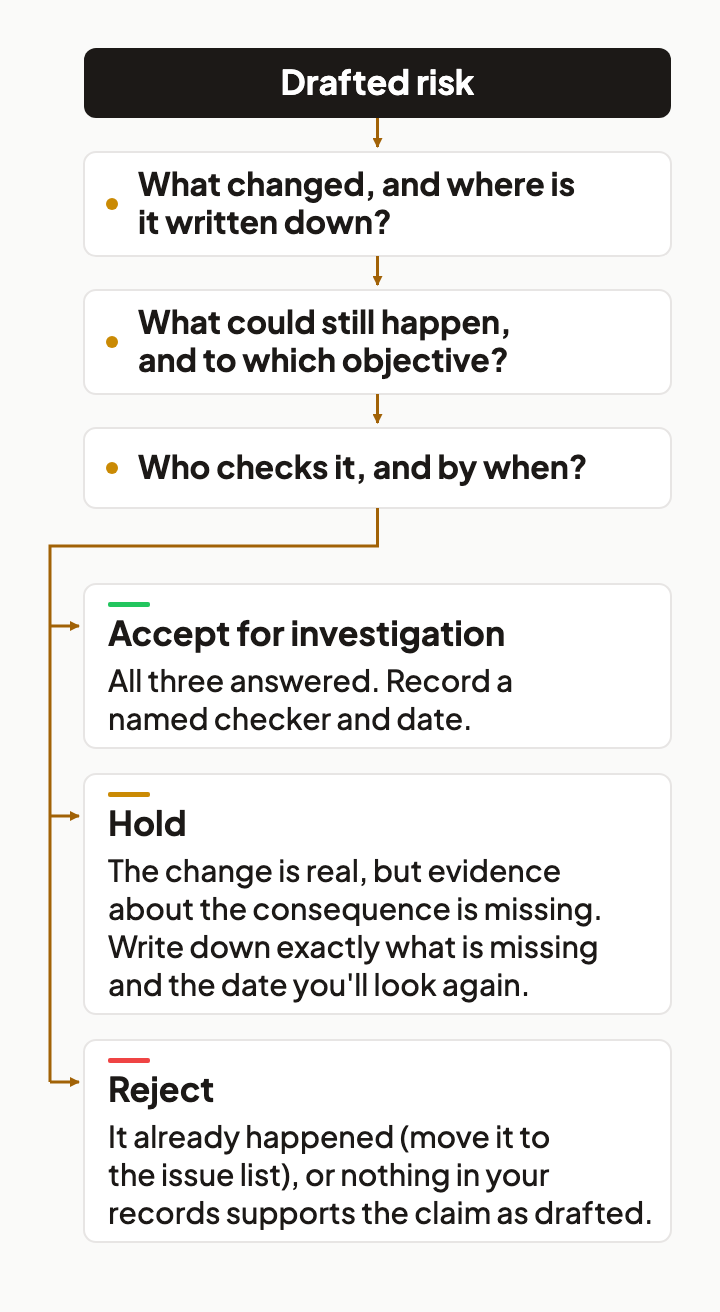
1. What changed, and where is it written down? A specific change in the work, with a source and a date: a reverted feature, a moved milestone, a vendor email, a failed test run. "Integration is complex" is a mood. If the assistant can't tie a drafted risk to a specific change in the work, you're looking at a guess.
2. What could still happen, and to which objective? An uncertain future event that touches something the project is trying to hit. HM Treasury's Orange Book defines risk as "the effect of uncertainty on objectives" 4.
3. Who checks it, and by when? One named person and a date. "The team will keep an eye on it" fails.
Then route it:
Accept for investigation: all three answered.
Hold: the change is real, but evidence about the consequence
      is missing. Write down exactly what is missing and the
      date you'll look again.
Reject: it already happened (move it to the issue list),
        or nothing in your records supports the claim as drafted.
Hold is the easiest route to skip, and it does the most work. A source can prove the change without proving the consequence, and hold is where that gap gets written down instead of argued about in a meeting. Rejecting a source-free line doesn't rule out the worry behind it; if a real signal turns up later, it comes back through the same three questions.
This test is my adaptation of the PMI and Orange Book guidance for a small team with a live board. Neither body publishes it as a standard, and none of the sources I reviewed measures whether a filter like this makes projects land on time.
What's the difference between a risk and an issue when AI drafts them?
An issue has already happened; a project risk is an uncertain future event that could affect an objective. PMI asks the assistant to keep those apart 1, and the Orange Book definition explains why: once the event has happened, the uncertainty is gone. The awkward part is that one status update often carries both, and a drafted list tends to file them under the same heading. The Python example below has exactly that.
A real update to practise on: the Python 3.13.0 release
Invented examples always route neatly, so here's a public record instead.
When Python 3.13.0rc1 (release candidate 1) came out on 1 August 2024, the release page said "the official release of 3.13.0 is scheduled for Tuesday, 2024-10-01" 7. On 26 September, Alex Waygood opened CPython issue #124567, "Incremental GC causes a significant slowdown for Sphinx" (GC is the garbage collector), and it was labelled a release blocker the same day 8. On 28 September, Thomas Wouters ("I am the release manager for 3.13") posted "Incremental GC and pushing back the 3.13.0 release" 9. He proposed reverting the incremental garbage collector, cutting a third release candidate (rc3), and moving the final release to 7 October. Of that test window he wrote that it "should be enough to find any obvious issues with the rollback" 9.
Now imagine pasting that 28 September post into an assistant and asking for risks. Here's how four plausible lines would route. The first comes straight from the record. The second is my inference from the test window Wouters described: his post plans that window, it doesn't predict a new blocker. I wrote the last two to show the kind of thing an assistant adds on its own; they are not claims from the Python sources.
| Drafted line | Change and source | Uncertain future event | Route |
|---|---|---|---|
| "The incremental GC significantly slows Sphinx" | Issue #124567, filed 26 Sep | None left: the slowdown was reported and marked a blocker | Issue list. It already happened. |
| "rc3 testing turns up a release blocker before 7 Oct and the final slips again" (my inference) | Revert plan and rc3 test window in the 28 Sep post | A new blocker during the rc3 window, against the 7 Oct final | Accept. Proposed checker in this example: Thomas Wouters (release manager), before the 7 Oct final. |
| "Other workloads stay slower even after the revert" (my example) | The Sphinx issue is a reason to ask | An unnamed workload, no timings | Hold. Missing: a named workload and timings compared with the previous build. Look again when rc3 feedback comes in. |
| "The rollback will break every downstream package" (my example) | Nothing in the record | Unanchored | Reject. No source. Checking downstream compatibility is still sensible; this claim just isn't evidence. |
The accepted line works because it names what would let the final go out: a candidate with no new blockers. That's the same question as asking what would release the dependency before you plan around one. The rc3 announcement says it "rolls back the incremental cyclic garbage collector (GC)" 10. That confirms the rollback, not that the Sphinx slowdown is gone, so before you mark an issue like that closed, test a claim that work is done against the actual state of the system rather than the label on the ticket.
What happened next: rc3 shipped on 1 October, a day later than the post proposed, and its announcement said "The final release of Python 3.13.0 will now happen next week, Monday October 7th" 10. PEP 719 records rc3 on 1 October and the final on 7 October 11, and the release team announced "Python 3.13.0 is now available" that day 12.
Please don't read that as proof the triage works. Nothing in the record says Python's release team used AI or anything like this test, and the routing above is my reading after the fact. A date that held tells you nothing about a method nobody used. What the case does show is a single real update carrying a current issue, a decided change and a separate risk you could actually check, which is exactly the mix a drafted list flattens.
Who should own an AI-drafted risk?
Name one investigator to check the evidence by a date; the person accountable for the objective decides the response. "Accept" means accept for investigation, not accept the risk. The investigator's job is to find out whether the event is getting closer and report back by the date. The Orange Book's guidance on treatments records accountable and responsible people, indicators and timing as separate things 4, and that split is worth keeping even when you're five people. When using AI for project risk management, the assistant can suggest who might know; it shouldn't be the one who decides.
On a small team the investigator and the owner are often the same person, which is fine as long as both roles are written down. In the Python case, PEP 719 names Wouters as the 3.13 release manager 11, so he held the date decision. Naming him as the checker for the rc3 line is my inference from that role. His post doesn't assign anyone.
Should AI score risk probability?
Don't use an AI-generated probability unless you can show the data and method behind it. If a drafted register comes back with a percentage in the likelihood column, ask what it was calculated from. If the honest answer is three status notes, leave the field blank.
Xiong and colleagues tested how language models express confidence across a set of benchmark tasks and found that "LLMs, when verbalizing their confidence, tend to be overconfident" 5. Those were benchmark answers, not delivery forecasts, so it says nothing direct about your project. It's still a fair reason to distrust a percentage built from three status notes.
APM's risk guide draws the line usefully: "Risks for which there is ample data can be assessed statistically", while project-specific uncertainty calls for systematic analysis 2. My inference from that: an AI-drafted probability on a one-off project deserves suspicion. The Orange Book ties the choice between qualitative and quantitative analysis to its purpose and to how reliable the evidence is 4. So a number belongs in the record when there's data and a method behind it, such as your own history of slipped releases. A number the assistant produced from thin notes doesn't.
An unscored risk can still be urgent. To rank them without numbers, ask when the decision has to be made, which milestone is exposed, and how hard it would be to undo. It's the same habit as letting the assistant rank tasks but making it leave a guessed input unscored. That's most of what AI risk management for project managers needs from a model: good drafting, honest blanks.
The objections worth taking seriously
"We'll miss weak signals." Fair, if hold turns into a bin. It shouldn't: each hold carries the missing evidence and a revisit date. When something high-impact can't wait for the evidence, escalate it the way your team already handles urgent unknowns, ask someone who knows that part of the system, and look at sources your board doesn't hold. If two assistants read the same notes, their agreeing doesn't count as a second source.
"Risk registers are theatre." Also fair, when an entry changes nothing. Under this test every accepted risk has a person, a date and a check, so it changes somebody's week. If an entry doesn't, cut it.
Where this doesn't fit. If your team needs enterprise or portfolio risk quantification (Monte Carlo schedules, aggregated exposure), you need a quantitative method, not a triage filter. It also isn't a framework for governing risks created by AI systems. That's a different question. The test covers one job: deciding which AI-drafted project risks deserve an investigator. An AI project risk assessment is only as good as the status evidence the assistant can read.
Put the triage where the team already looks
Risks parked in a spreadsheet nobody opens tend not to get investigated. Keep the triage on the board the team already revisits. Accepted risks become investigation tasks with a person and a due date, holds sit in their own column with the missing evidence in the description, and current issues go wherever your team tracks issues. Agiflow is one example of a shared task board an assistant can read through project-scoped access. The same triage can work on another board if the assistant can read the source updates and the team can record decisions there.
If you later want project risk management with AI to route the decisions your team has recorded, record the decision before you automate the routing, so a re-run doesn't quietly re-decide last week's call.
When a revisit date comes round, open the hold column and read each missing-evidence line. If the evidence turned up, run the three questions again before you name anyone. If it didn't, close the card with the reason, or set a new date only if you can say what you're still waiting for.
References
- Christopher Richardson, "10 Practical Ways Project Managers Are Using AI Right Now", PMI, displayed 22 October 2026. https://www.pmi.org/zh-cn/disciplined-agile/sitecore/content/pmiheadless/home/blog/blog-posts/2026/10/19/18/08/how-to-use-ai-in-project-management. Accessed 29 November 2026.
- APM Risk Specific Interest Group, "Project risk analysis and management", Association for Project Management, January 2018. https://www.apm.org.uk/resources/whitepapers/project-risk-analysis-and-management/. Accessed 29 November 2026.
- James Elliott, "How AI is turbocharging project risk management", Association for Project Management blog, 13 August 2024. https://www.apm.org.uk/blog/how-ai-is-turbocharging-project-risk-management/. Accessed 29 November 2026.
- HM Treasury, "The Orange Book: Management of Risk – Principles and Concepts", GOV.UK, updated 18 November 2026. https://www.gov.uk/government/publications/orange-book/the-orange-book-management-of-risk-principles-and-concepts. Accessed 29 November 2026.
- Xiong et al., "Can LLMs Express Their Uncertainty? An Empirical Evaluation of Confidence Elicitation in LLMs", arXiv:2306.13063 (ICLR 2024), revised 17 March 2024. https://arxiv.org/abs/2306.13063. Accessed 29 November 2026.
- Reddit r/projectmanagement, "Genuinely Curious! Did the AI change anything about the project manager's fundamentally responsibility? If yes, how?", comment by Aggravating_Hippo546. https://www.reddit.com/r/projectmanagement/comments/1r3qwxj/genuinely_curious_did_the_ai_change_anything/. Accessed 29 November 2026.
- Python.org, "Python 3.13.0rc1", 1 August 2024. https://www.python.org/downloads/release/python-3130rc1/. Accessed 29 November 2026.
- Alex Waygood, "Incremental GC causes a significant slowdown for Sphinx", CPython issue #124567, GitHub, 26 September 2024. https://github.com/python/cpython/issues/124567. Accessed 29 November 2026.
- Thomas Wouters, "Incremental GC and pushing back the 3.13.0 release", Python Discourse, 28 September 2024. https://discuss.python.org/t/incremental-gc-and-pushing-back-the-3-13-0-release/65285. Accessed 29 November 2026.
- Thomas Wouters, "Python 3.12.7 and 3.13.0rc3 released", Python Discourse, 1 October 2024. https://discuss.python.org/t/python-3-12-7-and-3-13-0rc3-released/66306. Accessed 29 November 2026.
- Thomas Wouters, "PEP 719 – Python 3.13 Release Schedule", Python Enhancement Proposals. https://peps.python.org/pep-0719/. Accessed 29 November 2026.
- Thomas Wouters and the Python release team, "Python 3.13.0 (final) has been released", Python Discourse, 7 October 2024. https://discuss.python.org/t/python-3-13-0-final-has-been-released/66972/1. Accessed 29 November 2026.
Put this project board inside ChatGPT
Open Agiflow in ChatGPT to plan campaigns, create tasks, and check what needs attention. Create a free Agiflow account when you are ready to keep the board for your team.
More to read
Is AI Project Management Software Worth It for Small Teams?
Before you pay for AI in your project tool, time one recurring workflow to sign-off, checking included. Keeping your current workflow is a valid result.
5 min readVibe Kanban Alternatives: Find the Half You Actually Lost
Vibe Kanban still runs locally and shipped v0.1.46 on November 15, 2026. The shutdown removed the hosted shared record. Pick a replacement for that half.
5 min readAI Sprint Planning When Agents Outrun Your Reviewers
Coding agents can produce more changes than your qualified reviewers can inspect. Plan the sprint against review capacity per skill and decide what waits.
5 min read