MCP Project Management Is Real. Nobody Owns It Yet.
Seven MCP-native project, task, and memory tools appeared on Show HN across roughly a year. They point to the same missing layer: durable project context for external AI assistants.
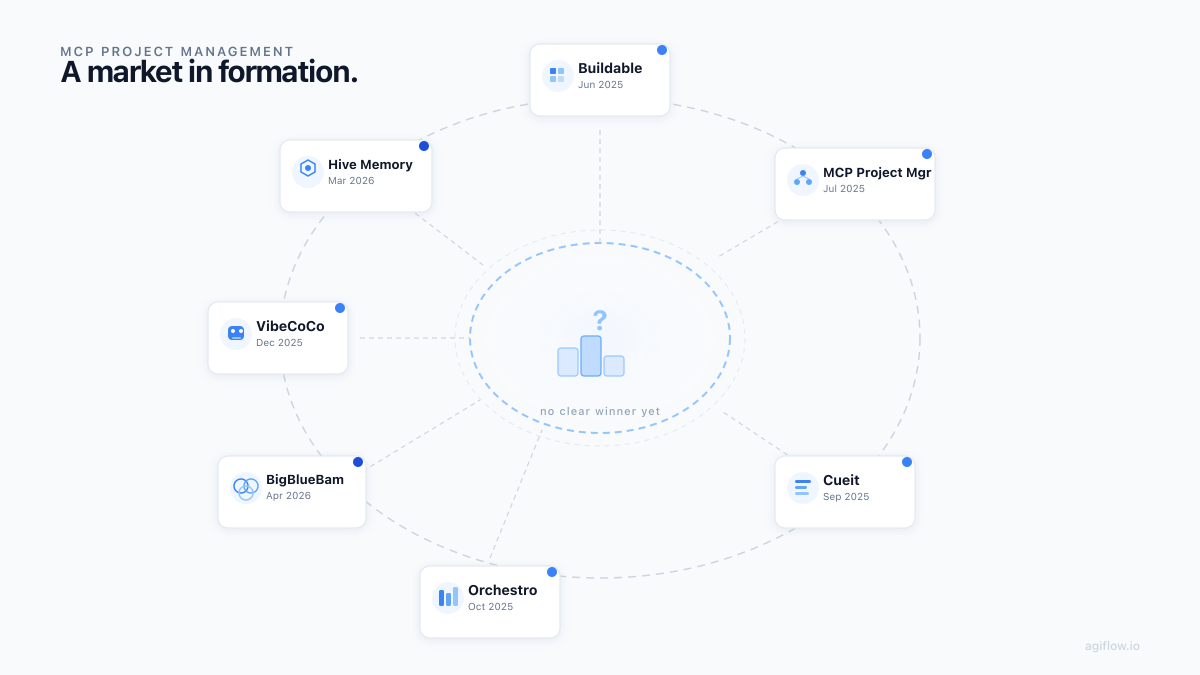
One correction matters before drawing any conclusion about this space: these launches were not a one-week spike. The Show HN trail runs from June 2025 to April 2026. That slower pattern is more useful. Over roughly a year, at least seven independent teams shipped MCP-native project, task, or memory tooling for AI-assisted work, and no obvious default emerged [1].
The evidence is strong enough to treat MCP project management as a real category. It is not strong enough to pretend the category has a finished shape. Once MCP gave assistants a standard way to connect to external systems, teams started packaging the same missing layer in different ways: a board, a task tree, a memory store, or a larger work suite [2].
I am treating the launches as evidence, not as a ranking. The useful question is not which repo has the cleanest UI. It is why so many builders reached for the same design choice: make project state readable and writable by an external assistant without turning the chat transcript into the source of truth.
TL;DR
| Signal | Evidence | Read |
|---|---|---|
| Multiple MCP-native PM tools launched independently | Show HN records across 2025-06 to 2026-04 [1] | Several teams saw the same opening |
| The tools keep circling the same job | Task trees, boards, memory, work suites, shared state [5] [6] | The missing layer is durable project context for assistants |
| MCP lowered the integration tax | MCP standardizes assistant-to-system connections [2] | Building on top of the protocol became practical |
| No default product has emerged | No entrant has broken out in the launch set [1] | The market is still open |
The MCP project management category is forming
The launch sequence tells the story better than any single demo.
| Date | Tool | What it says it does | Why it matters |
|---|---|---|---|
| 2025-06-20 | Buildable | Project management through MCP | Early signal that the board layer around MCP was productizable [1] |
| 2025-07-16 | MCP Project Manager | Hierarchical task management for AI assistants | Shows one of the first durable shapes: task trees and scoped work [1] [6] |
| 2025-09-29 | Cueit | Project management with LLMs over MCP | Moves from task capture toward a broader assistant-facing workflow layer [1] |
| 2025-10-12 | Orchestro | Trello for Claude Code with Kanban Board | Makes the category legible to builders already working inside Claude Code [1] |
| 2025-12-15 | VibeCoCo | Plan your project, get a custom MCP server for your AI agent | Treats the MCP server itself as part of the product surface [1] |
| 2026-03-01 | Hive Memory | Cross-project memory for AI coding agents | Pulls the category toward memory and continuity, not just tasks [1] |
| 2026-04-22 | BigBlueBam | MIT-licensed work OS where agents are first-class coworkers | Pushes toward a full work system rather than a narrow task board [1] [5] |
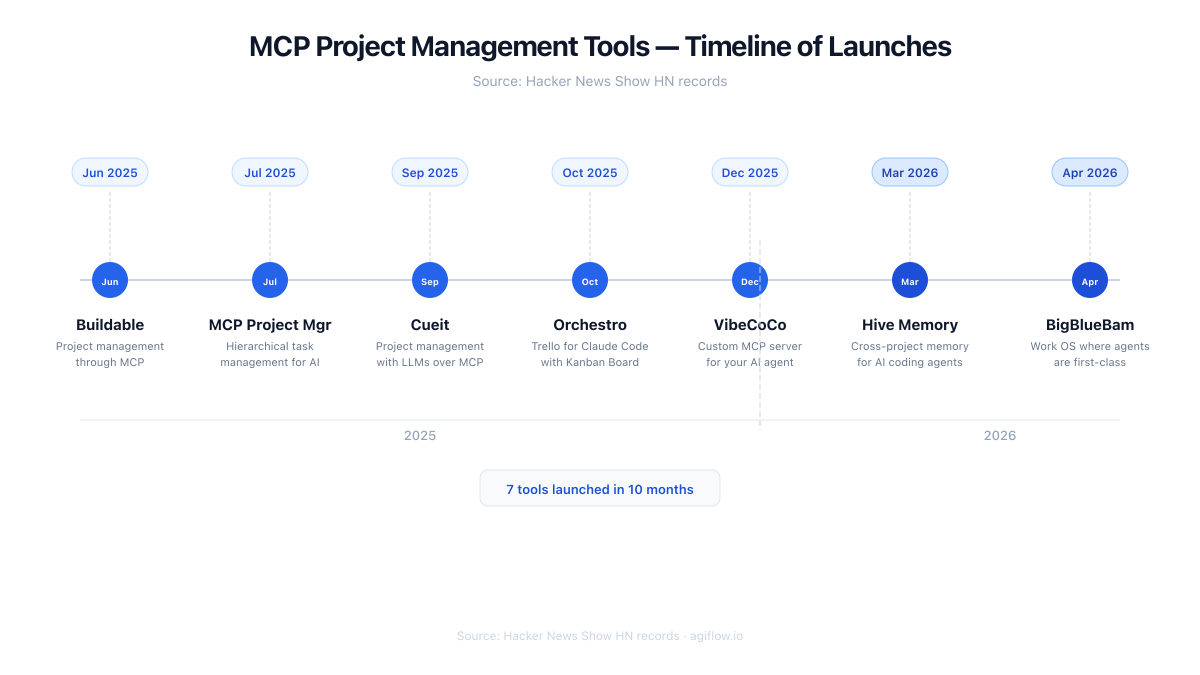 _Seven MCP-native project/task/memory tools launched on Show HN in roughly 12 months. None broke out._
These are not clones. Treating them that way would miss the point. The shared thread is narrower: each product gives an assistant somewhere outside the conversation to inspect work, change state, and leave a trail [2] [3].
MCP is the reason this showed up when it did. Before MCP, every product had to carry its own integration story. After MCP, the assistant-to-system connection had a common shape. A protocol does not create a great product by itself, but it changes the cost model enough that several teams could independently try the project layer [2].
This is what a young software category often looks like in practice: different teams, different entry points, same customer pressure. The consensus is not in the UI yet. It is in the job people keep trying to make the software do.
The missing layer is durable project context
The repeated need is not a prettier Kanban board. It is project context an assistant can actually use: scope, status, ownership, and evidence that survive past one chat session.
| Product shape | What it stores | What the assistant needs from it |
|---|---|---|
| Task tree | Parent-child work breakdown | "What is the scope and what is left?" |
| Project board | Status and ownership | "Who owns this and where is it in the flow?" |
| Memory layer | Cross-project continuity | "What happened before that I still need to remember?" |
| Work OS | State, tools, and execution context | "What can I read, update, and prove?" |
Agiflow's product model points in the same direction. The platform has project-management objects like Project, TaskStatus, Artifact, VaultEntry, Workflow, and ProjectTemplate, plus McpServer and McpSession on the integration side. That is not an agent runtime. It is the working surface the assistant reads from and writes back to.
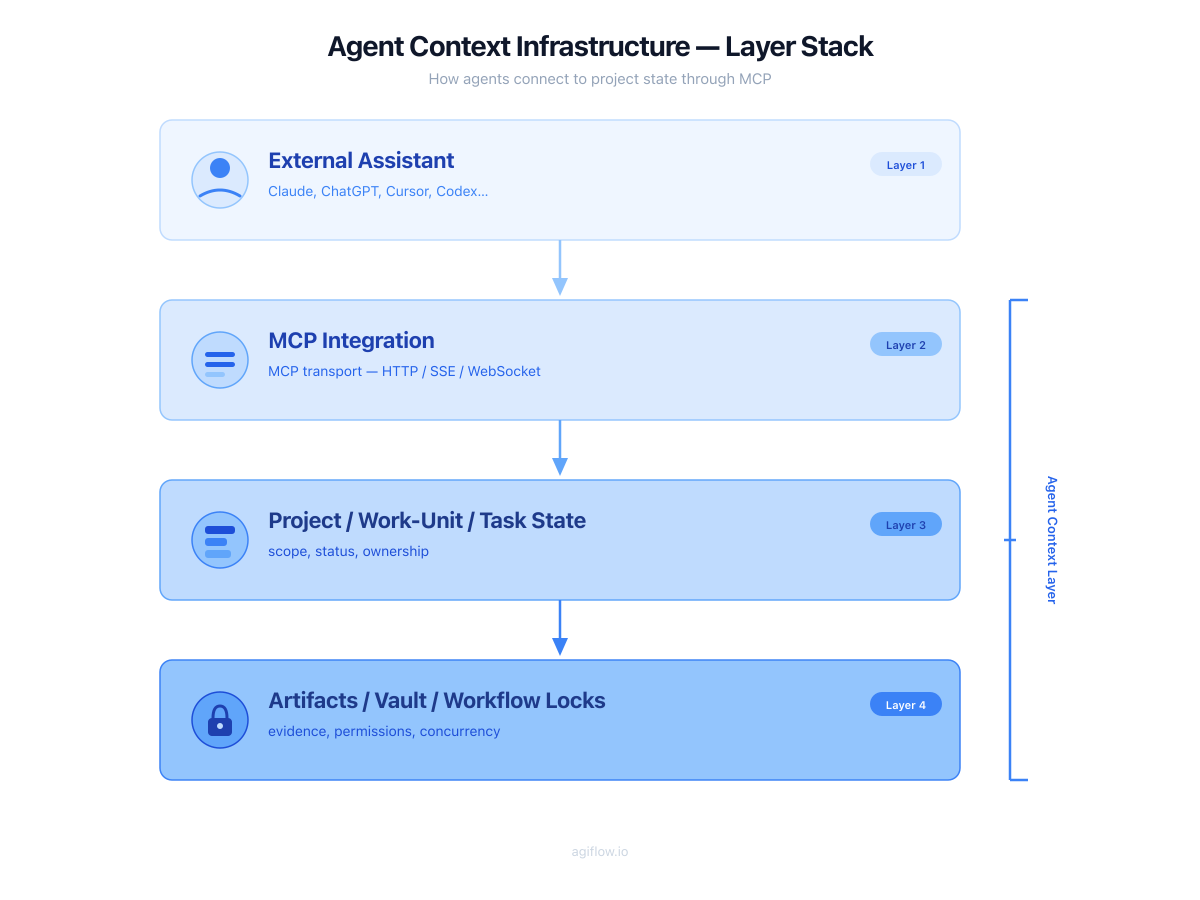 _The shared layer the category is converging on: durable context the assistant can read and update._
The stack I care about is:
external assistant -> MCP integration -> project, work-unit, and task state -> artifacts, vault entries, workflow locks
Seen this way, the launch wave makes more sense. These tools are not trying to own all of software delivery. They are trying to own the layer where work becomes legible to the assistant and durable across turns, sessions, and machines.
For the single-session version of the same problem, read Why AI Coding Agents Lose Context. The board-level story starts one layer higher.
Why teams keep rebuilding the same thing
Three forces are doing most of the work.
| Driver | Evidence | Why it pulls teams toward the same solution |
|---|---|---|
| MCP standardization | MCP is a standard for connecting assistants to systems where data lives [2] | The integration cost fell enough to make project context practical |
| Adoption inflection | Industry coverage in 2026 describes MCP as normal infrastructure, with registry growth and broad client support [3] [4] | Builders can assume the protocol exists and design around it |
| Persistent context pressure | The launch set keeps splitting the same job across task, board, and memory vocabulary [1] | Teams are solving the same pain from different starting points |
In this case the problem is mundane and expensive: an assistant can produce useful work, but the operating record of that work is scattered across chats, local files, tool logs, and task trackers. The work may be done, but the system of record often cannot prove it, resume it, or coordinate the next run.
The launch set reads more like a family resemblance than a clean product race. One tool starts with hierarchy. Another starts with memory. Another starts with a work OS. Another frames itself around Claude Code. The entry points differ because the unresolved problem is larger than any one surface: how do you give an external assistant a durable contract for work without pretending the chat thread is the product?
For the operational version of that question, Introducing the Agiflow CLI: Scaling AI Agents Across Machines is the next step. It shows what changes when the board has to survive beyond one laptop.
I would not read this as crowding. I would read it as a category still negotiating its canonical shape.
What the category still does not solve
The early tools cover real ground. They still leave hard platform questions open.
| What many tools already cover | What the category still misses |
|---|---|
| Task trees and board views | Durable shared state across assistant sessions |
| Memory and project history | Scoped permissions and safe write boundaries |
| Basic MCP connectivity | Workflow locks and ownership semantics |
| An assistant-facing UI | Artifact handling that travels with the work |
MCP Project Manager shows the other end of the spectrum. Its value is easy to understand because the core object is easy to understand: hierarchical project management for assistants [6]. A task tree is useful. It is still not a full context layer if the assistant cannot reliably carry state forward, attach artifacts, and know when its claim on the work is exclusive.
From a team-operations perspective, the durable version of this category has to answer four questions without improvising:
- What is the work?
- Who owns it right now?
- What evidence proves it happened?
- What happens when two assistants want the same thing?
The current wave is strongest on question one and getting more credible on question two. It is still uneven on questions three and four.
Work units help here because they compress scope into something an assistant can carry without losing the shape of the feature. But the wider market still has to finish the surrounding machinery: locks, artifacts, permissions, and durable state.
Where Agiflow stands honestly
Agiflow belongs in this category. I would not describe it as above the category, and I would not use it as proof that the category is already solved.
| Agiflow surface | What it does | What it does not do |
|---|---|---|
| Project-management domain | Holds project, task, artifact, vault, workflow, and template state | It does not pretend the chat thread is the system of record |
| MCP integration domain | Connects assistants through MCP sessions | It does not replace the assistant itself |
| Workflow locks | Enforces ownership so two runs do not step on each other | It does not declare victory for the category |
| CLI surface | Gives a real execution path across machines | It does not become an agent runtime just because it can move fast |
The stronger claim is narrower: Agiflow already operates as the board layer for an external assistant. The assistant stays external, the state stays durable, and the work stays attached to artifacts and locks instead of disappearing into conversation history.
See the work-unit model in Coordinating Multi-Task AI Workflows with Work Units. For the operational surface behind that claim, read Introducing the Agiflow CLI: Scaling AI Agents Across Machines.
My read: MCP project management is real, the repeated need is durable assistant-readable project context, and the default product has not been crowned. The opportunity is still open, but it will not be won by another board alone. It will be won by the product that makes scope, evidence, permissions, and execution state boringly reliable.
References
[1] Hacker News (Algolia) - MCP project-management Show HN launches - https://hn.algolia.com/api/v1/search?query=MCP+project+management&tags=story&numericFilters=created_at_i%3E1748822400 - Verified launch records for the seven independent MCP-native project/task/memory tools referenced in this post.
[2] Anthropic - Introducing the Model Context Protocol - https://www.anthropic.com/news/model-context-protocol - Primary MCP announcement and the basis for the "connect assistants to systems where data lives" framing.
[3] WorkOS - Everything your team needs to know about MCP in 2026 - https://workos.com/blog/everything-your-team-needs-to-know-about-mcp-in-2026 - Industry context for MCP adoption inflection and ecosystem normalization.
[4] DigitalApplied - MCP ecosystem H1 2026 retrospective adoption data points - https://www.digitalapplied.com/blog/mcp-ecosystem-h1-2026-retrospective-adoption-data-points - Industry tracker used for ecosystem-size context.
[5] BigBlueBam repository - https://github.com/eoffermann/BigBlueBam - Verified repository for the MIT-licensed work OS example referenced in the launch set.
[6] MCP Project Manager repository - https://github.com/croffasia/mcp-project-manager - Verified repository for the hierarchical task-management example referenced in the launch set.
More to read
Why AI Coding Agents Lose the Plan - and Why It's a Memory Problem, Not an Intelligence Problem
Context-window decay is a memory problem, not an intelligence problem. Learn why long prompts lose the plan and why explicit acceptance criteria survive where prose plans fail.
15 min readMulti-Agent Orchestration with Claude and Codex: Role Separation, Handoff Contracts, and Verification Gates
Architect multi-agent code systems that stay coherent. Learn role separation patterns, handoff contracts, and verification gates to prevent coordination failures.
18 min readIntroducing the Agiflow CLI: Scaling AI Agents Across Machines
GitHub Actions was never built for the fast closed loop an agent needs — going back, redoing a step, fixing its own work. Local agent fan-out solved the loop on one laptop and broke on two. The Agiflow CLI is the convenience wrapper we use internally to drive workflow locks, work units, and artifacts through the Agiflow API — so agents on different machines can pull the same backlog without stepping on each other.
8 min readPut this project board inside ChatGPT
Open Agiflow in ChatGPT to plan campaigns, create tasks, and check what needs attention. Create a free Agiflow account when you are ready to keep the board for your team.